Confused about Annamalaiyar vs Arunachaleswarar Temple? Discover why both names point to the same Tiruvannamalai shrine and what each name truly means.
The Annamalaiyar vs Arunachaleswarar Temple debate is the single most common confusion among first-time pilgrims planning a Tiruvannamalai trip. You see one name on a travel blog, another on a government portal, and a third on a WhatsApp forward from a relative. So you start wondering whether these are two separate temples in the same town, two shrines inside a larger complex, or simply one temple called by two names.
The short answer, settled here upfront: they are the exact same temple. One sacred shrine at the base of Arunachala Hill, dedicated to Lord Shiva, with two Tamil-Sanskrit names that have coexisted for over a thousand years. However, the story behind why both names exist — and when each one is used — reveals something fascinating about South Indian temple tradition, linguistics, and devotional culture.
Quick Answer: Yes, They Are the Same Temple
Annamalaiyar Temple and Arunachaleswarar Temple refer to one identical shrine in Tiruvannamalai, Tamil Nadu. Both names describe Lord Shiva worshipped as the Agni Lingam at the foot of Arunachala Hill. The official name used by the Tamil Nadu Hindu Religious and Charitable Endowments Department is “Arulmigu Arunachaleswarar Temple.”
Key Takeaways at a Glance
- One temple, two names: Annamalaiyar (Tamil) and Arunachaleswarar (Sanskrit)
- Location: Tiruvannamalai, Tamil Nadu – 606601
- Presiding deity: Lord Shiva as Agni Lingam (fire element)
- Consort: Goddess Unnamulai Amman (Parvati)
- Classification: One of the five Pancha Bhoota Sthalams
- Temple area: 25 acres (10 hectares)
- Official government name: Arulmigu Arunachaleswarar Temple
Annamalaiyar vs Arunachaleswarar Temple: What Each Name Means
The two names come from two different linguistic traditions. However, both point to the same deity, the same sanctum, and the same hill. Understanding the etymology makes the confusion disappear in seconds.
The Meaning of “Annamalaiyar”
“Annamalai” is a pure Tamil word. It combines “anna” (meaning elder brother or great) and “malai” (meaning mountain or hill). Therefore, Annamalai literally translates to “the great and inaccessible mountain.” The suffix “-yar” is an honorific that turns a noun into a respectful title.
So, Annamalaiyar means “the Lord of the Great Mountain.” Tamil saint-poets of the 7th century — Appar, Sambandar, and Sundarar — used this name in their Tevaram hymns. Consequently, every Tamil Shaivite devotee grows up hearing “Annamalaiyar” before anything else. For them, this is the original, native, heart-language name of the deity.
The Meaning of “Arunachaleswarar”
“Arunachaleswarar” comes from Sanskrit. The breakdown runs like this: “Aruna” (red, crimson, radiant), “achala” (mountain, immovable), and “Ishwara” (lord, supreme). Put together, Arunachaleswarar means “the Lord of the Red Mountain” or “the Lord of the Radiant, Immovable Mountain.”
Notably, the sunrise over the Arunachala hill bathes the rocks in a deep reddish-orange glow. This visual reality gave the mountain its Sanskrit name. Moreover, Sanskrit was the language of pan-Indian scripture, so temple authorities, priests, and inscriptions from the Vijayanagara period onwards preferred Arunachaleswarar in formal contexts.
Why One Temple Has Two Names: The Historical Reason
South Indian temples routinely carry dual names — one Tamil, one Sanskrit. The reason traces back to a linguistic partnership that has shaped Hindu tradition for over two millennia.
The Tamil-Sanskrit Dual Naming Tradition
Tamil is one of the oldest living classical languages on earth. Sanskrit is the scriptural language of the Vedas and Puranas. When Shaivite bhakti saints composed hymns in Tamil, they used Tamil names. Meanwhile, when Brahmin priests conducted rituals based on Agama scriptures, they invoked Sanskrit names.
Both streams flowed into every major Tamil Nadu temple. As a result, devotees accepted both names as equally valid. For instance, Chidambaram’s deity is Thillai Nataraja in Tamil and Nataraja in Sanskrit. Similarly, Madurai’s goddess is Meenakshi in Tamil and Meenakshi Amman in formal usage.
Vijayanagara Inscriptions and the Name Shift
Inscriptions inside the temple reveal another layer. The Vijayanagara Empire, which patronised the temple between the 14th and 16th centuries, left 48 inscriptions from the Sangama Dynasty, two from the Saluva Dynasty, and 55 from the Tuluva Dynasty. Most were written in Tamil, but several used Sanskrit — and the name “Arunachaleswarar” appears more frequently in the Sanskrit inscriptions.
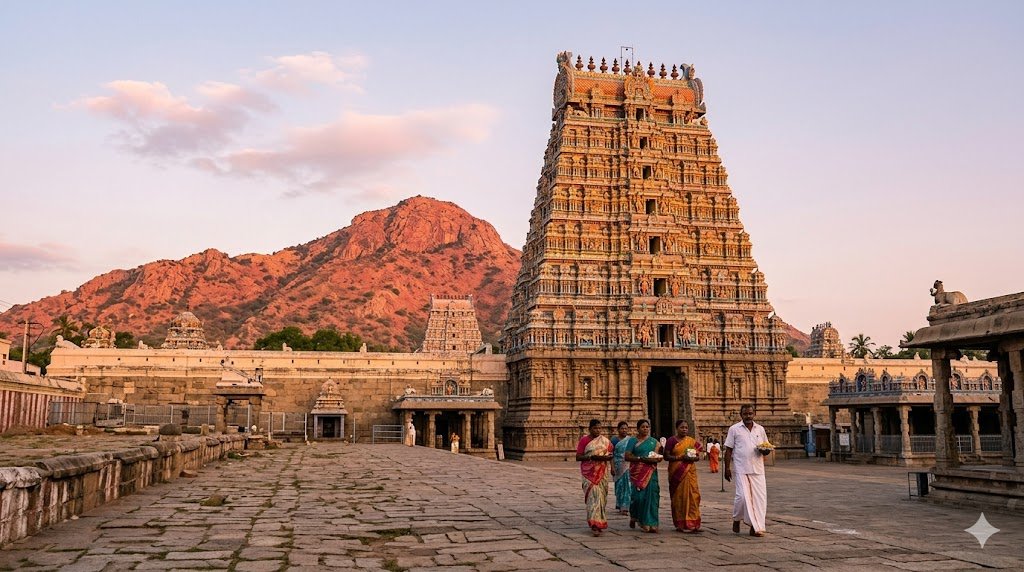
Krishnadevaraya, the famous Vijayanagara emperor who ruled from 1509 to 1529 CE, expanded the temple significantly. Furthermore, he began construction of the massive eastern Raja Gopuram, which was completed during the reign of Sevappa Nayaka between 1532 and 1580 CE. This gopuram stands 66 metres tall with 11 storeys — one of the tallest temple towers in India.
The Deity: One Shiva, Worshipped as Agni Lingam
Whether you call him Annamalaiyar or Arunachaleswarar, you are worshipping Lord Shiva in his manifestation as Agni — the fire element. This is the single most important fact to understand about the temple.
The Pancha Bhoota Sthalam Classification
Five sacred Shiva temples across South India represent the five elements of creation. Together, they are called the Pancha Bhoota Sthalams.
| Element | Temple | Location | Lingam Name |
|---|---|---|---|
| Fire (Agni) | Annamalaiyar / Arunachaleswarar | Tiruvannamalai, TN | Agni Lingam |
| Water (Jalam) | Jambukeswarar | Thiruvanaikaval, TN | Appu Lingam |
| Air (Vayu) | Kalahasteeswarar | Srikalahasti, AP | Vayu Lingam |
| Earth (Prithvi) | Ekambareswarar | Kanchipuram, TN | Prithvi Lingam |
| Sky (Akasha) | Nataraja | Chidambaram, TN | Akasha Lingam |
The Legend Behind the Agni Lingam
Two mythological stories explain why Shiva chose Arunachala as his fire abode. Both appear in Shaivite scripture.
First, Brahma and Vishnu once argued over who was supreme. To settle the dispute, Shiva appeared as a limitless column of fire. He challenged them to find its top and bottom. Vishnu took the form of a boar and dug downwards, while Brahma turned into a swan and flew upwards. Neither could find the end. Afterwards, Shiva settled at the base of the hill as the Agni Lingam we worship today.
Second, Parvati playfully covered Shiva’s eyes, plunging the world into darkness. As a result, Shiva opened his third eye, restored light, and asked her to perform penance at Gautama Rishi’s ashram in Tiruvannamalai. Eventually, Shiva manifested as fire atop Arunachala and merged with Parvati to form the Ardhanarishwara — the half-male, half-female form.
Inside the Temple Complex: What You Actually See
The temple spreads across 25 acres, making it one of the largest Shiva temples in the world. Additionally, it features four gopurams, five prakarams (outer courtyards), and a thousand-pillared hall built during the Vijayanagara period.
The Main Sanctum
The inner sanctum faces east. Inside sits the Agni Lingam, the form of Shiva worshipped as Annamalaiyar or Arunachaleswarar. Furthermore, you’ll find images of Nandi (Shiva’s bull vahana) and Surya (the sun god) within the same precinct. Behind the sanctum wall stands a sculpture of Venugopalaswamy, a form of Krishna — a rare example of Vishnu iconography inside a Shiva shrine.
The Unnamulai Amman Shrine
Goddess Parvati, here known as Unnamulai Amman (in Tamil) or Apitakuchambaal (in Sanskrit), has her own shrine in the second precinct. Notably, she is depicted in a standing posture, which is uncommon in most Shiva temples where the goddess is usually seated.
The Arunachala Hill Itself
The 2,668-foot hill behind the temple is not just a backdrop. Devotees consider the hill itself to be Shiva in his physical form. Therefore, circumambulating the hill — a ritual called Girivalam — is considered equivalent to worshipping the deity directly. The 14-kilometre circuit draws tens of thousands every full moon and over a million pilgrims during Karthigai Deepam.
When to Use Which Name
Though both names are interchangeable, there’s an unspoken etiquette around when each one surfaces. Knowing this helps you sound informed rather than confused.
| Context | Preferred Name | Why |
|---|---|---|
| Tamil devotional songs (Tevaram) | Annamalaiyar | Original saint-poet usage |
| Government & official records | Arunachaleswarar | HR&CE official designation |
| Tourism websites | Both | To reach wider audiences |
| Pancha Bhoota Sthalam texts | Arunachaleswarar | Sanskrit scriptural tradition |
| Local Tamil speech | Annamalaiyar | Native mother-tongue comfort |
| North Indian pilgrims | Arunachaleswarar | Sanskrit familiarity |
Other Names You Might Encounter
Beyond the two main names, Tiruvannamalai devotees sometimes use several other terms. Hence, don’t get thrown off when you hear these variations.
- Arunachala: Refers to the sacred hill itself, often used interchangeably with the temple name
- Arunagiri: “Giri” means hill in Sanskrit; another word for the same mountain
- Tiruvannamalai Temple: Named after the town; used in casual conversation
- Sonachalam / Sonagiri: Obscure Sanskrit synonyms meaning “red hill”
- Arulmigu Arunachaleswarar Thirukovil: The full ceremonial Tamil name
Darshan Timings and Practical Visit Details
Since both names refer to the same shrine, a single set of timings applies. The temple is open daily from 5:30 AM to 9:30 PM, with a mid-day break.
Daily Darshan Schedule
- Morning session: 5:30 AM to 12:30 PM
- Midday break: 12:30 PM to 3:30 PM (temple closed for cleaning)
- Evening session: 3:30 PM to 9:30 PM
Daily Pooja Timings
- Ushakala Pooja: 5:30 AM
- Kala Santhi: 8:00 AM
- Uchikala: 11:30 AM
- Sayaratchai: 5:30 PM
- Irandam Kala: 7:30 PM
- Arthajama: 9:00 PM
How to Reach
Tiruvannamalai sits around 185 km from Chennai and 210 km from Bengaluru. The nearest railway station is Tiruvannamalai (TNM), which connects to Chennai, Villupuram, and Katpadi. Additionally, Chennai International Airport lies 201 km away, making it the nearest airport. State buses run frequently from Chennai, Pondicherry, and Bengaluru to the temple town’s central bus stand.
Original Analysis: Why the Name Confusion Keeps Growing
Here’s an observation worth sharing. The Annamalaiyar vs Arunachaleswarar Temple confusion is getting worse, not better, in the Google-search era. The reason is algorithmic. Search engines treat the two names as different keywords, and travel websites compete separately for each one. Consequently, pilgrims searching “Annamalaiyar Temple” land on different content than those searching “Arunachaleswarar Temple,” even though both pages describe the same place.
Moreover, the rise of English-medium schooling in Tamil Nadu means younger devotees often learn the Sanskrit name first through textbooks. Meanwhile, their grandparents only know the Tamil name. As a result, three generations in the same family can end up calling the same temple three different things — Annamalaiyar, Arunachaleswarar, and simply “Tiruvannamalai Temple.” Understanding this naming layer is no longer optional for anyone planning a visit.
Festivals: Same Temple, Grand Celebrations
The temple hosts dozens of festivals. However, two stand out for their scale and spiritual weight.
Karthigai Deepam
Celebrated during the full moon of the Tamil month of Karthigai (November–December), this is the temple’s flagship festival. A massive cauldron holding three tonnes of ghee is lit atop Arunachala Hill at sunset. The flame is visible for several kilometres. Furthermore, the temple complex swells with over a million visitors during the 10-day festival period.
Girivalam (Full Moon Circumambulation)
Every Pournami (full moon night), devotees walk the 14-kilometre path around Arunachala Hill barefoot. Specifically, the ritual is believed to free the soul from the cycle of birth and rebirth. Tens of thousands participate each month, and the path includes eight lingams (Ashta Lingams), each corresponding to a cardinal direction.
The Bottom Line
Annamalaiyar and Arunachaleswarar are two names for the same sacred shrine at Tiruvannamalai. One is Tamil, the other Sanskrit. Both have been used for over a thousand years, both appear in scripture, and both point to Lord Shiva as the Agni Lingam. So, whether you say Annamalaiyar in the auto-rickshaw or Arunachaleswarar at the temple counter, you are referring to the same deity, the same sanctum, and the same sacred mountain. Pick whichever name feels natural — the Lord answers to both.
Frequently Asked Questions
Is Annamalaiyar Temple the same as Arunachaleswarar Temple?
Yes. Both names refer to the same Shiva temple at Tiruvannamalai in Tamil Nadu. Annamalaiyar is the Tamil name and Arunachaleswarar is the Sanskrit name. The official government designation is “Arulmigu Arunachaleswarar Temple” under the Tamil Nadu HR&CE Department.
Why does one temple have two different names?
South Indian temples often carry both a Tamil name (used by bhakti saints and devotees) and a Sanskrit name (used in scripture and formal rituals). The two naming traditions coexisted for centuries because both Tamil and Sanskrit were considered sacred temple languages.
What is the meaning of Arunachaleswarar?
Arunachaleswarar is a Sanskrit compound meaning “Lord of the Red Mountain.” It combines “Aruna” (red or radiant), “achala” (mountain), and “Ishwara” (lord). The name refers to the reddish glow of Arunachala Hill at sunrise.
What is the meaning of Annamalaiyar?
Annamalaiyar is a Tamil name meaning “Lord of the Great Inaccessible Mountain.” It combines “anna” (great or elder) and “malai” (hill), with the honorific suffix “-yar” turning it into a respectful title for the deity.
Which name should I use when visiting the temple?
Both names are fully accepted and understood at the temple. Local Tamil devotees typically say Annamalaiyar, while priests and official signage often use Arunachaleswarar. You can use either name comfortably without causing confusion.
Is Arunachala Hill part of the same temple?
Yes. Arunachala Hill is considered the physical form of Lord Shiva himself and is inseparable from the temple. The main sanctum sits at the hill’s base, and the 14-kilometre Girivalam path around the hill is a core devotional practice of the temple tradition.
Is Annamalaiyar Temple one of the Pancha Bhoota Sthalams?
Yes. The temple represents the element of fire (Agni) among the five Pancha Bhoota Sthalams. The other four are Jambukeswarar (water), Kalahasteeswarar (air), Ekambareswarar (earth), and Chidambaram Nataraja (sky).

The Tiruvannamalai Devasthanam Editorial Team is an independent group of writers and pilgrimage researchers focused on the Arunachaleswarar (Annamalaiyar) Temple and the Girivalam. Our guides are compiled from published sources and the official Tamil Nadu HR&CE portal, then cross-checked before publishing. We are an independent information resource and are not affiliated with, or endorsed by, the temple administration or HR&CE. Because timings, fees and seva details change without notice, we recommend confirming anything that affects your travel at the temple counter or on the official government portal before you go.
