The Thiruvannamalai Agni Lingam story is one of Hinduism’s most profound legends — Shiva’s infinite fire column, the humbling of Brahma and Vishnu, and why the hill IS the lingam.
The Thiruvannamalai Agni Lingam story is not merely a temple legend — it is the foundational cosmic event that explains why one hill in Tamil Nadu is worshipped as Lord Shiva himself, why the Arunachaleswarar Temple stands among the most spiritually charged shrines in all of India, and why millions of pilgrims walk barefoot around a 2,669-foot mountain every full moon night in silent reverence. At its core, this story is about ego, infinity, and the one divine truth that neither the Creator nor the Preserver could comprehend — but that every human heart, if it is honest, already knows.
Key Takeaways: Thiruvannamalai Agni Lingam Story
- Shiva appeared as an infinite column of fire — the Jyoti Stambha — to resolve a supremacy dispute between Brahma and Vishnu
- Vishnu, who admitted defeat honestly, received Shiva’s blessing; Brahma, who lied, was cursed to have no temples
- The place where this cosmic fire column appeared became Arunachala Hill — the hill itself IS the Agni Lingam
- Thiruvannamalai is the Fire (Agni) element shrine among the Pancha Bootha Sthalams — five elemental Shiva temples
- Every year, the Karthigai Deepam festival re-enacts this event by lighting a massive fire visible for miles on the hilltop
- Merely thinking of Thiruvannamalai is said to grant liberation — the temple is called Ninaithale Mukthi Tharum Thiruthalam
The Thiruvannamalai Agni Lingam Story: The Original Legend
In the earliest ages of creation, Lord Brahma and Lord Vishnu fell into a profound dispute. Each believed himself to be the Supreme Being. Brahma, as Creator, argued that the universe sprang from him. Vishnu, as Preserver, held that without his sustaining power, all creation would dissolve. Their argument shook the heavens — and in the trembling of those celestial worlds, the stage was set for one of Hinduism’s most humbling cosmic revelations.
Between them, without warning, appeared a blazing column of fire — the Jyoti Stambha, a pillar of light stretching beyond the highest heaven downward through the deepest underworlds. No beginning. No end. No edge. Just fire, boundless and eternal, filling all space with its presence. It was Lord Shiva, manifesting in his most formless, most truthful form — not as a person, not as a deity with attributes, but as the infinite itself.
Shiva’s Challenge: Find the Beginning or the End
A single challenge accompanied the manifestation: whoever could discover either the top or the base of this column would be acknowledged as the supreme among the two. Brahma and Vishnu accepted immediately — how difficult, after all, could it be for gods of their stature?
Vishnu assumed the form of the great boar Varaha and plunged downward into the earth, descending through layer after layer of the underworld, digging furiously, searching for the base of the column. He dug for aeons. The column had no base. Finally, exhausted and humbled, Vishnu surrendered. He returned to the surface and confessed, with full honesty, that he had failed. He bowed before the fire and acknowledged Shiva’s supremacy without hesitation or excuse.
Brahma took the form of a swan (Hamsa) and rose into the air, climbing higher and higher through the cosmic layers, seeking the top of the column. He flew for aeons. The column had no top. Then, on his long descent, Brahma encountered something extraordinary — a Thalambu flower (screw pine blossom) drifting downward through the air. When questioned, the flower revealed that it had been falling from the top of the column for thousands of years, and still had not reached the ground. Brahma recognized an opportunity.
Brahma’s Lie and Shiva’s Wrath
He convinced the Thalambu flower to bear false witness — to tell Shiva that Brahma had indeed seen the crown of the column, with the flower as evidence. The flower, swayed by Brahma’s authority, agreed to lie. Brahma returned and declared victory. He had found the top, he claimed, and presented the Thalambu flower as proof.
Shiva knew the truth instantly. His anger was not the anger of wounded pride — it was the fury of a cosmic principle violated: that before the infinite, no ego can stand. He cursed Brahma that he would receive no temples or worship on earth. He cursed the Thalambu flower that it would never again be used in any sacred offering or pooja anywhere. Then he turned to Vishnu — who had returned empty-handed, but honest — and declared that Vishnu would be worshipped by all people for all time, for his humility was itself a form of wisdom.
The place where this column of fire stood — where the infinite made itself known and where two divine egos were reduced to nothing before its boundless presence — became Arunachala Hill in Tiruvannamalai, Tamil Nadu. Shiva then took the form of the hill itself, settling permanently into the earth as Annamalai — the unmoving mountain — so that his presence would bless all who came to him for aeons to come.
The Second Legend: Parvati’s Penance and Karthigai Deepam
The Thiruvannamalai Agni Lingam story has a second narrative strand, equally beautiful and emotionally profound, that explains the annual Karthigai Deepam festival which draws over three million pilgrims to the hills every November–December.
Goddess Parvati and Lord Shiva were resting together in their divine abode at Mount Kailash when Parvati, in a moment of playful affection, placed her palms over Shiva’s eyes. Though the gesture lasted only a fraction of a second in divine time, its effect on the universe was catastrophic — all light vanished from creation simultaneously. For years, the world was submerged in complete darkness. Crops failed. Life faltered. Prayers rose from every corner of existence.
Parvati realized the gravity of her action and descended to earth to perform penance. According to the Sthala Purana, she worshipped near the base of the Arunachala hills in Thiruvannamalai, performing intense tapas to restore light and to be reunited with her Lord. While deep in her penance, the demon Mahishasura arrived and attempted to disturb her. In response, Parvati manifested as Goddess Durga and destroyed the demon — a victory celebrated on the full moon day of Karthigai.
At the moment of her victory, Shiva appeared at the summit of the Arunachala hill as a column of fire — an act of both restoration and revelation. He returned light to the universe and simultaneously drew Parvati into himself, merging with her to form Ardhanarishvara, the half-male, half-female form of the divine that represents the perfect union of consciousness and energy, Shiva and Shakti.
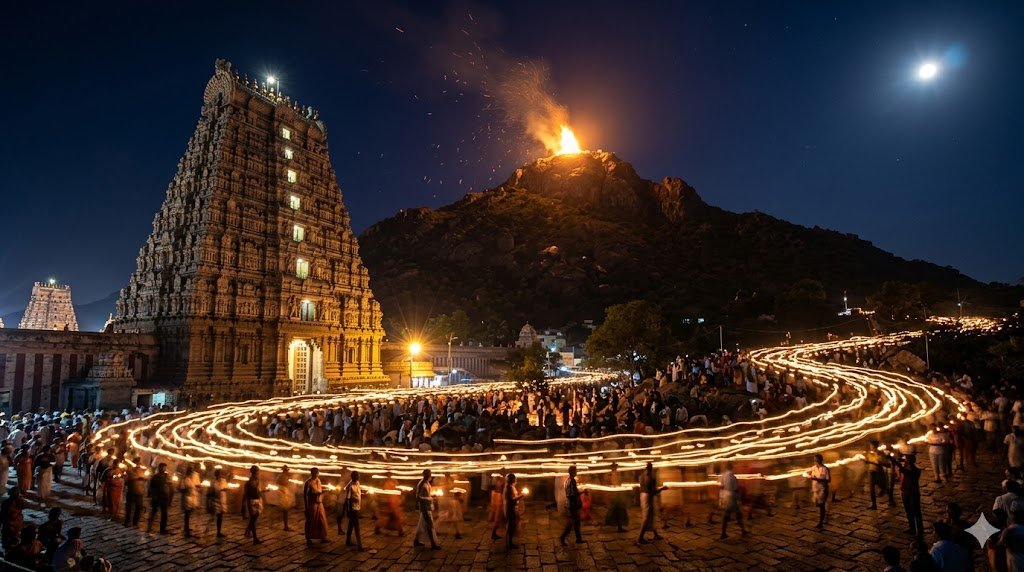
Every year since, this cosmic event is re-enacted at Karthigai Deepam. On the tenth evening of the festival, at exactly 6:00 PM, a massive fire — lit using a massive copper pot containing ghee and camphor — blazes from the summit of Arunachala Hill. It can be seen from towns and villages up to 30 kilometres away. The flame represents Shiva as Jyoti Swaroopa, the luminous form — and every pilgrim who sees it, in that moment, is said to receive his darshan directly.
Why Arunachala Hill IS the Agni Lingam — Not Just a Symbol
Most temples house a Shivalingam inside a sanctum sanctorum. Thiruvannamalai is different in a way that no other Pancha Bootha Sthala replicates: the Agni Lingam here is not a stone object inside a chamber. The entire 2,669-foot Arunachala Hill — the red mountain visible from all across the town — is the Lingam. Lord Shiva did not merely visit here. He became the hill. He still inhabits it.
The Skanda Purana’s Arunachala Mahatmyam, one of the most ancient scriptures referencing this kshetra, confirms that the hill radiates a divine fire that cannot be physically seen but spiritually felt — and that circumambulating it even once is equal to performing great penance for lifetimes. The Thiruvannamalai Puranam records that in Kritayuga, Annamalai existed entirely as fire. In Tretayuga, it was emerald. In Dwaparayuga, gold. In the present Kaliyuga, it is rock — but the fire within it is unchanged, merely veiled behind a veil of stone.
This understanding transforms what visitors experience at Thiruvannamalai. The darshan here is not a moment before a carved image. It is a sustained encounter with a divine being who has chosen to take the form of geography — who is, quite literally, the ground beneath your feet and the horizon before your eyes.
Thiruvannamalai and the Pancha Bootha Sthalams
Thiruvannamalai holds one of five seats in a cosmological system that maps Lord Shiva’s presence to the fundamental elements of creation. Each of the Pancha Bootha Sthalams — the Five Elemental Shrines — manifests Shiva as one of the five elements that compose the physical universe.
| Temple | Location | Element | Lingam Name |
|---|---|---|---|
| Arunachaleswarar Temple | Thiruvannamalai, Tamil Nadu | Fire (Agni) | Agni Lingam |
| Nataraja Temple | Chidambaram, Tamil Nadu | Space (Akasha) | Akasha Lingam |
| Jambukeshwara Temple | Thiruvanaikaval, Tamil Nadu | Water (Jal) | Appu Lingam |
| Ekambareswarar Temple | Kanchipuram, Tamil Nadu | Earth (Prithvi) | Prithvi Lingam |
| Srikalahasteeswara Temple | Srikalahasti, Andhra Pradesh | Air (Vayu) | Vayu Lingam |
Why this page no longer quotes rupee figures
We could not find a published seva tariff for Arunachaleswarar Temple (HR&CE temple code TM020343) anywhere on the government portal, annamalaiyar.hrce.tn.gov.in. The figures we used to print here were not sourced from HR&CE, and they contradicted the figures on our own other pages — the same seva appeared at prices that differed several times over.
The seva counter inside the temple quotes the current rate, and HR&CE revises rates from time to time. That counter is the only authority we can point you to with confidence.
Remarkably, all five Pancha Bootha Sthalams are aligned almost in a straight line — a geographical precision that no satellite or GPS technology existed to enable when these temples were established thousands of years ago. This alignment is considered one of ancient India’s most astonishing architectural and astronomical facts.
The Arunachaleswarar Temple: Architecture, Gopurams and Sacred Spaces
The Arulmigu Arunachaleswarar Temple spreads across 25 acres at the base of Arunachala Hill, making it one of the largest Shiva temples in the world. Six concentric prakarams (enclosures) surround the central sanctum, each layer revealing different epochs of construction and different dynasties of patronage.
The Eastern Gopuram — the Rajagopuram — rises to 66 metres, making it one of the tallest temple towers in India. The four main gopurams of the temple, each facing one of the cardinal directions, are built in identical proportions, creating a visual symmetry that emphasizes the hill’s own balanced presence behind them. The Chola kings constructed many of the earliest enclosures between the 9th and 13th centuries. Krishnadevaraya of the Vijayanagara Empire added the magnificent Thousand Pillar Mandapam — used during Thirumanjanam abhishekam on Ardra Nakshatra. The Nayak rulers contributed detailed stonework, additional mandapams, and the temple tanks.
Inside the complex, the Pathala Lingam — an underground chamber with a Shivalingam — holds special significance. Sri Ramana Maharshi, the 20th century’s most celebrated Advaita sage, is said to have performed his earliest and deepest meditation here, remaining immovable for months while serpents and insects moved across his body without disturbance. A shrine to Ramana Maharshi’s samadhi stands adjacent to the complex, drawing spiritual seekers from across the world.
Two sacred tanks — Shivagangai Teertham near the Rajagopuram and Brahma Teertham near the south gopuram — serve ritual and devotional functions throughout the year. The sanctum houses images of Nandi, Surya, and on the rear wall of the sanctum, an unusual image of Venugopala Swamy (a form of Krishna) — a rare visual affirmation of Shaiva-Vaishnava harmony within this sacred space.
The Significance of Ardra Nakshatra at Thiruvannamalai
It was on an Ardra Nakshatra day that the cosmic Agni Lingam first appeared at Thiruvannamalai — a detail preserved in the Thiruvannamalai Puranam and referenced in temple inscriptions. This makes Ardra Nakshatra an especially potent time to visit. The annual Ardra Darshanam, when thousands of devotees gather for a special abhishekam of the Shiva Lingam, is considered among the most spiritually charged events in the temple calendar. Many pilgrims plan their annual visit specifically around this nakshatra.
Girivalam: Circumambulating the Agni Lingam Itself
Understanding the Thiruvannamalai Agni Lingam story makes the practice of Girivalam — walking around the Arunachala Hill — immediately comprehensible. You are not walking around a symbol of Shiva. You are circumambulating Shiva himself, who chose to become this hill. The pradakshina is the act of devotion made directly to the deity’s body.
The Girivalam circuit covers approximately 14 kilometres and passes eight directional Shivalingams — the Ashta Lingams — each presiding over a cardinal or intercardinal direction and associated with specific blessings.
| Lingam | Direction | Blessings |
|---|---|---|
| Indra Lingam | East | Wealth and prosperity |
| Agni Lingam | Southeast (~1.8 km) | Relief from disease, fear, enemy troubles |
| Yama Lingam | South | Blessings of ancestors; good sibling relations |
| Nirruti Lingam | Southwest | Begetting children |
| Varuna Lingam | West | Relief from disease; fame |
| Vayu Lingam | Northwest | Relief from evil eye; good marriage |
| Kubera Lingam | North | Wealth and peace of mind |
| Ishana Lingam | Northeast | Clarity of thought and intellect |
Performing Girivalam barefoot on Pournami (full moon) nights is the most auspicious form of this circumambulation. Monthly, over three million devotees walk this circuit — making the Pournami Girivalam at Thiruvannamalai one of the largest regular human congregations for a spiritual purpose anywhere on earth. The walk takes 3 to 4 hours at a moderate pace. Couples who have difficulty conceiving traditionally perform Girivalam and return to carry their newborn child around the hill in a cradle suspended from sugarcane stems — a thanksgiving pradakshina that deeply moved every pilgrim who witnesses it.
Karthigai Deepam: The Annual Return of the Cosmic Fire
The Karthigai Deepam festival is the living continuation of the Thiruvannamalai Agni Lingam story — the one night each year when the original cosmic event is made visible to human eyes. The 17-day Brahmotsavam culminates on the 10th day, the Pournami night of the Tamil month of Karthigai (November–December).
The day begins with Bharani Deepam early in the morning — five lamps are lit simultaneously from a single source, symbolizing the five elements arising from Parameshwara. In the evening, those five lamps are reunited, symbolizing the dissolution of the elements back into the one. Then, at exactly 6:00 PM, the Maha Deepam blazes from the summit of Arunachala Hill — lit inside a five-and-a-half-foot copper vessel filled with ghee and camphor, tended by temple priests who have climbed the hill in a sacred procession. The flame can be seen from 30 kilometres away on a clear night.
Over five million people gather to witness the Maha Deepam each year — across the hilltop, in the streets, on rooftops, and along the Girivalam path. In that moment, as the flame flares from the summit, every person present sees not just a festival fire but the original Jyoti Stambha made briefly visible to mortal eyes. The Ardhanarishvara deity is brought to the Katchi Mandapam inside the temple so that devotees can witness the divine union — Shiva and Parvati together — at the moment the hill itself burns with his presence.
Temple Darshan Timings and Practical Information
Daily Temple Timings
| Session | Timings | Best For |
|---|---|---|
| Morning Session | 5:30 AM – 12:30 PM | Peaceful darshan, Ushakalam Pooja, Abhishekam |
| Afternoon Break | 12:30 PM – 3:30 PM | Temple closed for afternoon rituals |
| Evening Session | 3:30 PM – 9:30 PM | Sayaraksha Pooja, vibrant devotional atmosphere |
Six daily poojas are conducted between 5:30 AM and 10:00 PM, each including abhishekam, alankaram, naivedyam, and deepa aradhana. The Ushakalam Pooja at 5:30 AM is the most serene — minimal crowds, full priestly attention, and the cool morning air of the hill as a companion. The evening Sayaraksha Pooja draws larger crowds and the devotional atmosphere builds toward a moving Deepa Aradhana.
Darshan Options and Ticket Prices
General darshan at the Arunachaleswarar Temple is free for all pilgrims. Special and VIP options are available for those who prefer shorter waiting times and closer proximity to the sanctum during high-footfall days.
| Darshan Type | Price | Notes |
|---|---|---|
| Sarva Darshan (Free) | ₹0 | Available to all; wait time varies by footfall |
| Special Entry | Ask at the counter | Faster queue; available at counter and online |
| VIP Darshan | Ask at the counter | Priority access; closest proximity to Lingam |
| Platinum Darshan | Ask at the counter | Premium experience; advance booking recommended |
| Diamond Darshan | Ask at the counter | Highest priority; very limited slots |
How to Reach Thiruvannamalai
Thiruvannamalai sits approximately 185 km from Chennai and 215 km from Bengaluru, in the heart of Tamil Nadu. It is accessible by all three major transport modes.
By Train
Tiruvannamalai Railway Station receives trains on the Villupuram–Katpadi line. The nearest major junctions are Villupuram (76 km) and Katpadi (65 km), both of which connect to Chennai, Bengaluru, and Hyderabad through major express and passenger trains. From Villupuram and Katpadi, regular buses and taxis reach the temple town within 90 minutes.
By Road
State-run Tamil Nadu Transport Corporation (SETC/TNSTC) buses connect Thiruvannamalai directly from Chennai (approximately 4 hours), Bengaluru (approximately 5 hours), Vellore (2 hours), and Pondicherry (2.5 hours). The roads are well maintained, and private taxis and cabs are widely available from all surrounding cities. Parking facilities are available near the temple complex.
By Air
Chennai International Airport is the nearest major airfield, approximately 200 km away. From the airport, taxis reach Thiruvannamalai in about 3.5 to 4 hours via NH-48. Pondicherry also has a small airport with limited connections, approximately 100 km from the temple town.
The Spiritual Significance of Thiruvannamalai Beyond the Legend
The Thiruvannamalai Agni Lingam story carries a teaching that extends well beyond temple mythology. The fire column had no beginning and no end — and neither Brahma’s creativity nor Vishnu’s pervasiveness could measure or contain it. What Shiva revealed in that moment was not his own superiority over two deities. He revealed that the infinite cannot be contained by any claim, any role, or any identity — including the identities of Creator and Preserver.
Sri Ramana Maharshi, who spent the majority of his life at Arunachala — first in the cave of Virupaksha and later at the Ramana Ashram at its base — described the hill as his guru. He did not treat Arunachala as a symbol of the self. He said it was the self — the same infinite awareness that the Jyoti Stambha represented, now dwelling permanently as rock. His presence drew spiritual seekers from across the world, and the hill’s gravitational pull on sincere seekers has only deepened in the decades since his mahasamadhi in 1950.
Several other great sages have confirmed the hill’s power. Sri Kavyakantha Ganapati Muni, Ramana’s principal disciple, frequently praised Arunachaleswara’s greatness. Sri Jagadguru Chandrasekhara Saraswati Swamigal of the Kanchi Kamakoti Peetam regularly visited for Girivalam. Ancient Tamil saints — Sambandar (7th century), Appar, Sundarar, Manickavasagar, and Arunagirinathar — all composed works in praise of Annamalaiyar, and their verses are enshrined in the Tirumurai as among the highest expressions of Tamil Shaiva devotion.
The Bottom Line on the Thiruvannamalai Agni Lingam Story
The Thiruvannamalai Agni Lingam story asks every visitor a quiet question: what is the limit of what you believe yourself to be? Brahma knew the answer — and lied because he couldn’t bear it. Vishnu knew the answer — and bowed because he could. The fire that appeared between them still burns on that hill, covered by rock in this age but unchanged in its nature, waiting for the honest heart.
Visit the Arunachaleswarar Temple early in the morning, when the Ushakalam pooja fills the air with the smell of camphor and the sound of Vedic chanting. Walk the Girivalam on a Pournami night, when the hill stands silent and enormous against a full moon sky and three million people walk in barefoot quiet. Come for Karthigai Deepam if you can, and watch the summit burn at 6:00 PM while the crowd around you exhales — not in excitement, but in recognition.
For current darshan timings, festival schedules, special pooja bookings, and Girivalam dates, visit the official temple portal at hrce.tn.gov.in and thiruvannamalai.in. Temple operations can vary seasonally and during festival weeks — always confirm timings locally before your visit.
Frequently Asked Questions About Thiruvannamalai Agni Lingam Story
What is the Agni Lingam at Thiruvannamalai?
The Agni Lingam at Thiruvannamalai is the Arunachala Hill itself — not a stone Lingam inside a temple chamber, but the entire 2,669-foot mountain, which Shiva became after manifesting as an infinite column of fire. The Arunachaleswarar Temple stands at the base of this hill and worships Shiva as the fire element, one of the five Pancha Bootha Sthalams of South India. According to tradition, the hill has existed as fire since Kritayuga and took its present rocky form in Kaliyuga, though its inner fire remains unchanged.
Why did Shiva appear as a column of fire at Thiruvannamalai?
Shiva appeared as an infinite column of fire — the Jyoti Stambha — to resolve an ego-driven dispute between Brahma and Vishnu over who was supreme. By manifesting as a boundless flame with no beginning and no end, he demonstrated that the infinite cannot be measured, claimed, or contained by any ego. The place where this column appeared became Arunachala Hill, and Shiva settled into the earth as the hill itself, choosing to remain as a permanent blessing to all who approach him with honest hearts.
What happened to Brahma in the Thiruvannamalai Agni Lingam story?
Brahma, tasked with finding the top of the infinite fire column, encountered a Thalambu (screw pine) flower descending through the air during his flight upward. Unable to find the column’s summit, he bribed the flower into bearing false witness that he had seen the top. When Shiva discovered the deception, he cursed Brahma to receive no temples or worship on earth. He also cursed the Thalambu flower to never be used in sacred offerings. Vishnu, who honestly admitted defeat, was blessed to be worshipped eternally for his humility.
What is Karthigai Deepam and how does it connect to the Agni Lingam story?
Karthigai Deepam is Thiruvannamalai’s most significant annual festival, celebrated on the full moon of the Tamil month of Karthigai (November–December). On the 10th evening of the 17-day festival, at 6:00 PM, a massive fire is lit atop Arunachala Hill inside a five-and-a-half-foot copper vessel. It re-enacts the moment Shiva appeared as fire on the hilltop after Parvati’s penance — restoring light and merging with Parvati to form Ardhanarishvara. Over five million pilgrims gather to witness this event each year, making it one of India’s largest spiritual congregations.
What is Girivalam at Thiruvannamalai and why is it significant?
Girivalam is the practice of circumambulating Arunachala Hill — the Agni Lingam itself — on foot, typically barefoot, in a clockwise direction. The full circuit covers approximately 14 kilometres and passes eight directional Shivalingams (Ashta Lingams) representing the eight cosmic guardians. Because the hill IS Lord Shiva, walking around it is pradakshina of the deity’s living form. Pournami (full moon) nights are the most auspicious time, and millions of pilgrims participate monthly. Ancient tradition holds that even one sincere Girivalam is equivalent to lifetimes of spiritual practice.
What is the best time to visit Thiruvannamalai?
October to December is the ideal period — combining pleasant weather, the charged spiritual atmosphere of Karthigai Masam, and the culminating Karthigai Deepam festival. Pournami nights throughout the year are especially powerful for Girivalam. For a quieter, more contemplative visit without festival crowds, weekday mornings between January and March offer the most peaceful darshan and unhurried access to the Girivalam path.

The Tiruvannamalai Devasthanam editorial team is an independent group of writers and researchers documenting pilgrimage to the Arunachaleswarar Temple and Arunachala Hill, Tiruvannamalai. We are not affiliated with the temple or the Tamil Nadu HR\&CE Department. Every darshan timing, festival date and ritual detail we publish is cross-checked against the HR\&CE department, on-the-ground reports and at least two independent sources before it is published, and festival dates are re-verified each year. Spotted an error? Tell us and we will correct it.
