A detailed look at Tiruvannamalai Temple history — from Pallava origins and 9th-century Chola construction to Vijayanagara expansion and present-day ASI care.
Tiruvannamalai Temple history stretches across more than 1,200 years of unbroken worship, six major dynasties, and some of the most ambitious stone-carving campaigns ever undertaken in South India. The temple you walk into today — all 25 acres of prakarams, nine gopurams, and the towering 217-foot Rajagopuram — did not rise in a single century. Instead, it grew layer upon layer, each Chola, Hoysala, Vijayanagara, and Nayak king adding to what the previous had built. This article traces that long story from its earliest Pallava-era mentions in 7th-century Tamil hymns to its present-day stewardship under the Hindu Religious and Charitable Endowments Department and the Archaeological Survey of India.
Quick Summary: Tiruvannamalai Temple History at a Glance
For readers short on time, here is the condensed timeline. Additionally, this overview frames the detailed sections that follow.
- Pre-9th century: Pallava rule; temple mentioned in 7th-century Tamil Saiva hymns by saints Appar and Sambandar
- 9th–13th centuries: Chola dynasty builds the core stone structure (approximately 850–1280 CE)
- 1328 CE: Hoysala king Veera Ballala III shifts his capital to Tiruvannamalai and builds the Vallala Maharaja Gopuram
- 1336–1565 CE: Vijayanagara empire (Sangama, Saluva, and Tuluva dynasties) expand the complex dramatically
- 1509–1572 CE: Krishnadevaraya begins the Rajagopuram; Sevappa Nayaka completes it in 1572 CE
- 17th century: Temple overrun briefly by the Carnatic Sultanate and later the Nawab
- 18th–19th centuries: French, British, and local Nawabi rule; temple survives
- 1922–1950: Ramana Maharshi establishes his ashram at the foot of Arunachala
- 2002: ASI declares the temple a national heritage monument
- Present day: Managed by the Tamil Nadu HR&CE Department
What Is Tiruvannamalai Temple? A Brief Definition
The Arunachalesvara Temple — also called Annamalaiyar or Arunachaleswarar Temple — is a Hindu shrine dedicated to Lord Shiva at the foot of the sacred Arunachala Hill in Tiruvannamalai, Tamil Nadu. It is one of the five Pancha Bhoota Sthalams and represents the element of fire (Agni). Notably, it is considered one of the largest Shiva temples in the world, covering approximately 25 acres.
Origins Before the Cholas: The Pallava and Early Period
The site itself predates every surviving stone wall. Ancient Tamil poets like Nakkirar, Kapilar, and Paranar referenced the Arunachala hill as early as the 1st century BCE. Clearly, the sanctity of the hill was established long before any dynastic builder arrived.
By the 7th century CE, the area was under Pallava rule. Consequently, inscriptions suggest Pallava kings administered the shrine from their capital at Kanchipuram. The Tamil Saiva saints Appar and Sambandar, who lived in the 7th century, composed hymns praising Annamalaiyar. These hymns — preserved in the Thevaram canon — confirm that the temple was already an important pilgrimage centre two centuries before the Cholas began their major construction.
However, no monumental stone structure from the Pallava period survives in its original form at Tiruvannamalai. Most of what can be seen today was either built or rebuilt by later dynasties on earlier foundations.
The Chola Era: Building the Temple You See Today (9th–13th Century)
The real architectural story of Tiruvannamalai Temple history begins with the Chola dynasty. Specifically, Chola patronage spanned from roughly 850 CE to 1280 CE — over four centuries of continuous building and endowments.
Why the Cholas Chose Tiruvannamalai
The Cholas were the most ambitious temple builders in Tamil history. Their reign saw the Brihadeeswara at Thanjavur, the Gangaikonda Cholapuram, and the Airavatesvara at Darasuram. Therefore, bringing the Tiruvannamalai shrine into their royal temple network was a natural extension of their religious and political ambitions.
Epigraphic evidence — the hundreds of inscriptions carved into the temple walls — shows that Chola kings made repeated gifts of land, gold, cattle, and oil for temple lamps. Moreover, they funded the daily rituals and sponsored festivals.
What the Cholas Built
The present stone sanctum and its immediate prakaram walls trace back to Chola construction. Additionally, the Cholas are credited with establishing the core Dravidian layout: a central garbhagriha, an ardha-mandapam, and a maha-mandapam aligned on an east-facing axis.
The first two prakarams (concentric compound walls) are sometimes attributed by local tradition to even earlier Pandiya rulers, though most modern historians attribute them to the Cholas. Furthermore, the Cholas expanded the temple outward in concentric zones, a pattern that later dynasties would follow and amplify.
Hoysala Chapter: Veera Ballala III Makes Tiruvannamalai His Capital
In 1328 CE, an unusual thing happened in Tiruvannamalai Temple history. The Hoysala emperor Veera Ballala III — whose original capital was Dwarasamudra (modern Halebidu in Karnataka) — shifted his royal seat to Tiruvannamalai. As a result, the town briefly became the capital of the Hoysala kingdom.
Why the Hoysalas Came South
The reason was political survival. Malik Kafur, the general of Alauddin Khilji, had sacked Dwarasamudra in the early 14th century. Subsequently, Ballala III was forced to flee south, continuing his resistance against the Delhi Sultanate from Tamil country.
Despite being a refugee king, Ballala III was a devoted Shaivite. Therefore, he used his final decades to beautify the Arunachalesvara Temple as a spiritual thanksgiving.
The Vallala Maharaja Gopuram
Ballala III built the Vallala Maharaja Gopuram between 1328 CE and 1331 CE — the direct entrance and exit between the fifth and fourth prakarams. Moreover, a 2.5-foot statue of the king stands in the archway of this gopuram to this day. Nine separate inscriptions of Ballala III are preserved inside the temple complex, including one from 1317 CE that records his devotion.
Local legend holds that Lord Arunachaleswarar himself performed Ballala’s funeral rites — a rare honour normally reserved for a son. Ballala III died in 1343 CE at Madurai, captured and executed by the forces of Muhammad bin Tughlaq. Hence, with his death the Hoysala dynasty ended, but his gopuram still stands.
Vijayanagara Expansion: The Golden Age (1336–1565 CE)
After the Hoysalas, the Vijayanagara Empire rose in the Deccan and extended its reach into Tamil country. Subsequently, three successive Vijayanagara dynasties — the Sangama (1336–1485 CE), the Saluva, and the Tuluva (1491–1570 CE) — poured unprecedented wealth into Tiruvannamalai.
Krishnadevaraya’s Twenty Endowments
The most famous Vijayanagara patron was emperor Krishnadevaraya (reigned 1509–1529 CE). Specifically, temple records credit him with twenty major endowments at Arunachaleswarar Temple.
Krishnadevaraya’s contributions included the eastern Rajagopuram foundation, the Shivaganga Theertham tank, the Thousand Pillar Hall, the Indra Vimana, the Vinayaka Chariot, and the Tirumaladevi Amman Samudram lake. Furthermore, he gifted the gold plating for the sanctum doors and the Apitakuchambal shrine doors, a well known as Araamudhu in front of the goddess shrine, a royal ornament called Krishnarayan for both deities, the Nagabharanam, and several gold statues and silver pots.
The Rajagopuram: Second-Tallest Temple Tower in India
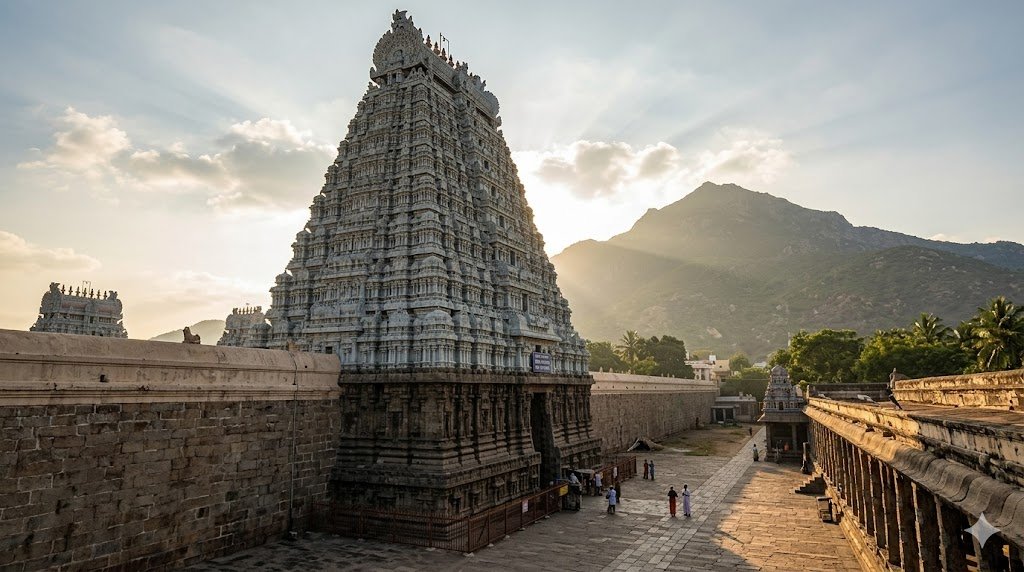
The most iconic monument from this era is the eastern Rajagopuram. At 217 feet (66 metres) with 11 stories, it remains one of the tallest temple towers in India. Krishnadevaraya began construction during his reign. Eventually, it was completed in 1572 CE during the period of Sevappa Nayaka (1532–1580 CE) of the Thanjavur Nayak dynasty.
The granite base alone measures 135 feet by 98 feet. Moreover, inscriptions attribute the tower’s final construction to Sivanesa and his brother Lokanatha in 1572 CE. Nayak-era texts like the Raghunathabhyudayam and Sangitha Sudha describe the towers in detail.
The Thousand Pillar Hall
Inside the fifth precinct stands the Thousand Pillar Hall, also built under Krishnadevaraya’s patronage. Notably, its pillars are carved with images of yali — a mythical beast with the body of a lion and the head of an elephant — which served as a symbol of Nayak power. The tank opposite the hall was dug at the same time.
Dynastic Patrons Timeline at a Glance
| Period | Dynasty/Ruler | Key Contribution |
|---|---|---|
| Before 9th century | Pallavas | Earliest royal association; 7th-century hymns |
| 850–1280 CE | Cholas | Core sanctum, first prakarams, bulk of inscriptions |
| 1328–1343 CE | Hoysala Veera Ballala III | Vallala Maharaja Gopuram, royal statue |
| 1336–1485 CE | Vijayanagara Sangama | Outer prakarams, early tower work |
| 1509–1572 CE | Krishnadevaraya + Sevappa Nayaka | Rajagopuram, Thousand Pillar Hall, Shivaganga tank |
| 17th century | Carnatic Sultanate, Nawabs | Period of sieges and reduced patronage |
| 18th–19th centuries | French, British, local rulers | Continued worship despite political flux |
| 2002–Present | ASI + TN HR&CE Department | Heritage monument status and administration |
Invasions, Sieges, and the Colonial Interlude
In the 17th century, the temple came under the dominion of the Carnatic Sultanate. Subsequently, it was besieged in succession by Muraru Raya, Krishna Raya, Mrithis Ali Khan, and Burkat Ullakhan. Each siege disrupted worship temporarily but never erased it.
As European powers expanded in South India, Tiruvannamalai was attacked by both the French and the English. The French occupied the town for a brief period in the 18th century. However, unlike many other Tamil temples that suffered irreversible damage, Arunachalesvara survived these centuries with its core structures largely intact.
By the 19th century, the temple had come under British colonial administration as part of the Madras Presidency. Although the British did not patronise the shrine directly, daily worship continued uninterrupted under traditional temple trustees.
The Ramana Maharshi Era: A Modern Spiritual Awakening
A new chapter in Tiruvannamalai Temple history opened in 1896, when a 16-year-old boy named Venkataraman Iyer arrived at the foot of Arunachala. Later known as Bhagavan Sri Ramana Maharshi, he would spend the rest of his life — 54 years — at the hill.
Ramana Maharshi lived near his mother Alagammal’s samadhi from 1922 onwards. Gradually, Sri Ramanasramam grew around him. Additionally, seekers from across the world — including Paul Brunton, Somerset Maugham, and later Arthur Osborne — visited him.
Until his samadhi in 1950, Ramana Maharshi taught the path of self-enquiry (Atma Vichara) — the simple question “Who am I?” Because of him, Tiruvannamalai became not just a traditional pilgrimage destination but also a global spiritual hub, drawing Advaita seekers from every continent.
Architectural Legacy: What Pilgrims See Today
The temple complex spans approximately 25 acres (10 hectares), with compound walls measuring 700 feet on the east and west, 1,479 feet on the south, and 1,590 feet on the north. Furthermore, the complex contains five concentric prakarams, nine gopurams, and multiple shrines.
The Four Cardinal Gopurams
- Eastern Rajagopuram: 217 ft, the main entrance, 11 stories
- Southern Thirumanjangopuram: southern entry, second-tallest tower
- Western Pei Gopuram: western entry, richly carved
- Northern Ammani Ammal Gopuram: named after a woman sanyasini who funded its construction
Other Notable Structures
Beyond the four main gopurams, the complex houses the Kili Gopuram (parrot tower), the Vallala Maharaja Gopuram, the Thousand Pillar Hall, the Deepa Darshana Mandapam (a 16-pillared hall of light in the third precinct), the Kalyana Mandapam built in Vijayanagara style, the Arunagirinathar Mandapam, the Brahma Theertham, and the Shivaganga Theertham tanks.
Inscriptions: The Temple’s Own Archive
Arunachaleswarar Temple holds hundreds of inscriptions carved into its walls, pillars, and base mouldings. Specifically, these epigraphs record royal gifts, festival endowments, land grants to Brahmins, and the appointment of temple functionaries.
Many inscriptions use the formal royal title “Jayankonda Cholamandalam Senkunra kotta Vanakopadi Annanattu Taniyur Tiruvannamalai” — a reminder that the town carried an administrative identity within the Chola empire. Additionally, inscriptions from the Vijayanagara period are written in Sanskrit, Tamil, Telugu, and Kannada, reflecting the empire’s multilingual reach.
Present-Day Administration and Heritage Status
Since Independence, the temple has been administered by the Hindu Religious and Charitable Endowments Department of the Government of Tamil Nadu. The HR&CE appoints executive officers, manages revenues, and oversees daily rituals and festivals.
In 2002, the Archaeological Survey of India declared the Arunachalesvara Temple a national heritage monument. Consequently, ASI now shares responsibility for structural preservation, while HR&CE retains control over religious activities.
The temple is also recognised in the Shaivite tradition as one of the Pancha Bhoota Sthalams (fire element), one of the Aathara Thalams (corresponding to the Manipooraga chakra), and a Mukthi Thalam — a place where liberation is believed attainable. Saints like Seshadri Swamigal, Gugai Namashivayar, Yogi Ramsuratkumar, and Ramana Maharshi are all associated with the site.
Key Festivals That Carry the History Forward
Festivals are the living expression of Tiruvannamalai Temple history. Four Brahmotsavams are held every year, but the most famous by far is Karthigai Deepam.
Karthigai Deepam lasts ten days in November or December. On the tenth day, a massive beacon lamp is lit atop Arunachala hill. Moreover, the flame can be seen from 15 km away. It symbolises Shiva as a column of fire and draws millions of pilgrims. Additionally, every full-moon night (Pournami), tens of thousands of devotees walk the 14 km Girivalam path barefoot around the hill.
The Bottom Line
Tiruvannamalai Temple history is not a single story but a continuous conversation between dynasties, saints, and ordinary pilgrims spanning over a millennium. The Cholas gave it stone. The Hoysalas gave it a royal capital briefly. Krishnadevaraya and the Nayaks gave it scale. Ramana Maharshi gave it modern spiritual voice. Today, the ASI and HR&CE hold it in trust for future generations. For anyone planning a visit, knowing this layered past transforms every gopuram, every pillar, and every inscription into a readable timeline of South Indian history.
Frequently Asked Questions
Who built the Tiruvannamalai Arunachaleswarar Temple originally?
The present stone structure was built by the Chola dynasty in the 9th century CE, although the site was already a worship centre under the Pallavas before that. Later, Hoysala, Vijayanagara, and Nayak rulers added expansions over the following seven centuries.
How old is Tiruvannamalai Temple?
The main stone temple is approximately 1,200 years old, dating to the 9th century CE. However, the site itself has been a place of Shiva worship for over 2,000 years, referenced in Tamil literature from the 1st century BCE onwards.
Who built the tallest gopuram at Tiruvannamalai?
The eastern Rajagopuram was begun by Vijayanagara emperor Krishnadevaraya (1509–1529 CE) and completed in 1572 CE during the reign of Sevappa Nayaka of the Thanjavur Nayak dynasty. It rises to 217 feet with 11 stories.
What role did Krishnadevaraya play in Tiruvannamalai Temple history?
Krishnadevaraya carried out twenty major developments at the temple, including the Rajagopuram, Thousand Pillar Hall, Shivaganga Theertham, gold plating of sanctum doors, and several gold ornaments. Therefore, he is considered the single most prolific individual patron in the temple’s history.
Why was Veera Ballala III important to the temple?
Veera Ballala III, the last Hoysala emperor, made Tiruvannamalai his capital in 1328 CE after fleeing his original seat at Dwarasamudra. He built the Vallala Maharaja Gopuram between 1328 and 1331 CE, and a statue of him still stands inside that gateway.
Is Tiruvannamalai Temple protected by the ASI?
Yes. In 2002, the Archaeological Survey of India declared Arunachaleswarar Temple a national heritage monument. However, the Tamil Nadu HR&CE Department continues to manage the temple’s religious administration and daily rituals.
What is the connection between Ramana Maharshi and the temple?
Ramana Maharshi arrived at the foot of Arunachala hill in 1896 as a 16-year-old boy and lived there for 54 years until his samadhi in 1950. His ashram, Sri Ramanasramam, sits near the temple and has made Tiruvannamalai a global centre for Advaita Vedanta seekers.

The Tiruvannamalai Devasthanam Editorial Team is an independent group of writers and pilgrimage researchers focused on the Arunachaleswarar (Annamalaiyar) Temple and the Girivalam. Our guides are compiled from published sources and the official Tamil Nadu HR&CE portal, then cross-checked before publishing. We are an independent information resource and are not affiliated with, or endorsed by, the temple administration or HR&CE. Because timings, fees and seva details change without notice, we recommend confirming anything that affects your travel at the temple counter or on the official government portal before you go.
