
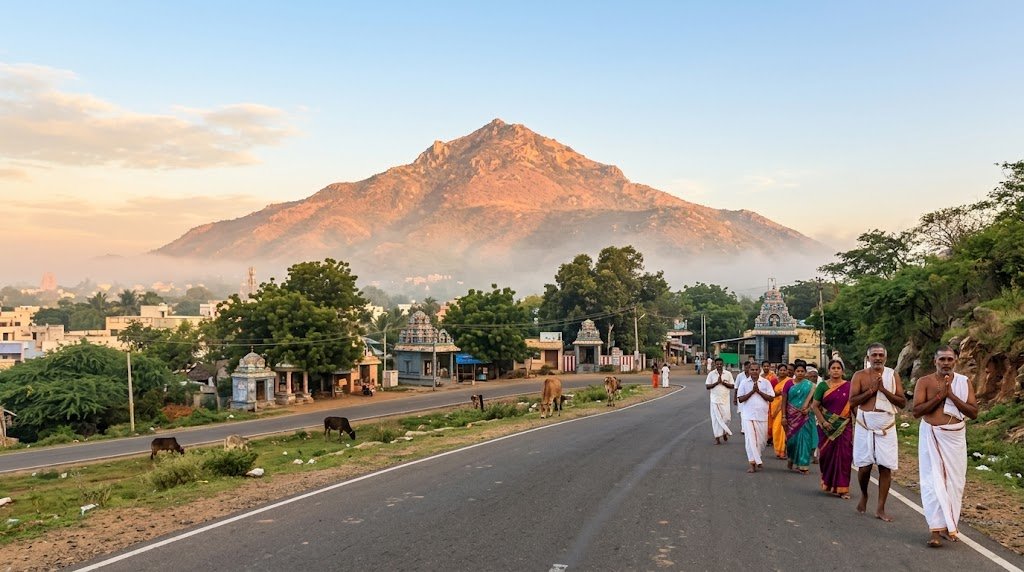
Barefoot Girivalam at Arunachala: tradition, mandatory rules debate, foot preparation, walking tips, route timing and what to do if barefoot isnt possible.
The barefoot Girivalam question is the single biggest debate among first-time pilgrims to Tiruvannamalai. Some sit on the steps of Arunachaleswarar Temple, removing their shoes with quiet resolve. Others quietly slip on thick socks, glancing around to see if anyone notices. A few stride out in full sports shoes and wonder if the pooja still counts. The truth sits somewhere between strict tradition and modern practicality — and most devotees discover it only after their first 3 kilometres on the hot tar road.
This guide settles the question honestly. Furthermore, it walks you through exactly how to prepare your feet for the 14-kilometre circumambulation, what tradition demands, what saints have said, and what to do if your soles simply cannot take it.
Quick Summary at a Glance
- Traditional rule: Yes, barefoot is the scriptural and saintly recommendation
- Strictly enforced? No, the temple does not police footwear on the 14 km path
- Distance: 14 kilometres around Arunachala Hill
- Time required: 3.5 to 4.5 hours at devotional pace
- Best timing: Pre-dawn (4:00 AM) or post-sunset
- Minimum compromise: Barefoot at least at the eight Lingam shrines
- Pace guidance: Walk like “a queen in her ninth month” — slow and deliberate
- Direction: Always clockwise, hill on your right
Is Barefoot Girivalam Truly Mandatory
The short answer is: traditionally yes, practically no. According to scripture, saintly guidance, and centuries of unbroken practice, Girivalam is meant to be performed without footwear. Specifically, the hill itself is considered the physical manifestation of Lord Shiva, not just a path leading to a temple. Therefore, wearing shoes is symbolically equivalent to walking on the deity.
However, the Arunachaleswarar Temple administration does not enforce this as a rule. Furthermore, no checkpoint along the route stops shod pilgrims. Consequently, modern Girivalam has become a personal devotional choice rather than an administrative mandate.
What Tradition Actually Says
The classical instruction comes from generations of Tamil devotees and saints who walked the path themselves. Specifically, Bhagavan Ramana Maharshi — who lived on Arunachala for over 50 years — strongly recommended barefoot circumambulation. He held that direct contact between the soles and the sacred earth allows the hill’s vibration to enter the body.
Moreover, a well-known story from the 1800s describes a wealthy landlord arriving in a palanquin to perform Girivalam while wearing shoes. According to local tradition, divine intervention forced him to dismount and remove his footwear. Therefore, the message has always been consistent — humility, surrender, and barefoot contact.
The Spiritual Case for Barefoot Girivalam
Beyond tradition, the spiritual reasoning behind barefoot Girivalam has practical roots that millions of devotees report experiencing.
Why Bare Feet Matter
- Direct skin contact with sacred ground transmits subtle energy
- Walking slowly forces awareness of every step
- Discomfort dissolves ego and entitlement
- Pain anchors the mind in the present moment
- Bare soles connect physically with the hill’s geomagnetic field
- The act mirrors the surrender of sadhus and saints
Furthermore, the rocks of Arunachala are Archaean Charnockite — approximately 2.5 billion years old, older than the Himalayas. Consequently, devotees believe the earth itself carries ancient meditative energy that bare feet can absorb in ways shoes block entirely.
When Barefoot Girivalam Is Genuinely Difficult
That said, certain situations make barefoot walking impractical or even unsafe. Specifically, blanket adherence to tradition can sometimes backfire.
When to Consider Footwear
- You have diabetes, neuropathy, or circulation issues
- You have never walked more than 2 km barefoot in your life
- The tar road temperature exceeds 40°C in midday sun
- You have open cuts, blisters, or recent foot injuries
- You are over 65 with reduced foot sensitivity
- The path is wet and slippery from recent rain
- You are pregnant or recovering from major surgery
Moreover, walking with bruised feet creates a different problem. Specifically, the mind shifts from devotion to pain — which contradicts the very purpose of Girivalam. Therefore, if your feet take over your attention, the spiritual benefit drops sharply.
The Practical Hierarchy: Barefoot to Slippers
Experienced devotees and even some priests now recommend a hierarchy of compromise. Specifically, do as much barefoot as possible — but adapt to your physical reality.
The Four-Tier System
| Tier | What It Means | Best For |
|---|---|---|
| Full barefoot | No footwear for entire 14 km | Regular barefoot walkers, devotees |
| Thick socks only | Cotton or woollen socks throughout | Sensitive feet, first-timers |
| Slippers / open sandals | Removed at all eight Lingam shrines | Elderly, those with health conditions |
| Walking shoes | Last-resort option | Medical conditions, injury recovery |
Notably, whichever tier you choose, removing footwear at the eight Lingam shrines is universally expected. Furthermore, doing so is considered the minimum mark of respect.
How to Prepare Your Feet for Barefoot Girivalam
If you have decided to attempt full barefoot Girivalam, foot preparation begins 7 to 10 days before your visit. Specifically, soft urban feet cannot handle 14 kilometres of tar and stone without conditioning.
The Two-Week Foot Conditioning Plan
- Days 1 to 3: Walk barefoot inside your home for 30 minutes morning and evening
- Days 4 to 6: Walk barefoot on your balcony or terrace for 45 minutes
- Days 7 to 9: Walk barefoot on garden grass or beach sand for 1 hour
- Days 10 to 12: Walk barefoot on a hard footpath for 1 hour
- Days 13 to 14: Rest your feet completely before the Girivalam day
Additionally, daily foot massage with coconut oil or ghee thickens the skin gradually. Furthermore, soaking feet in lukewarm salt water each evening reduces inflammation and toughens the soles.
The Night Before Girivalam
Trim your toenails short. Specifically, long nails press painfully against stones during the walk. Apply a thin layer of coconut oil and wear cotton socks to sleep. Moreover, avoid washing your feet with hot water on the morning of the walk — it softens skin you spent two weeks toughening.
Choosing the Right Time to Walk
The timing of your Girivalam decides whether barefoot walking is bliss or torture. Specifically, the tar road heats up dramatically during midday and can cause serious burns.
Best Time Slots
| Time Slot | Surface Temperature | Pros and Cons |
|---|---|---|
| 3:00 AM – 6:00 AM | Cool, comfortable | Best for barefoot, peaceful |
| 6:00 AM – 9:00 AM | Warm, manageable | Good for first-timers, more crowded |
| 10:00 AM – 4:00 PM | Hot to scorching | Avoid barefoot entirely |
| 5:00 PM – 8:00 PM | Cooling down | Pleasant, slightly busy |
| 9:00 PM – 2:00 AM | Cool, lit pathways | Full moon nights are ideal |
Best Days for Barefoot Girivalam
Pournami (full moon) nights draw the largest crowds — sometimes over a million devotees. Furthermore, Karthigai Deepam in November-December and Maha Shivaratri in February-March are spiritually most powerful. However, weekdays just after full moon offer the rare combination of energetic blessings and lighter crowds. Therefore, plan accordingly based on whether you prioritise atmosphere or comfort.
Walking Tips for the 14-Kilometre Path
Even seasoned walkers find barefoot Girivalam different from regular walking. Specifically, the path includes tar road, packed earth, loose gravel, stone steps, and occasional broken patches.
Pace Like a Pregnant Queen
Ancient instruction holds that Girivalam should be walked at the pace of a “queen in her ninth month of pregnancy” — slow, deliberate, and gentle. Therefore, do not treat it as a fitness walk. Specifically, the average completion time is 3.5 to 4.5 hours when walked at this devotional pace.
The Eight Lingam Shrines
The path passes through eight Lingam shrines, each representing one of the eight cardinal directions. Furthermore, devotees traditionally pause at each shrine for prayer. The shrines are: Indra Lingam, Agni Lingam, Yama Lingam, Niruti Lingam, Varuna Lingam, Vayu Lingam, Kubera Lingam, and Esanya Lingam. Specifically, removing footwear at each shrine is non-negotiable, regardless of what you wear elsewhere on the path.
What to Carry on Barefoot Girivalam
Travel light, but carry the essentials.
Essential Items
- A small water bottle, around 750 ml
- One pack of glucose biscuits or dates for energy
- A small towel for wiping feet at the shrines
- A simple cotton bag to carry slippers if you switch tiers
- Mobile phone for emergencies, silenced
- ₹200 to ₹300 in small denominations
- A small flashlight if walking pre-dawn
- Sandalwood paste or vibhuti for forehead application
What to Wear
Men typically wear a dhoti or veshti with a light cotton upper cloth. Women wear sarees or salwar kameez. Specifically, choose breathable cotton fabrics in light colours. Furthermore, avoid synthetic fabrics that retain sweat. Moreover, dress modestly — this is not a tourist walk.
Mid-Walk Care: Looking After Your Feet
Even with the best preparation, your feet need active care during the walk itself.
Every 2 Kilometres
- Sit briefly and check soles for cuts or splinters
- Sip a small quantity of water — do not gulp
- Stretch your toes and arch your feet
- Apply a small amount of coconut oil if blisters form
- Chant softly to maintain rhythm and focus
- Look up at the Arunachala peak — it realigns purpose
What to Do If Pain Becomes Severe
Listen to your body. Specifically, if pain shifts your focus entirely away from devotion, switch to thick socks or slippers immediately. Furthermore, completing Girivalam with bleeding or badly bruised feet is not spiritually superior to completing it gently with socks. Notably, saints have long emphasised that intention matters more than rigid adherence.
The Mental Side of Barefoot Girivalam
Most pilgrims underestimate how much barefoot Girivalam tests the mind rather than the body. Specifically, the discomfort triggers internal resistance, irritation, and impatience.
How to Stay Mentally Anchored
Chant “Arunachala Shiva, Arunachala Shiva, Arunachala Shiva, Aruna Shiva” rhythmically with your steps. Furthermore, focus on the peak whenever you feel pain. Moreover, observe — do not engage with — fellow walkers. Specifically, idle conversation drains the energy you are trying to build through the walk.
Maintain mauna — sacred silence — as much as possible. Therefore, switch off your phone or set it to airplane mode. Consequently, the mind quickly drops into a meditative rhythm that no shoe-clad walker can replicate.
What First-Timers Often Get Wrong
Three patterns repeatedly trip up first-timers attempting barefoot Girivalam.
Starting Too Fast
Adrenaline and enthusiasm tempt walkers to rush the first 3 km. However, by km 5, the soles are screaming. Specifically, slow consistent pacing protects the feet far better than any quick burst.
Skipping the Eight Lingams
Many devotees stick to the main path and bypass the Lingam shrines. Furthermore, this misses the spiritual core of the practice. Specifically, each shrine resets the energy and gives the feet a brief rest.
Ignoring Hydration
Walking 14 km — even slowly — depletes fluids rapidly. Therefore, sip water every kilometre rather than drinking a large quantity at once. Moreover, dehydration causes cramps that have nothing to do with footwear.
Insider Tips Most Guides Miss
Beyond standard advice, certain insights emerge only from experienced Girivalam walkers.
The Pre-Walk Foot Cooling
Just before starting, dip your feet in cool water for 5 minutes at the temple tank. Specifically, this firms up the skin and reduces early-walk friction. Furthermore, it has a calming effect on the entire body.
Walk With One Companion
Solo Girivalam is powerful but isolating. Conversely, walking in a large group invites chatter and breaks silence. Therefore, the optimal arrangement is one quiet companion who shares your pace and silence.
Carry Cotton, Not Synthetics
If you must wear something on your feet, choose thick cotton socks, not synthetic ones. Specifically, cotton breathes, absorbs sweat, and tears more easily over stones — which is actually safer than synthetic friction.
Looking Ahead: When to Return
Most devotees who complete one Girivalam want to return. Specifically, many commit to monthly full-moon walks as an ongoing sadhana. Furthermore, regular practice gradually builds foot resilience until barefoot becomes the natural choice. Therefore, treat your first Girivalam as the beginning of a long relationship with Arunachala rather than a one-time achievement.
The Bottom Line
Barefoot Girivalam is the scriptural and saintly tradition, but it is not enforced as a rigid rule. Walk barefoot if your feet can handle it, prepare for two weeks beforehand, and choose pre-dawn or post-sunset slots when the tar road is cool. If full barefoot is impossible, wear thick cotton socks or simple slippers — but always remove them at the eight Lingam shrines. Walk slowly, chant rhythmically, sip water every kilometre, and listen to your body. The hill rewards sincere effort far more than rigid adherence. Treat Arunachala with respect, walk with intention, and the 14 kilometres will give back what no footwear policy can dictate.
Frequently Asked Questions
Is barefoot Girivalam mandatory at Tiruvannamalai?
Traditionally yes, but practically no. Specifically, Hindu scripture and saints like Sri Ramana Maharshi strongly recommend barefoot Girivalam because Arunachala is considered Lord Shiva himself. However, the temple administration does not enforce this as a rule. Therefore, devotees with health issues or sensitive feet can wear socks or slippers.
How long does barefoot Girivalam take to complete?
The full 14-kilometre barefoot Girivalam takes between 3.5 and 4.5 hours at the traditional devotional pace. Furthermore, the prescribed walking style is slow and deliberate, like a queen in her ninth month of pregnancy. Specifically, do not treat Girivalam as a fitness walk or rush through it.
What should I do if my feet hurt during barefoot Girivalam?
Pause briefly, sit down, and check your soles for cuts or splinters. Furthermore, apply a small amount of coconut oil to blistered areas. If pain becomes severe enough to break your concentration, switch to thick cotton socks or slippers immediately. Specifically, completing Girivalam with bleeding feet is not spiritually superior to walking comfortably.
Can I wear shoes for Girivalam if I have diabetes?
Yes, absolutely. Specifically, diabetics, those with neuropathy, circulation issues, or recent foot injuries should wear comfortable walking shoes or thick-soled slippers. Furthermore, foot injuries can take weeks to heal in diabetic patients. Therefore, prioritise health and remove footwear only at the eight Lingam shrines as a mark of respect.
What is the best time of day for barefoot Girivalam?
Pre-dawn between 3:00 AM and 6:00 AM is ideal because the tar road is cool. Furthermore, post-sunset between 5:00 PM and 8:00 PM is equally pleasant. Specifically, avoid the 10:00 AM to 4:00 PM window when the tar surface temperature can exceed 40°C and cause foot burns.
How do I prepare my feet for barefoot Girivalam?
Begin foot conditioning 10 to 14 days before. Specifically, walk barefoot at home for 30 minutes daily, then gradually move to garden grass, beach sand, and hard footpaths. Furthermore, massage feet with coconut oil and soak them in lukewarm salt water each evening. Trim toenails the night before.
Are there facilities along the Girivalam path for foot care?
Yes, small shops and rest areas along the 14-kilometre path sell water, glucose biscuits, and basic first-aid items. Furthermore, several volunteer groups distribute free water and snacks during full moon nights. Specifically, public restrooms and seating areas are available at major junction points.
Can I do Girivalam by car or auto if I cannot walk?
Yes, motorised Girivalam — known as Vahana Girivalam — is acceptable for those who genuinely cannot walk. Specifically, this option is widely used by elderly devotees and people with disabilities. However, the spiritual benefits of barefoot walking are considered far greater. Therefore, attempt walking even partially before opting for vehicle circumambulation.
You May Also Like
- Arunachaleswarar Temple Tiruvannamalai – Timings, Sevas and Darshan Guide
- Karthigai Deepam Festival – Dates, Rituals and Significance
- The Eight Lingams of Girivalam Path – Complete Spiritual Guide
- Pancha Bhoota Sthalams – The Five Elemental Shiva Temples

The Tiruvannamalai Devasthanam editorial team is an independent group of writers and researchers documenting pilgrimage to the Arunachaleswarar Temple and Arunachala Hill, Tiruvannamalai. We are not affiliated with the temple or the Tamil Nadu HR\&CE Department. Every darshan timing, festival date and ritual detail we publish is cross-checked against the HR\&CE department, on-the-ground reports and at least two independent sources before it is published, and festival dates are re-verified each year. Spotted an error? Tell us and we will correct it.
