
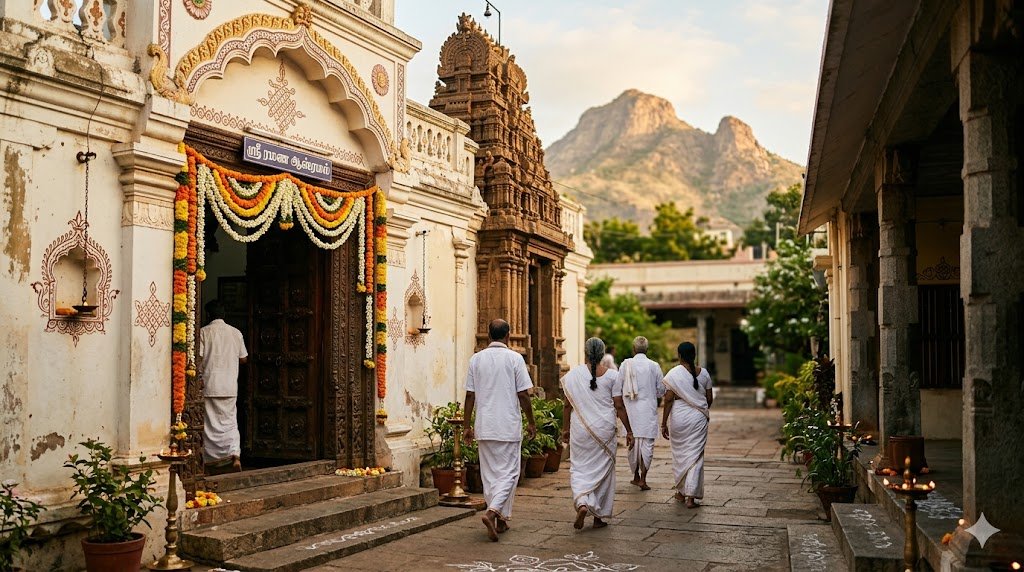
Seshadri Swamigal Ashram preserves the legacy of the saint who revealed Ramana Maharshi to the world. Discover his life, miracles, and visiting details.
Seshadri Swamigal Ashram in Tiruvannamalai stands as a quiet sanctuary on Chengam Road, holding the samadhi of one of the most extraordinary saints South India has ever known. Locals still call him the “Saint with the Golden Hand” — and almost every shop, home, and roadside altar in Tiruvannamalai displays his photograph. However, his real claim to greatness lies elsewhere. He was the saint who first discovered a young Ramana Maharshi meditating in the Patala Lingam vault and revealed him to the world.
This guide walks you through the saint’s full life story, the ashram he left behind, exact darshan timings, accommodation details, and everything a pilgrim needs to know before visiting. Moreover, you will learn the lesser-known miracles, the famous “three lingas of Arunachala” tradition, and insider tips most websites miss.
Quick Summary at a Glance
- Saint: Sri Seshadri Swamigal (1870–1929), known as the Saint with the Golden Hand
- Birthplace: Vazhur village, near Vandavasi, Tiruvannamalai district, Tamil Nadu
- Samadhi: 4 January 1929, at age 59, in Tiruvannamalai
- Ashram location: Chengam Road, Seshadri Nagar, Tiruvannamalai – 606 603
- Timings: 6:00 AM to 12:30 PM, then 3:30 PM to 8:30 PM (office until 9:00 PM)
- Entry: Free for all visitors
- Distance: Roughly 3 km from Tiruvannamalai bus station, adjacent to Sri Ramana Ashram
- Phone: +91-4175-236999, +91-4175-238599, +91-4175-236740
- Famous link: Discovered young Ramana Maharshi in the Patala Lingam vault
Who Was Seshadri Swamigal? The Saint Behind the Ashram
Seshadri Swamigal was a 19th and early 20th century Tamil saint whose spiritual stature in Tiruvannamalai is matched only by Bhagavan Ramana Maharshi himself. Notably, devotees of Arunachala speak of three lingas in Tiruvannamalai — Arunachala the mountain, Ramana Maharshi, and Seshadri Swamigal.
He lived as a wandering ascetic for forty years on the streets of Tiruvannamalai. Furthermore, he never owned a home, never accepted disciples in any formal sense, and refused all worldly comforts. Locals used to call Sri Seshadri “Mother Parvathi” and Sri Ramana “Skanda” (Lord Subramanya) , treating them as mother and son in divine form.
The Birth of Seshadri Swamigal in 1870
Seshadri was born on 22 January 1870 in Vazhur village, near Vandavasi in present-day Tiruvannamalai district. His parents were Varadaraja Sastrigal and Maragatham Ammal, a deeply scholarly couple from Kanchipuram. Additionally, his mother Maragatham was the adopted daughter of the renowned scholar Kamakoti Sastriyar, a celebrated Devi Upasaka.
According to family tradition, the couple remained childless for many years. Therefore, Goddess Kamakshi appeared in a dream and instructed them to consume consecrated butter — soon after, Maragatham conceived. The child was born under the auspicious Hastham nakshatram during Brahma Muhurta, and astrologers predicted he would attain great spiritual heights.
Why He Was Called the “Saint with the Golden Hand”
The nickname has a charming origin story. When Seshadri was just four years old, he visited a shop selling bronze idols with his mother. Surprisingly, after he touched the items, the entire stock sold out within minutes. Meanwhile, similar incidents repeated wherever he went — vendors began competing to hand him items, believing his touch brought instant fortune.
For this reason, the local community gave him the Tamil name Thanga Kai, meaning “Golden Hand.” Even today, devotees believe his blessing brings prosperity and unblocks stuck circumstances.
The Spiritual Journey to Arunachala
Seshadri’s path to Tiruvannamalai began with his mother’s dying wish. As Maragatham lay on her death bed, she called her elder son close and whispered the name “Arunachala” into his ear three times. Consequently, this single moment shaped the rest of his life.
Although he had never visited Tiruvannamalai, he drew the five-peaked Arunachala mountain from memory on a piece of cardboard. Remarkably, the drawing closely resembled the actual mountain. Then he began worshipping that drawing, often from 5:00 AM until noon, fasting for entire days.
Arrival in Tiruvannamalai at Age Nineteen
At nineteen, Seshadri Swamigal walked into Tiruvannamalai and never left. For the next forty years, he lived as a complete renunciate. Specifically, he meditated at Drupadi Amman Koil, Easanyan Mutt, the Durga Amman temple corridor, Kambathu Ilayanar shrine, the Patala Lingam, and the Arunachala Yogiswarar Mandapam.
Interestingly, he never climbed to the top of Arunachala. Instead, he walked the lower slopes, performed pradakshina around the hill, and spent endless hours absorbed in samadhi at temple corners across the town.
How Seshadri Swamigal Discovered Ramana Maharshi
This is the single most important episode in the saint’s public legacy. In 1896, a sixteen-year-old boy named Venkataraman Iyer arrived in Tiruvannamalai from Madurai. Soon after, he disappeared into the Patala Lingam — a windowless underground vault beneath the thousand-pillared hall of the Arunachaleswarar temple.
The boy sat in such deep samadhi that he was unaware of the world around him. Meanwhile, his thighs developed bleeding sores from insect bites. Pus oozed from his legs. Mischievous boys threw stones into the vault from above. Yet Venkataraman did not move, did not speak, and did not eat.
The Saint Who Revealed Ramana to the World
Seshadri Swamigal had already lived in Tiruvannamalai for six years when this happened. Notably, he was ten years older than Ramana. While walking near the thousand-pillared hall one day, he noticed the disturbance and discovered the young boy in samadhi.
According to the well-documented account by Venkatachala Mudali, Seshadri pointed towards the pit and said simply, “Go and see the Chinnaswami there.” That single sentence brought devotees to the vault. Subsequently, they carried the unconscious boy out, cleaned his wounds, and the world later came to know him as Bhagavan Sri Ramana Maharshi.
For this reason, devotees say Seshadri Swamigal “revealed Ramana to the world.” Without his intervention, the boy might have died alone in that dark cellar.
The Big Seshadri and Small Seshadri Tradition
Because the two saints were so close in spirit, locals coined affectionate names for them. Seshadri, being older, became “Periya Seshadri” or “Anna” (elder brother). Similarly, Ramana was sometimes called “Chinna Seshadri” or “Thambi” (younger brother).
Once, a devotee told Ramana that everyone called Seshadri a madman. Ramana smiled and replied that there were three madmen in Arunachala — Seshadri, Arunachaleswarar (the deity), and himself. That answer reveals the depth of mutual respect between the two giants of Tiruvannamalai.
Famous Miracles of Seshadri Swamigal
The saint’s life was filled with strange and miraculous incidents. However, he never claimed any powers and often hid them. Below are some of the most cited episodes from his life.
The Donkeys as Saptarishis
One day, his uncle saw Seshadri performing pradakshina around a group of donkeys and prostrating before them. Naturally, he asked why. The saint replied that the donkeys were actually the seven Saptarishis — Agasthiar, Vashistar, Jamadagni, and the others — and identified each one by name.
The Healing of Subramanya Shastri
Sri Subramanya Shastri once consumed Poornathi Lehiyam medicine despite Seshadri Swamigal warning him not to. As a result, he fell seriously ill. When he reached the Kambathu Ilayanar temple seeking help, Swamigal turned to him without being told anything and said, “I asked you not to consume Poornathi Lehiyam. Why did you eat it in spite of my warning?” That moment convinced Shastri that the saint knew everything happening from a distance.
The Mongoose After His Samadhi
After Seshadri Swamigal’s passing, the caretaker of the Tiruvannamalai burial grounds longed to see him again. The saint had instructed him to go to Vallimalai Swamigal, his disciple. Strangely, every day a mongoose would appear and eat the food kept for the old man. While the caretaker watched devotees singing Thiruppugazh to the mongoose, the animal transformed momentarily into Seshadri Swamigal before vanishing.
Mahasamadhi: The Final Days in 1929
Seshadri Swamigal indicated his approaching end in November 1928. For around forty days, he ran a fever and his body weakened steadily. Despite his reluctance, devotees bathed and dressed him for a final photograph and held a ceremonial honouring. Then, on 4 January 1929, he attained Mahasamadhi at the age of 59.
The funeral procession is remembered as one of the grandest in Tiruvannamalai’s history. Specifically, the entire stock of camphor in the town’s shops was exhausted that night. Buses arrived overflowing with devotees, and the streets glowed with burning camphor like daylight. At Agni Theertham, Sri Ramana Maharshi himself joined the procession to honour his elder companion.
The Seshadri Swamigal Ashram Today
The ashram was constructed at the place where the saint’s mortal remains were interred at the foothills of Arunachala. Importantly, Sri Ramana Maharshi himself supervised the construction of the original samadhi shrine. Later, Ramana chose to live next door, and Sri Ramanasramam developed adjacent to the Seshadri Ashram on Chengam Road.
The Samadhi Shrine and Other Saints
At the heart of the Seshadri Swamigal Ashram lies the central samadhi of the saint. Around it, however, the ashram also enshrines several other realised souls of Tiruvannamalai. These include the samadhis of Sri Kannadi Swamigal, Sri Sadai Swamigal, and Sri Umadevi Ammayar, along with shrines for Dakshinamurthy and Ambal.
Together, these samadhis make the ashram a complete spiritual ecosystem. Pilgrims who do girivalam often pause here for darshan before continuing around the holy mountain.
Facilities Inside the Ashram
The premises include a peaceful garden with cement benches offering a view of Arunachala. Also available are a meditation hall, a homa shala for fire rituals, a small bookstore, a basic canteen, and accommodation rooms for devotees. Additionally, the ashram organises annadanam (free meals), spiritual discourses, and meditation sessions throughout the year.
Visiting Details: Timings, Entry, and Address
Below is a quick reference table covering everything you need before planning your visit to the Seshadri Swamigal Ashram.
| Detail | Information |
|---|---|
| Address | Chengam Main Road, Seshadri Nagar, Tiruvannamalai – 606 603, Tamil Nadu |
| Morning Timings | 6:00 AM to 12:30 PM |
| Evening Timings | 3:30 PM to 8:30 PM |
| Office Hours | 6:00 AM to 9:00 PM |
| Entry Fee | Free |
| Phone | +91-4175-236999, 238599, 236740 |
| seshadhriashram@gmail.com | |
| Distance from Bus Stand | Roughly 3 km |
| Nearby Landmark | Adjacent to Sri Ramana Ashram |
Best Time to Visit Seshadri Swamigal Ashram
The ashram welcomes pilgrims year-round, but certain dates carry special significance. For instance, the Aradhana day — the saint’s samadhi anniversary — falls on the Hastham star in the Tamil month of Margazhi (December–January). Likewise, his birthday is observed on the Hastham star in the month of Thai (January–February).
Furthermore, every full moon night attracts thousands of pilgrims for the famous girivalam pradakshina around Arunachala. Many begin or end their walk with darshan at this ashram.
How to Reach Seshadri Swamigal Ashram
Tiruvannamalai is well-connected by road and rail across Tamil Nadu and neighbouring states. Therefore, reaching the ashram is straightforward regardless of your starting point.
By Train
Tiruvannamalai railway station lies about 3 km from the ashram. Trains from Chennai Egmore, Villupuram, and Vellore halt here. From the station, an auto-rickshaw to the Seshadri Swamigal Ashram costs around ₹80 to ₹120 depending on the time of day.
By Bus
The Tiruvannamalai bus stand operates buses from Chennai (about 185 km), Bengaluru, Vellore, Pondicherry, and Salem. Specifically, state-run TNSTC and SETC buses run frequent services. From the bus stand, take any auto towards Chengam Road or Ramana Ashram — the fare is roughly ₹70 to ₹100.
By Air
The nearest airport is Chennai International Airport, around 200 km away. Alternatively, Bengaluru airport (around 220 km) and Puducherry airport (around 110 km) also serve the route. From any airport, taxis and bus connections take you to Tiruvannamalai in 4 to 5 hours.
Common Mistakes Pilgrims Make at the Ashram
Many first-time visitors leave without experiencing the ashram fully. Here are mistakes worth avoiding.
- Treating it like a hotel. Accommodation is meant for spiritual aspirants, not casual tourists. Therefore, expect basic rooms, no luxury, and a focus on practice.
- Skipping the side samadhis. Most visitors rush to the main shrine and miss Umadevi Ammayar, Kannadi Swamigal, and others. Each one is significant.
- Visiting only during darshan rush. Early morning around 6:30 AM offers the most peaceful experience. The afternoon reopening at 3:30 PM is also calm.
- Ignoring the garden bench view. The cement benches in the garden offer one of the best Arunachala views in town. Sit there for at least 15 minutes.
- Loud conversation. The ashram is a place of meditation. Keep voices low, switch phones to silent, and dress modestly.
Insider Tips for the Seshadri Swamigal Ashram Visit
A few practical pointers that locals and regular pilgrims swear by:
- Combine with Ramanasramam. The two ashrams are next door. Plan a half-day for both, with breakfast at the Ramana canteen and lunch annadanam at Seshadri Ashram.
- Park outside. There is no dedicated car parking. Park near Ramana Ashram and walk across.
- Carry exact change. The bookstore stocks rare biographies and photographs, but card payment is not always available.
- Ask for the homa schedule. If a homa is happening during your visit, witnessing it adds tremendous spiritual depth.
- Visit on Hastham nakshatram days. The saint was born under Hastham. Special poojas happen on these monthly star days.
Nearby Spiritual Sites to Combine with Your Visit
Tiruvannamalai is a complete pilgrimage circuit on its own. While at the Seshadri Swamigal Ashram, consider including these in your trip:
- Sri Ramanasramam — Adjacent to the ashram. Bhagavan Ramana’s samadhi, meditation hall, and old hall are must-visits.
- Arunachaleswarar Temple — Around 2 km away. Contains the Patala Lingam where Ramana was discovered by Seshadri Swamigal.
- Skandashramam and Virupaksha Cave — Halfway up the hill. Where Ramana lived for many years before settling at the foot.
- Girivalam Path — The 14 km circumambulation route around Arunachala, with eight directional lingams.
- Agni Lingam — Close to the ashram. One of the eight lingams of the girivalam route.
Why Seshadri Swamigal Still Matters in 2026
Nearly a century after his samadhi, the saint’s photograph still hangs in countless homes across Tamil Nadu. Why does his memory remain so alive? The answer lies in three things he embodied: total renunciation, deep devotion to Arunachala, and a complete absence of self-promotion.
Modern spiritual culture often celebrates teachers who build institutions and speak in public. Seshadri Swamigal did the opposite. Instead, he wandered the streets, refused disciples, and let his life speak. Consequently, his legacy proves that real spiritual stature does not need a brand. The Seshadri Swamigal Ashram is not a monument to his teachings — there were almost none in written form. It is a monument to a way of being.
The Bottom Line
Seshadri Swamigal Ashram offers something rare in modern pilgrimage tourism — a quiet, unhurried, deeply authentic spiritual space. The saint who lived here was a true mahatma, the one who recognised young Ramana Maharshi when no one else did. His samadhi continues to draw pilgrims who come seeking blessings, peace, and a glimpse of Arunachala from the garden benches.
Plan at least 90 minutes for your visit, combine it with Ramanasramam and the Arunachaleswarar temple, and visit either at 6:30 AM or after 4:00 PM for the calmest experience. Above all, approach the ashram as a place of silence, not sightseeing.
Frequently Asked Questions About Seshadri Swamigal Ashram
Where is the Seshadri Swamigal Ashram located?
The Seshadri Swamigal Ashram is located on Chengam Main Road in Seshadri Nagar, Tiruvannamalai – 606 603, Tamil Nadu. It sits adjacent to Sri Ramana Ashram and is roughly 3 km from the Tiruvannamalai bus stand and railway station. The address makes it easy to combine with a visit to Ramanasramam.
What are the timings of the ashram?
The ashram is open from 6:00 AM to 12:30 PM in the morning and from 3:30 PM to 8:30 PM in the evening. Additionally, the office and accommodation desk operate from 6:00 AM until 9:00 PM. Entry is completely free for all visitors.
Did Seshadri Swamigal really discover Ramana Maharshi?
Yes. In 1896, Seshadri Swamigal found a sixteen-year-old Venkataraman Iyer (later Ramana Maharshi) sitting in deep samadhi inside the Patala Lingam vault of the Arunachaleswarar temple. He alerted devotees, who carried the boy out and cared for him. This single act revealed Ramana to the world.
Is accommodation available at Seshadri Swamigal Ashram?
Yes, basic accommodation is available for genuine spiritual seekers. The rooms are simple and meant for devotees, not tourists looking for hotel-like comfort. Single occupancy is sometimes restricted. Therefore, contact the ashram in advance at +91-4175-236999 to confirm availability.
Why was Seshadri Swamigal called the Saint with the Golden Hand?
At age four, Seshadri visited a shop selling bronze idols with his mother. After he touched the items, the entire stock sold out within minutes. Similar incidents repeated wherever he went, so the Tamil community named him Thanga Kai or “Golden Hand.” Devotees still believe his blessing brings prosperity.
What is the relationship between Seshadri Swamigal and Ramana Maharshi?
The two were contemporaries who lived in Tiruvannamalai during the same era. Seshadri arrived six years before Ramana and was ten years older. Locals called them “Big Seshadri” and “Small Seshadri” affectionately. After Seshadri’s samadhi in 1929, Ramana joined his funeral procession at Agni Theertham and supervised the construction of his samadhi shrine.
When did Seshadri Swamigal attain samadhi?
Seshadri Swamigal attained Mahasamadhi on 4 January 1929 at the age of 59. His samadhi anniversary, called Aradhana, is observed every year in the Tamil month of Margazhi on the Hastham nakshatram. Thousands of devotees attend the special poojas and processions held on that day.

