
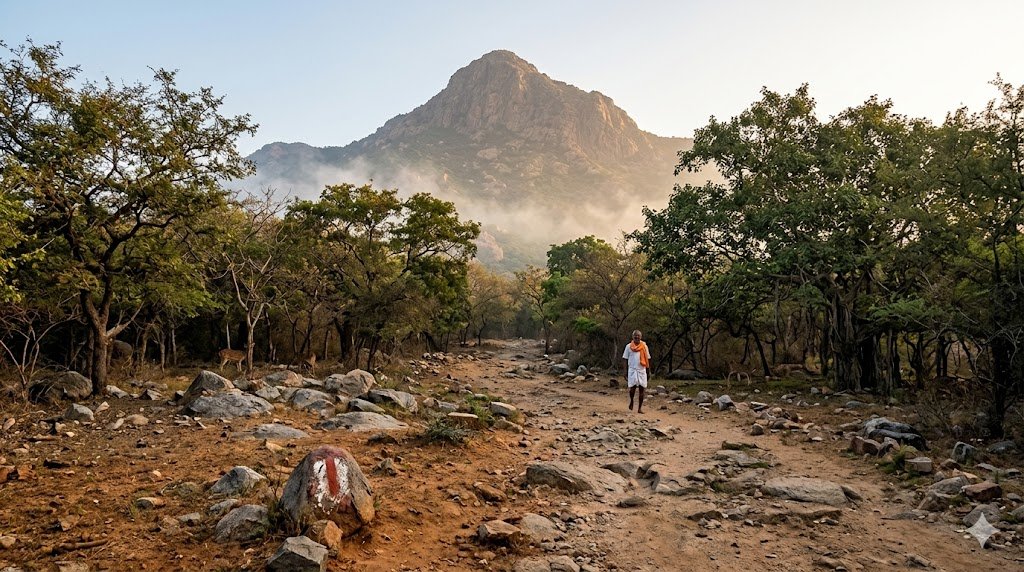
The Inner Girivalam Path Tiruvannamalai winds closer to sacred Arunachala than the outer route. Discover entry points, distances, permits, and safety essentials.
The Inner Girivalam Path Tiruvannamalai is the quieter, wilder, and more spiritually charged alternative to the famous 14 km outer pradakshina road — a sacred trail that hugs the slopes of Arunachala itself, weaving past hidden caves, ancient lingams, and forgotten shrines that most full-moon pilgrims never see. Unlike the asphalt outer road jammed with lakhs of devotees on Pournami nights, this inner trail offers raw silence, leopard sightings, and the kind of direct communion with Bhagavan Arunachaleswara that drew Ramana Maharshi and countless saints up these same slopes. However, walking it today requires understanding forest department rules, current access restrictions, and real safety considerations that the casual blog never mentions.
Moreover, the path is not a single trail — it is a network. There is the Inner Path itself, a parallel “Inner Inner Path” closer to the mountain, the Yellow Path crossing the saddle, and connecting trails to Skandashram, Virupaksha Cave, and the Ashta Lingams. Each carries different distances, different difficulty levels, and different access rules.
Quick Summary: What Pilgrims Need to Know
- Total length: Approximately 10-11 km (shorter than the 14 km outer path)
- Surface: Rough forest track, rocks, dirt — not asphalt
- Time required: 4-6 hours at devotional pace; 3-4 hours brisk walk
- Best season: October to February (cool, dry, no fire risk)
- Forest department status: Restricted during festivals; permits sometimes required
- Best starting point: Sri Ramanasramam back gate, before sunrise
- Footwear: Closed shoes recommended (despite barefoot tradition)
- Wildlife: Spotted deer, peacocks, occasional leopard sightings, snakes
What Makes the Inner Girivalam Path Different from the Outer Road
The outer Girivalam route is a 14 km tarmac loop that follows Hill Round Road, passing through Tiruvannamalai’s busy streets, shops, lodges, and traffic. By contrast, the Inner Girivalam Path Tiruvannamalai cuts through forest reserve land — closer to the mountain by anywhere from 200 to 800 metres, depending on the section.
Specifically, this matters spiritually. Ancient texts and traditional pilgrims consider proximity to Arunachala itself the measure of the pradakshina’s potency. Therefore, walking the inner trail — where the hill’s slopes literally rise beside you — is considered a more intense spiritual experience than the outer road.
Where the Two Paths Diverge
The inner path roughly parallels the outer road but stays inside the reserved forest perimeter. Furthermore, several connecting trails link the two — meaning pilgrims can switch between them depending on energy levels, weather, and forest department checkposts.
| Feature | Outer Path | Inner Path |
|---|---|---|
| Distance | 14 km | 10-11 km |
| Surface | Asphalt road | Forest track, rocks |
| Traffic | Vehicles, crowds | Pedestrians only, mostly empty |
| Eight Lingams | All visible | Reached via short detours |
| Best Time | Pournami nights | Early morning, weekdays |
| Difficulty | Easy, flat | Moderate, uneven terrain |
| Crowd Level | Heavy on full moons | Light to very light |
| Wildlife Encounters | Rare | Common |
The Six Sections of the Inner Girivalam Path Tiruvannamalai
Veteran inner-path walkers traditionally divide the trail into six recognisable sections. Knowing these helps you plan rest stops, water breaks, and which section to attempt if you cannot complete the full circuit.
Section 1: Ramanasramam to Pachaiamman Koil (West Side)
Most pilgrims begin here. Enter through Sri Ramanasramam’s back gate, walk briefly up the path toward Skandashram, then turn left within roughly 100 metres. The trail markers are red and white — the standard inner path symbols painted on rocks and trees.
This first section runs about 2 km through scrubland to Pachaiamman Koil, the temple where Ramana Maharshi reportedly stayed during a plague outbreak in 1905. Notably, the terrain here is mostly flat with some rocky patches.
Section 2: Pachaiamman Koil to Kattu Siva Tank
From Pachaiamman Koil the trail heads roughly south-west, climbing gentle slopes for another 2 km. Kattu Siva Tank — a small stone water tank with a meditation perch nearby — marks the midpoint of the western stretch. Furthermore, this area features the Kattu Siva Cave, where saints have meditated for centuries.
Section 3: Kattu Siva to Adi Annamalai Temple
Here the path crosses one of its most beautiful stretches. The trail winds past primitive Naga shrines, ancient ash piles from saints’ offerings, and occasional clearings where Arunachala’s full western face becomes visible. Distance: approximately 1.5 km. Eventually you emerge near Adi Annamalai Temple — one of the oldest Shiva shrines on the route.
Section 4: Adi Annamalai to North Side (Yellow Path Junction)
Now you turn east. The trail climbs slightly over the saddle of the hill — this is where the “Yellow Path” branches off, offering a steeper but shorter route across Arunachala itself directly to Virupaksha Cave. Most regular pilgrims skip the Yellow Path. Specifically, it requires good fitness and adds significant elevation gain.
Section 5: North Side to Parvati Hill
The northern section is the wildest. Spotted deer are commonly seen here. So are peacocks. Above all, this stretch passes the entrance to the optional “Inner Inner Path” — a roughly 2 km parallel trail that runs even closer to the mountain’s base than the main Inner Path. Yellow and white markers (not red and white) indicate the Inner Inner branch.
Section 6: Parvati Hill back to Ramanasramam
The final stretch curves south through lighter scrub, past Kannapa Temple, and eventually connects back near Children’s Park and Ramana Nagar. From here it is a short walk back to Ramanasramam, completing roughly 10-11 km depending on which inner branches you took.
Forest Department Restrictions: The Critical Reality
This is the section every honest guide must address but few do. Since around 2012, the Tamil Nadu Forest Department has imposed varying levels of restriction on the Inner Girivalam Path Tiruvannamalai. The reasons are real — repeated forest fires, plastic waste accumulation, and wildlife disturbance.
Consequently, access rules have shifted multiple times over the years. As of recent reports, forest guards may stop walkers at certain points, ask about matches or lighters (strictly banned), and occasionally turn back groups that appear ill-prepared. During major festivals like Chitra Pournami, restrictions tighten considerably.
What the Forest Department Banned and Why
In May 2025, during Chitra Pournami when 25 to 30 lakh devotees converged on Tiruvannamalai, authorities imposed strict restrictions on climbing the Arunachala Hills to prevent untoward incidents and safeguard the surrounding forest environment. The Tamil Nadu Forest Department banned public access to the hills, particularly at seven vulnerable locations identified as high-risk zones.
Furthermore, officials confirmed that even entry to the 14-km Girivalam path encircling the Arunachala Hills was restricted, aimed at protecting the reserve forest and its wildlife, including over 5,000 spotted deer. Therefore, the inner path — being more deeply inside the reserve — typically faces tighter restrictions during such peak periods.
Current Access Status: How to Check Before You Go
Above all, do not assume the path is open simply because no signs are posted. Restrictions vary by season, recent fire incidents, and ongoing court orders. Specifically, check the following before planning your trek.
- Call Tiruvannamalai District Forest Office for current access status
- Ask at Sri Ramanasramam reception — they receive daily updates
- Speak with local Indian sadhus or shopkeepers near Ramana Nagar
- Check the Annamalai Restoration Society for any community advisories
- If permits are needed, they are typically issued the day before your walk
Safety Considerations: What Pilgrims Underestimate
The Inner Girivalam Path Tiruvannamalai is not a casual stroll. Despite the spiritual reputation, real safety considerations apply. Several first-time walkers each year experience problems that proper preparation would prevent.
Heat and Dehydration
Tamil Nadu summers (March to June) push temperatures past 38°C on the rocky western slopes. Furthermore, the inner path offers far less shade than the tree-lined outer road. Dehydration is the single most common medical issue.
Carry at least 1.5 to 2 litres of water per person. Naturally, electrolyte powders help. Avoid attempting the full circuit between 10 AM and 4 PM during summer months.
Wildlife Encounters
Snakes — particularly Russell’s vipers and cobras — inhabit the reserve forest. Although attacks are rare, encounters are not. Spotted deer are common. Leopards have been sighted on the north side, though confirmed attacks on humans have not been reported in recent decades.
Stick to marked trails. Make noise as you walk in dense sections. Do not pick up sticks or rocks without checking for snakes underneath.
Getting Lost
Side trails branch off frequently. Cow paths, sadhu paths, and old goat tracks can confuse the unprepared. Above all, the markers (red-and-white for Inner Path, yellow-and-white for Inner Inner Path) can fade or be obscured.
Download an offline map before starting. Tell someone your route and expected return time. If you lose the trail, traditional advice is to walk downhill — you will eventually reach Girivalam Road.
Solo Walking Risks
Although many serious sadhakas walk the inner path alone, this is not advised for first-time visitors. Notably, mobile signal drops in several sections. If you twist an ankle or get heat exhaustion, help may not reach you for hours.
What to Carry on the Inner Girivalam Path
Packing right makes the difference between a transformative experience and a miserable ordeal. Here is the practical kit list from experienced inner-path walkers.
- Water: Minimum 1.5 litres in a reusable bottle
- Electrolyte sachets: 1-2 sachets for hot months
- Light snacks: Dates, nuts, or fruit — nothing that creates wrappers
- Closed footwear: Trekking shoes or sturdy sandals (barefoot is traditional but rough on the path)
- Sun protection: Cap or scarf, especially for the western stretch
- Small first aid kit: Antiseptic, plaster, ankle support
- Mobile phone: Fully charged, with offline map downloaded
- Identification: Carry ID in case forest guards check
- Cash: ₹500 in small notes for chai stalls or emergencies
- Plastic bag: To carry back your own waste
What NOT to Carry
Equally important is what you must leave behind. The forest department enforces these rules through random checks.
- Matches and lighters: Strictly forbidden anywhere on the path
- Cigarettes and tobacco: Banned across the entire reserve
- Plastic water bottles you don’t plan to carry back: Disposal stations are limited
- Loud music devices: Disturbs wildlife and other pilgrims
- Drones: Banned over the reserve forest
- Pet animals: Not permitted on the inner trail
The Eight Lingams Along the Route
The eight Ashta Lingams positioned around Arunachala represent the eight cardinal and inter-cardinal directions. Each is associated with a different celestial guardian. Notably, the inner path reaches most of them via short detours from the outer road.
| Lingam | Direction | Significance |
|---|---|---|
| Indra Lingam | East | Strength, overcoming obstacles |
| Agni Lingam | Southeast | Purification, inner cleansing |
| Yama Lingam | South | Discipline, longevity, protection |
| Niruthi Lingam | Southwest | Freedom from fear, emotional health |
| Varuna Lingam | West | Peace, harmonious relationships |
| Vayu Lingam | Northwest | Health, mental clarity |
| Kubera Lingam | North | Prosperity, financial stability |
| Esanya Lingam | Northeast | Spiritual upliftment, divine grace |
Visiting all eight while walking the inner path adds roughly 1-2 km of detours. Plan accordingly.
Connecting Trails: Skandashram, Virupaksha, and the Caves
One of the inner path’s greatest advantages is access to Arunachala’s sacred caves where Ramana Maharshi lived for over two decades. Specifically, several connecting trails branch upward from the inner route.
Virupaksha Cave
Sri Ramana lived in Virupaksha Cave from 1899 to 1916 — 17 formative years. The cave is approached either from the Arunachaleswara Temple side via a long stone stairway, or from the Ramanasramam side via the back gate path. Furthermore, it sits roughly 400 metres above the inner path level.
Skandashram
Higher up the mountain, Skandashram is where Ramana lived from 1916 to 1922 with his mother. The climb from Ramanasramam takes 30 to 45 minutes for a moderately fit walker. The view of the Arunachaleswara Temple complex from Skandashram is one of the most photographed scenes in Tiruvannamalai.
Other Caves Worth Visiting
Mango Tree Cave, Guhai Namasivaya Cave, Palamaram Ashram and Cave, Banyan Cave, and Tortoise Cave all lie within short detours of the inner path. Visiting these turns a 5-hour pradakshina into a full-day spiritual exploration.
Best Time to Walk the Inner Girivalam Path
Timing affects everything — safety, spiritual experience, and forest department access. Although the Inner Girivalam Path Tiruvannamalai technically remains walkable year-round, certain windows are vastly superior.
By Season
- October to February: Best — cool, dry, low fire risk, full visibility
- March to May: Avoid — extreme heat, peak fire risk, frequent restrictions
- June to September: Mixed — monsoon makes trails slippery but cooler
By Time of Day
Start before sunrise. Specifically, leave Ramanasramam between 4:30 AM and 5:30 AM. The path is coolest, wildlife is most visible at dawn, and you finish before the day heats up. Above all, never start the inner path in the afternoon during dry months — fire risk peaks and forest guards often refuse entry.
Common Mistakes First-Time Inner Path Walkers Make
From speaking with longtime Arunachala residents and Ramanasramam volunteers, certain errors recur predictably among newcomers.
First, attempting the inner path on Pournami night. Crowds spill from the outer road and treat the inner path as overflow space, destroying its silence. Save Pournami for the outer route and walk the inner path on quiet weekdays instead.
Second, going barefoot despite never having walked rough terrain. Ramana’s quote about “one set of dead leather” inspires devotion but punishes unprepared feet. Therefore, wear shoes or strong sandals.
Third, ignoring the forest department entirely. If a guard turns you back, accept it and return another day. Arguing creates problems for future pilgrims and for yourself.
Fourth, carrying water in plastic bottles and discarding them en route. This single behaviour has caused most of the wildlife disturbance complaints and triggered past access restrictions.
The Spiritual Tradition of the Inner Path
Saints throughout the centuries have favoured the inner path. Specifically, Adi Shankaracharya, Guhai Namasivaya, Virupaksha Deva, and Ramana Maharshi all spent significant time on these slopes. The reason is not mystical fancy — it is direct proximity.
Furthermore, the inner trail passes primitive Naga shrines that predate organised temple worship. Old ash piles mark spots where saints performed homa fires. Caves carved by water and wind shelter sadhus who have lived in silence for years. Above all, the inner path is what Arunachala looked like before the town grew up around it.
The Bottom Line
The Inner Girivalam Path Tiruvannamalai is not for the casual full-moon pilgrim — it rewards those who arrive with preparation, respect, and patience. The forest department’s restrictions are real, the wildlife is real, and the spiritual intensity is also real. Choose your season carefully. Walk at dawn. Stay on marked trails. Carry your waste back. Above all, treat the path as the sacred reserve it is — not just a personal shortcut to merit.
If accessing the inner path becomes restricted, do not force entry. Walk the outer road with full devotion instead. Arunachala’s grace flows equally on both. For current updates on access status and trail conditions, consult Sri Ramanasramam directly at sriramanamaharshi.org or the Tamil Nadu Forest Department’s Tiruvannamalai office before planning your trek.
Frequently Asked Questions
Is the Inner Girivalam Path Tiruvannamalai open to all pilgrims?
Access depends on current forest department rules and the time of year. During major festivals like Chitra Pournami, Karthigai Deepam, and other Pournami nights, restrictions tighten significantly. Permits may sometimes be required from the District Forest Office. Check status at Ramanasramam reception or the Forest Office before planning.
How long does the inner path take to complete?
At a devotional pace with stops at lingams and shrines, expect 5 to 6 hours for the full 10-11 km circuit. A brisk walker without stops can finish in 3 to 4 hours. Adding detours to caves like Virupaksha or Skandashram extends the day to 7-8 hours total.
Can I walk the inner path barefoot like the outer Girivalam tradition?
Technically yes, but the inner trail is rocky, thorny, and uneven. Most experienced pilgrims wear closed shoes or sturdy sandals. Ramana Maharshi himself, when asked, said he already wore one set of dead leather (his body) and another set hardly mattered. Choose comfort over symbolism — the spiritual benefit comes from the walk itself.
Are women safe walking the Inner Girivalam Path alone?
Solo walking is generally not advised for first-time visitors regardless of gender. Mobile signal drops in sections, wildlife is real, and trails can confuse newcomers. Women specifically are advised to walk in small groups, start before sunrise alongside other devotees, and inform Ramanasramam or their accommodation of their planned route.
What is the difference between the Inner Path and the Inner Inner Path?
The Inner Path is the main forest trail roughly parallel to the outer Girivalam road, marked in red and white. The Inner Inner Path is a roughly 2 km parallel branch on the north side that runs even closer to Arunachala’s base, marked in yellow and white. The Inner Inner Path was developed around 2010 by Westerners and local volunteers and offers the closest possible proximity to the mountain.
Can I do the Inner Girivalam Path during monsoon season?
It is possible but not advised for inexperienced walkers. Rocks become slippery, leeches appear in some sections, and visibility drops in heavy rain. Furthermore, snake encounters increase during monsoon as cooler weather brings them out. October post-monsoon is the ideal compromise — cooler weather without rain hazards.
Is there any food or water available on the inner path?
No reliable food or water stalls exist along the inner route itself. A few small tea stalls operate near junction points where the inner path meets the outer road, but you cannot count on them. Carry all your water and snacks from the start. Refill points exist near Pachaiamman Koil and Adi Annamalai Temple but should not be relied upon for clean drinking water.

The Tiruvannamalai Devasthanam editorial team is an independent group of writers and researchers documenting pilgrimage to the Arunachaleswarar Temple and Arunachala Hill, Tiruvannamalai. We are not affiliated with the temple or the Tamil Nadu HR\&CE Department. Every darshan timing, festival date and ritual detail we publish is cross-checked against the HR\&CE department, on-the-ground reports and at least two independent sources before it is published, and festival dates are re-verified each year. Spotted an error? Tell us and we will correct it.
