The real answer on the largest Shiva temple India has — comparing Tiruvannamalai’s 25 acres with Chidambaram, Thillai Nataraja, Thanjavur and Thiruvarur rankings.
The question of which is the largest Shiva temple India holds is one of the most debated topics among pilgrims, heritage enthusiasts, and Tamil Nadu travel planners. Tiruvannamalai’s magnificent Arunachaleswarar Temple — popularly called Annamalaiyar Temple — is often crowned as the biggest in the country, yet the reality is more layered. Depending on how you measure “largest” — by area, by tower height, by sanctum size, or by historical stature — the answer shifts dramatically. Let’s settle this with facts, verified numbers, and clear comparisons.
Quick Answer: Is Tiruvannamalai the Largest Shiva Temple in India?
The short answer: No, Tiruvannamalai is not the single largest Shiva temple in India by area. However, it is certainly among the top five largest and holds the distinction of having one of the tallest temple gopurams in the world.
- Tiruvannamalai (Arunachaleswarar): 25 acres — one of the largest, but not the biggest
- Chidambaram Nataraja Temple: 40-50 acres — generally considered the largest Shiva temple in India
- Thiruvarur Thyagaraja Temple: 33 acres — a strong contender, also Shiva-dedicated
- Brihadeeswarar Temple, Thanjavur: Smaller in area but houses the tallest Chola-era vimana
- Verdict: Tiruvannamalai ranks among the top 3-4 largest Shiva temples in India — not the absolute largest
Understanding the Largest Shiva Temple India Claim
Most travel websites casually label Tiruvannamalai as “one of the largest” Shiva temples, and this phrasing gets misquoted as “the largest.” However, when you examine verified data from official tourism boards and Wikipedia sources, a different picture emerges.
The confusion stems from three factors. First, “largest” is rarely defined — area, height, or religious importance all differ. Additionally, Tiruvannamalai’s Rajagopuram is genuinely among the tallest in India at 66 metres. Furthermore, the temple’s fame as a Pancha Bhoota Sthalam (fire element) makes it feel grander than its physical size alone.
Tiruvannamalai Arunachaleswarar Temple: The Real Numbers
Let’s start with verified data from Wikipedia’s Arunachalesvara Temple entry and Tamil Nadu Tourism.
Key Dimensions and Features
| Parameter | Value |
|---|---|
| Total Area | 25 acres (10 hectares) |
| East Wall Length | 700 ft (210 m) |
| West Wall Length | 700 ft (210 m) |
| South Wall Length | 1,479 ft (451 m) |
| North Wall Length | 1,590 ft (480 m) |
| Rajagopuram Height | 66 m (217 ft), 11 stories |
| Rajagopuram Base | 135 ft × 98 ft |
| Number of Gopurams | 9 major gopurams |
| Number of Prakarams | 5 precincts |
Therefore, the temple covers a substantial 25 acres — but this figure is smaller than at least two other Shiva temples in Tamil Nadu alone.
The Actual Largest Shiva Temple India Has: Chidambaram Nataraja
According to multiple sources including Britannica references and heritage listings, the Thillai Nataraja Temple at Chidambaram is generally regarded as the largest Shiva-dedicated temple in India by area.
Chidambaram Temple Key Facts
- Area: 40-50 acres (sources vary between these figures)
- Deity: Lord Nataraja — Shiva’s cosmic dance form
- Pancha Bhoota Sthalam Element: Akasha (ether/sky)
- Major Halls: 5 sabhas — Chit Sabha, Kanaka Sabha, Nritya Sabha, Raja Sabha (1000-pillared hall), Deva Sabha
- Unique Feature: Walls display all 108 Bharatanatyam postures
- Historical Renovators: Chola, Pandya, Vijayanagara and Chera dynasties
Consequently, when pilgrims ask for the single biggest Shiva temple, Chidambaram is the more accurate answer. Nevertheless, Tiruvannamalai remains a close second contender in the physical area comparison.
Thiruvarur Thyagaraja: The Underrated Giant
Another surprise in this ranking is the Thyagaraja Temple at Thiruvarur, which also deserves mention. This Shiva temple complex covers approximately 33 acres — notably larger than Tiruvannamalai.
Interestingly, Thiruvarur features 9 Rajagopurams, 80 vimanas, 12 tall walls, 13 mandapams, and 15 sacred wells. Moreover, it houses 365 Shiva lingas — one for each day of the year. Most people outside Tamil Nadu have never heard this temple ranked higher than Tiruvannamalai, yet in pure square footage, it is.
Where Tiruvannamalai Genuinely Leads: Tallest Gopuram
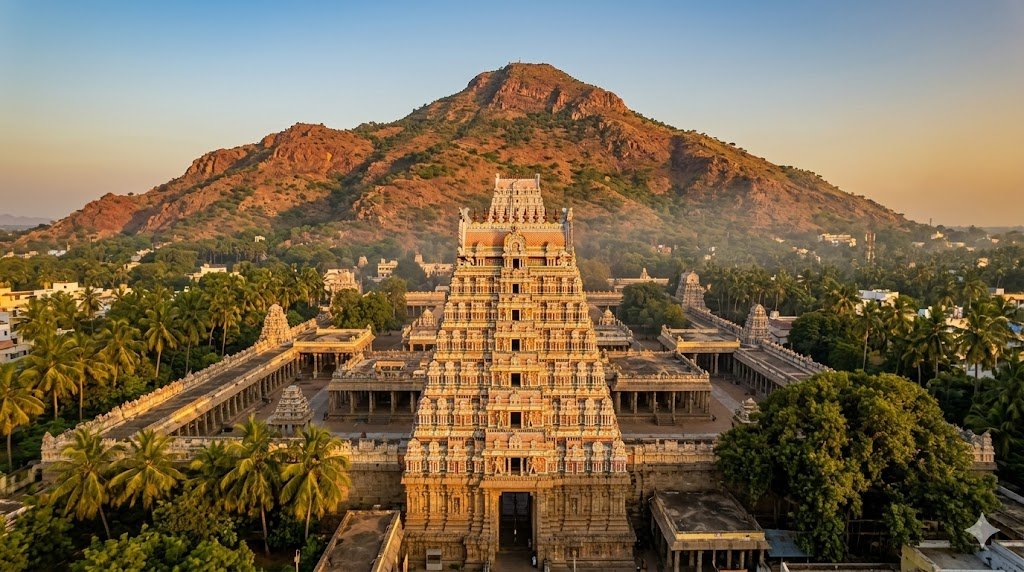
While Tiruvannamalai loses on total area, it scores on one measure that matters enormously to visitors — vertical grandeur. At 66 metres (217 feet), the eastern Rajagopuram is among the tallest temple towers in India.
This tower’s sheer scale is what creates the illusion of “largest.” When you stand at the base and look up, no measurement of acres can match that visual impact. Furthermore, the 11-storey structure took centuries to complete, with major contributions from the Vijayanagara Empire under rulers like Krishnadevaraya.
Tallest Gopurams in Tamil Nadu
| Temple | Location | Tallest Gopuram Height |
|---|---|---|
| Srirangam Ranganathaswamy | Srirangam | 72 m (236 ft) — tallest in Asia |
| Arunachaleswarar | Tiruvannamalai | 66 m (217 ft) |
| Annamalaiyar East Tower | Tiruvannamalai | 66 m (same structure) |
| Meenakshi Amman | Madurai | 51.9 m (170 ft) |
| Brihadeeswarar Vimana | Thanjavur | 66 m (216 ft) |
Therefore, if the question is “tallest Shiva temple gopuram,” Tiruvannamalai ties with Brihadeeswarar at roughly 66 metres — both iconic records.
Head-to-Head Comparison: Top 5 Largest Shiva Temples in India
Here’s a clear side-by-side comparison to settle the debate once and for all:
| Temple | Location | Area | Key Distinction |
|---|---|---|---|
| Thillai Nataraja | Chidambaram, TN | 40-50 acres | Largest Shiva temple by area |
| Thyagaraja Temple | Thiruvarur, TN | 33 acres | 365 Shiva lingas |
| Arunachaleswarar | Tiruvannamalai, TN | 25 acres | Tallest Shiva gopuram (66 m) |
| Ekambareswarar | Kanchipuram, TN | 23 acres | Prithvi (earth) element |
| Brihadeeswarar | Thanjavur, TN | ~16 acres | Tallest Chola vimana, UNESCO |
Clearly, Tiruvannamalai sits at rank 3 by area — impressive, but not the absolute largest.
Why Tiruvannamalai Still Feels Like the Biggest
Having visited both Chidambaram and Tiruvannamalai, first-time pilgrims almost always feel Tiruvannamalai is grander. There are clear psychological reasons for this.
The Arunachala Hill Backdrop
The temple sits at the base of the sacred Arunachala Hill, which rises 800 metres above the surroundings. Consequently, the temple-and-hill combination creates a visual scale no other Shiva shrine can match. Pilgrims complete the 14 km Girivalam (circumambulation of the hill) every full moon — which makes the entire “temple experience” feel vast beyond the 25-acre complex.
The Karthika Deepam Festival Effect
During the annual Karthika Deepam festival (November-December), a massive cauldron is lit atop Arunachala Hill. The flame is visible for kilometres and draws over 10 lakh pilgrims. Naturally, this festival inflates perceptions of the temple’s size and importance far beyond its physical footprint.
The Ramana Maharshi Connection
Additionally, the 20th-century sage Ramana Maharshi lived at Tiruvannamalai for over 50 years. His ashram brought international spiritual seekers, and his writings spread the temple’s fame globally. Therefore, the temple punches far above its weight in global recognition.
Different Ways to Measure “Largest”
The honest truth is that “largest Shiva temple” means different things to different people. Here are six valid ways to measure, and the winner in each category:
By Total Area
Winner: Chidambaram Nataraja Temple (40-50 acres). This is the standard measurement used by heritage agencies.
By Tallest Gopuram
Winner: Arunachaleswarar Temple, Tiruvannamalai (66 m). Among purely Shiva temples, this ties with Brihadeeswarar’s vimana.
By Sanctum Size
Winner: Brihadeeswarar Temple, Thanjavur. It houses one of the largest Shiva lingas in India, standing approximately 12 feet tall inside the sanctum.
By Number of Lingas
Winner: Thyagaraja Temple, Thiruvarur (365 lingas). Additionally, the temple features a massive chariot considered the largest in Asia.
By Historical Age
Winner: Debated between Chidambaram and Tiruvannamalai — both trace roots to the 7th-century Tevaram hymns of the Nayanar saints.
By Pilgrim Footfall
Winner: Arunachaleswarar Tiruvannamalai, especially during Karthika Deepam and monthly Girivalam (full moon) days.
Srirangam: The Hidden Context You Should Know
Before closing the debate, one clarification matters. The Srirangam Ranganathaswamy Temple at Srirangam (156 acres) is frequently called “the largest temple in India” and “the world’s largest functioning Hindu temple.” However, Srirangam is dedicated to Lord Vishnu (Ranganatha), not Shiva. Therefore, it does not enter the “largest Shiva temple” ranking.
Similarly, the Akshardham Temple in Delhi (100 acres) is dedicated to Swaminarayan, not Shiva. Additionally, Angkor Wat in Cambodia is originally Vishnu-dedicated, though it has Buddhist associations today. Consequently, Chidambaram retains its crown specifically within the Shiva temple category.
What This Means for Pilgrims Planning a Visit
If you are choosing where to visit based on grandeur, here is practical guidance. For the single biggest Shiva temple complex, Chidambaram is your destination. However, if you want the most dramatic pilgrimage experience — with a sacred hill, a towering gopuram, and a globally recognised spiritual atmosphere — Tiruvannamalai delivers unmatched impact.
Interestingly, serious pilgrims often combine both. Chidambaram and Tiruvannamalai are only 85 km apart, making a two-temple trip entirely feasible in a single weekend. Furthermore, both temples sit on the same Pancha Bhoota Sthala circuit — Chidambaram represents sky, Tiruvannamalai represents fire.
Looking Ahead: Will the Rankings Change?
Temple sizes are fixed by historical construction, so new physical expansions are unlikely. However, ongoing restoration projects at Chidambaram and Thiruvarur under the Tamil Nadu HR&CE department could alter visitor experiences significantly by 2027. Additionally, UNESCO has been reviewing heritage nominations that may elevate Tiruvannamalai and Chidambaram to World Heritage status, joining Thanjavur’s Brihadeeswarar.
For now, the ranking remains: Chidambaram is the largest Shiva temple in India, Thiruvarur is second, and Tiruvannamalai holds a solid third — backed by the most spectacular vertical architecture of the three.
Step-by-Step: Verify the Largest Shiva Temple India Claims Yourself
If you want to independently verify these rankings, here is the research approach we used:
- Step 1: Check official state tourism websites (Tamil Nadu Tourism, Karnataka Tourism)
- Step 2: Cross-reference Wikipedia entries for each temple’s dimensions
- Step 3: Look for UNESCO World Heritage documentation where applicable
- Step 4: Check Archaeological Survey of India (ASI) records for heritage-listed temples
- Step 5: Compare acre figures consistently (not mixed with hectares or square metres)
- Step 6: Separate Shiva-dedicated temples from Vishnu and other deity temples
- Step 7: Verify gopuram heights from multiple sources for consistency
Following this method exposes misleading claims in travel blogs. Moreover, it builds accurate understanding of Indian temple heritage.
Final Thoughts: The Honest Answer
To wrap this up cleanly — Tiruvannamalai is not the largest Shiva temple in India, but it is among the top three, and it deserves its legendary status for reasons beyond pure acreage. Chidambaram Nataraja holds the area crown. However, Tiruvannamalai’s 66-metre gopuram, sacred hill, and spiritual legacy make it feel unmatched in experience. For the complete Shiva temple journey, visit both — along with Thiruvarur and Thanjavur — and decide for yourself which “largest” truly matters to you.
Frequently Asked Questions
Is Tiruvannamalai the biggest Shiva temple in India?
No, Tiruvannamalai (Arunachaleswarar) Temple is not the biggest Shiva temple by area in India. It covers 25 acres, while Chidambaram Nataraja Temple covers 40-50 acres and Thiruvarur Thyagaraja Temple covers 33 acres. However, Tiruvannamalai has one of the tallest gopurams among Shiva temples at 66 metres.
Which is the largest Shiva temple in India?
The Thillai Nataraja Temple at Chidambaram in Tamil Nadu is generally considered the largest Shiva-dedicated temple in India. It covers approximately 40-50 acres and features five sabha (halls), carvings of all 108 Bharatanatyam postures, and a 1,000-pillared Raja Sabha.
Why do people call Tiruvannamalai one of the largest Shiva temples?
People call Tiruvannamalai one of the largest because it ranks among the top 3-5 Shiva temples by area (25 acres), has one of the tallest gopurams in India (66 metres, 11 stories), and is part of the Pancha Bhoota Sthalams. The sacred Arunachala Hill backdrop makes the complex feel much larger than its acreage.
What is the tallest Shiva temple tower in India?
The Rajagopuram of Arunachaleswarar Temple in Tiruvannamalai stands at 66 metres (217 feet) with 11 stories, making it among the tallest Shiva temple gopurams in India. The Brihadeeswarar Temple’s vimana in Thanjavur is similarly 66 metres tall but is a main temple tower, not a gateway tower.
How does Tiruvannamalai compare to Brihadeeswarar Temple?
Brihadeeswarar Temple at Thanjavur has a smaller area (around 16 acres) but houses one of the largest Shiva lingas in India and a 66-metre vimana. Tiruvannamalai covers 25 acres with a 66-metre Rajagopuram. Brihadeeswarar is a UNESCO World Heritage Site; Tiruvannamalai is not yet listed.
Is Srirangam Temple bigger than Tiruvannamalai?
Yes, Srirangam Ranganathaswamy Temple at 156 acres is far bigger than Tiruvannamalai’s 25 acres. However, Srirangam is dedicated to Lord Vishnu (Ranganatha), not Shiva. Therefore, it does not appear in the “largest Shiva temple” ranking — it is the world’s largest functioning Hindu temple overall.
What is the area of Tiruvannamalai Temple in acres?
The Arunachaleswarar Temple at Tiruvannamalai covers an area of 25 acres (10 hectares). The temple is enclosed by four high stone walls resembling fort ramparts, with the north wall being the longest at 1,590 feet and the south wall at 1,479 feet.

