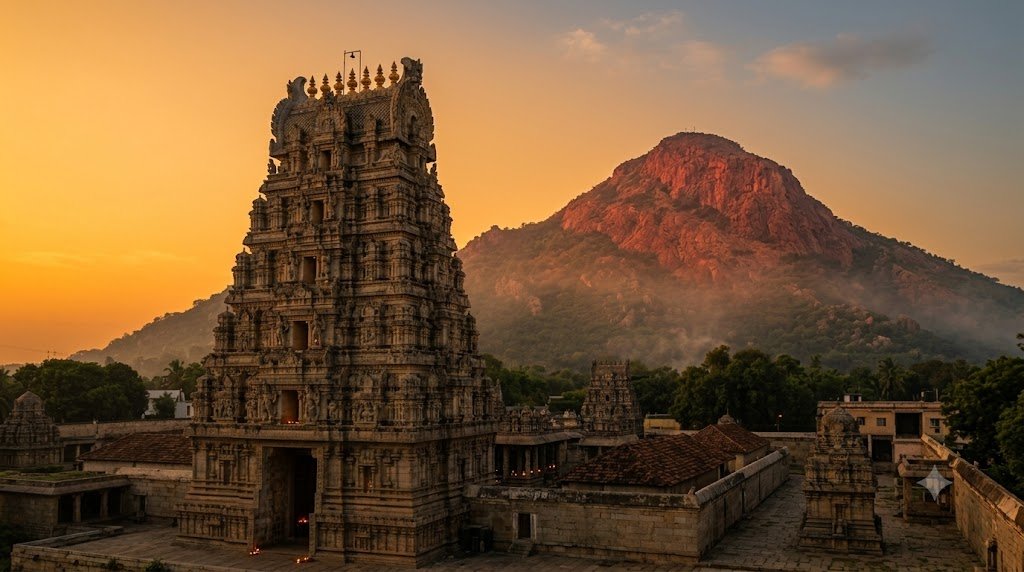
The Ardhanarishvara story Tiruvannamalai holds sacred does not begin in this temple town at all. It begins far north, on Mount Kailash, with a single playful act by Goddess Parvati. That one moment plunged the universe into darkness. To set it right, she travelled south to Arunachala and performed fierce penance. There, Lord Shiva blazed up as a column of fire, then drew her into himself as the half-male, half-female form the world now knows.
Quick Facts at a Glance
- Who: Ardhanarishvara, the composite form of Shiva (right half) and Parvati (left half).
- Where: Arunachaleswarar Temple, at the foot of Arunachala hill in Tiruvannamalai, Tamil Nadu.
- The trigger: Parvati playfully covered Shiva’s eyes, so the world lost all light.
- The merger: Shiva appeared as fire (Agni) atop the hill, then united Parvati into his own body.
- See it live: The Sri Arthanareeswarar idol receives special darshan during Karthigai Deepam, on 24 November 2026.
- Meaning: Purusha and Prakriti, the masculine and feminine forces, shown as equal and inseparable.
What Is the Ardhanarishvara Story Tiruvannamalai Devotees Tell?
The Ardhanarishvara story Tiruvannamalai tells is a tale of error, penance, and divine union. Parvati once covered Shiva’s eyes in jest at Kailash. Because his eyes are the sun and the moon, the cosmos went dark. So she came to Arunachala, did penance, and Shiva merged her into himself as Ardhanarishvara.
This legend matters because it gives Tiruvannamalai two of its deepest identities at once. It explains why the hill is worshipped as fire. It also explains the temple’s bond with the half-woman form of Shiva. Few shrines carry both threads so clearly, which is why pilgrims connect this place so strongly with the merger.
How Parvati’s Penance at Arunachala Led to the Merger
According to the local Sthala Purana, Parvati left Kailash in remorse and descended to earth. She reached the base of the Arunachala hills and began severe tapas, the disciplined penance meant to atone for her mistake. While she meditated, the demon Mahishasura tried to disturb her. In response, she took the fierce form of Durga and destroyed him.
Her victory and her penance together pleased Shiva. So he appeared at the summit of Annamalai hill as a towering pillar of fire. Light returned to the world in that instant. Then, instead of standing apart, Shiva drew Parvati into his own body. The two became Ardhanarishvara, joined down a single line, never to be separated again.
This atonement-and-reunion arc is the spine of the whole legend. Because Parvati’s victory over Mahishasura falls in the same sacred window, many devotees tie it to the Karthigai season. The merger, in this telling, is not just love. It is restoration, after the world was set right.
Why Shiva Appeared as Fire on Arunachala
Shiva chose fire here because Arunachala is the fire shrine among five sacred Shiva sites. These five are the Pancha Bhuta Sthalas, the temples linked to the five great elements. Arunachaleswarar Temple represents Agni, fire, while the others stand for earth, water, air, and ether.
At this temple, Shiva is worshipped as the Agni Lingam, the lingam of fire. The Arunachala hill itself, rising to about 2,668 feet, is revered as a natural lingam. So when the legend says Shiva became a column of flame, it is pointing at the hill you can still see today. The form and the fire are one.
The presiding deity is also praised in the Tevaram, the seventh-century Tamil hymns of the Nayanar saints. That makes Arunachaleswarar a Paadal Petra Sthalam, a temple sung in this revered canon. Such early mentions show how old this fire tradition really is.
What Ardhanarishvara Means: Half Shiva, Half Parvati
Ardhanarishvara means “the Lord who is half-woman,” from ardha (half), nari (woman), and ishvara (lord). The right half of the body is Shiva, with matted hair, the third eye, and a serpent. The left half is Parvati, softer, adorned with jewels and often a lotus.
This split is not random. The right, male side stands for Purusha, the still source of creation. The left, female side stands for Prakriti, nature and active energy. Together they say one thing plainly: creation needs both, as equals. Neither force works alone, which is the lesson the form was made to teach.
| Aspect | Right Half (Shiva) | Left Half (Parvati) |
|---|---|---|
| Principle | Purusha (consciousness) | Prakriti (nature, energy) |
| Marks | Third eye, serpent, matted hair | Jewellery, lotus, anklet |
| Vahana shown | Nandi the bull | Lion (in some depictions) |
| Idea conveyed | The source | The unfolding of creation |
Art historians trace this iconography back a long way. The earliest clear images appear in the Kushan era, around the first century CE. The form was then refined during the Gupta period, so by the medieval age Ardhanarishvara shrines stood across India.
Other Origin Legends of Ardhanarishvara
The fire-merger is the version Arunachala cherishes, yet it is not the only one. The scriptures hold several origin tales, and knowing them deepens any visit. Each story stresses a different truth about the union of Shiva and Shakti.
The Sage Bhringi Legend
Sage Bhringi worshipped only Shiva and refused to honour Parvati. He circled only the male deity, ignoring her completely. So Parvati merged into Shiva, forcing the sage to honour both at once. Bhringi then took a beetle’s form and bored through to circle only the Shiva half. Angered, Parvati cursed him to lose his flesh, and Shiva gave him a third leg to stand.
The Creation Legend from the Shiva Purana
In another telling, Brahma’s male beings could not multiply, so creation stalled. Brahma prayed to Shiva for help. Shiva appeared as Ardhanarishvara, and the female half brought forth the feminine powers needed to continue creation. This version frames the form as the very engine of life.
The Skanda Purana adds a tender version too. Here Parvati asks simply to stay with Shiva forever, embracing him limb to limb. Out of that wish, the joined form is born. Across all of them, the message stays steady: the two are ultimately one.
Where the Ardhanarishvara Story Tiruvannamalai Cherishes Comes Alive
The Ardhanarishvara story Tiruvannamalai cherishes comes alive most powerfully on one night each year. During Karthigai Deepam, the temple’s Sri Arthanareeswarar idol is decorated and brought out for special darshan. As the great fire is lit on the hill, devotees see the merged form below, mirroring the legend in real time.
This is the detail most guides miss. The Mahadeepam on the hilltop is not just a flame. It re-enacts the exact moment Shiva blazed up and absorbed Parvati. So when you view the Arthanareeswarar alankaram while the fire burns above, you are watching the legend staged in front of you.
The festival runs as a ten-day Brahmotsavam, ending on the Mahadeepam day. The huge lamp uses close to 3,500 kg of ghee. Once lit, it glows from the summit and can be seen from many kilometres away. Lakhs of pilgrims gather, since this is one of South India’s largest spiritual gatherings.
For 2026, the Mahadeepam falls on 24 November. Because the temple finalises the daily schedule closer to the date, confirm the timing on the official website before you travel. If you want to feel this legend rather than only read it, this is the night to come.
Tiruvannamalai vs Tiruchengode: Two Homes of Ardhanarishvara
Many readers confuse Tiruvannamalai with Tiruchengode, and the difference is worth clearing up. Tiruchengode, in Namakkal district, has a temple where Ardhanarishvara is the main presiding deity. Tiruvannamalai, by contrast, honours the form through its fire legend and its festival, not as the chief idol.
| Point | Tiruvannamalai | Tiruchengode |
|---|---|---|
| Main deity | Arunachaleswarar (Agni Lingam) | Ardhanareeswarar (presiding form) |
| Ardhanarishvara link | Fire-merger legend + Karthigai darshan | Primary deity of the temple |
| Element / theme | Fire, Pancha Bhuta Sthala | Hill shrine to the half-form |
| Best for | The merger story and the great lamp | Direct worship of Ardhanarishvara |
So which should you visit? If the fire-merger legend draws you, choose Tiruvannamalai, especially at Karthigai Deepam. If you want to stand before Ardhanarishvara as the central deity, Tiruchengode is your shrine. Many devout travellers eventually see both, since each tells the same union from a different angle.
Common Myths About the Ardhanarishvara Story
A few errors circulate widely online, so it helps to correct them. First, the right half is Shiva and the left half is Parvati, not the reverse. Many captions flip this, yet the iconography is fixed.
Second, Ardhanarishvara is not the same as Harihara. Harihara joins Shiva and Vishnu, whereas Ardhanarishvara joins Shiva and Parvati. The two composite forms get mixed up often, although they teach very different ideas.
Third, the form does not mean Shiva “contains” or outranks the Goddess. It means the masculine and feminine are equal and cannot be split. While popular retellings sometimes imply dominance, the scriptures clearly stress balance.
Tips for Experiencing the Ardhanarishvara Story Tiruvannamalai Reveres
Living the Ardhanarishvara story Tiruvannamalai reveres takes a little planning. These practical pointers come from how pilgrims actually approach the hill and the temple.
- Walk the Girivalam: Circle the hill on the roughly 14 km path, ideally on a full-moon night, since this honours the fire-lingam directly.
- Time your darshan: Reach the temple early, because queues swell sharply on full-moon days and during festivals.
- Dress traditionally: Men wear a dhoti or pancha, while women prefer a saree or churidar with dupatta.
- Plan for Karthigai crowds: If you come for the Mahadeepam, book stay months ahead, as lakhs arrive together.
- Look for the Arthanareeswarar idol: Ask temple staff when the merged form is taken out, so you do not miss it.
For the wider picture of the town, our complete Tiruvannamalai and Arunachala pilgrimage guide covers history, ashrams, and how to reach. If you plan to circle the hill, the Giri Pradakshina temples list maps the shrines along the route. To plan your visit inside the main temple, see our darshan timings and booking guide.
You can also verify festival dates and seva details on the official Arunachaleswarar Temple website and through the Tamil Nadu HR&CE department, which administers the shrine.
Before You Go
The Ardhanarishvara story Tiruvannamalai preserves is more than a myth about a careless moment. It binds together the hill, the fire, and the deepest idea in this form: that Shiva and Parvati are one. If you can, plan your trip around Karthigai Deepam, since that is when the legend stops being a story and becomes a sight. Come early, walk the hill, and watch for the merged form. That single night will explain everything the scriptures spend pages describing.
Frequently Asked Questions
What is the Ardhanarishvara story of Tiruvannamalai?
It is the legend that Parvati playfully covered Shiva’s eyes at Kailash, darkening the world. To atone, she did penance at Arunachala. Shiva then appeared as fire on the hill and merged her into himself as Ardhanarishvara, the half-male, half-female form.
Why did Shiva take the Ardhanarishvara form?
Shiva took the form to show that the masculine and feminine forces of creation are equal and inseparable. The right half is Shiva, the source, and the left half is Parvati, the active energy. Together they teach that creation needs both.
Is Ardhanarishvara the main deity at Tiruvannamalai?
No, the main deity is Arunachaleswarar, worshipped as the Agni Lingam of fire. Tiruvannamalai honours Ardhanarishvara through its fire-merger legend and through special Karthigai Deepam darshan, rather than as the chief idol.
When can I see Ardhanarishvara at the temple?
The Sri Arthanareeswarar idol receives special decoration and darshan during Karthigai Deepam. As the Mahadeepam burns on the hill, devotees view the merged form below. For 2026, the Mahadeepam falls on 24 November, though you should confirm the timing with the temple.
What is the difference between Tiruvannamalai and Tiruchengode Ardhanarishvara?
At Tiruchengode, Ardhanareeswarar is the presiding deity of the hill temple. At Tiruvannamalai, the form is tied to the fire-merger legend and the great lamp festival. Choose Tiruvannamalai for the story and the flame, and Tiruchengode for direct worship of the form.
What does the left and right side of Ardhanarishvara represent?
The right side is Shiva, marked by the third eye, serpent, and matted hair. The left side is Parvati, shown with jewellery and a lotus. The right stands for Purusha, consciousness, while the left stands for Prakriti, the energy of creation.
Which Puranas mention the Ardhanarishvara legend?
The form appears in the Shiva Purana, the Skanda Purana, and the Mahabharata. Different texts give different origins, from Brahma’s creation crisis to Parvati’s wish to stay with Shiva forever. The Tiruvannamalai fire version comes from the local Sthala Purana.
Is the Ardhanarishvara story the same as Harihara?
No, the two are different composite forms. Ardhanarishvara joins Shiva and Parvati as half-male and half-female. Harihara joins Shiva and Vishnu in one body. People confuse them often, yet they carry separate meanings.

Independent pilgrim guide for Arunachaleswarar Temple, Tiruvannamalai. Darshan timings, Girivalam dates, pooja booking, accommodation, festival schedules, and devotee guidance for visitors.
