Annabhishekam Arunachaleswarar Temple ritual on Aippasi Pournami — discover the rice abhishekam procedure, timings, 2026 date, benefits, and how to participate.
The Annabhishekam Arunachaleswarar Temple ritual is the one day each year when the Agni Linga at Tiruvannamalai is buried under a thick blanket of fragrant cooked rice — and devotees travel from across Tamil Nadu, Karnataka, Andhra Pradesh, and overseas to witness it. Most pilgrims have seen photos of the white rice mound covering the lingam. However, few understand why this particular abhishekam is treated as the most spiritually charged of the entire Tamil year.
This guide walks through everything that matters about the rice abhishekam at Annamalaiyar temple — the Aippasi Pournami timing, the exact procedure inside the sanctum, the supporting pachadi offering, sponsorship options, the spiritual meaning according to Saiva tradition, and what to expect when you visit in 2026.
Quick Summary: Annabhishekam Key Facts
- Ritual: Cooked rice abhishekam covering the Shiva Lingam
- Temple: Sri Arunachaleswarar Temple (Annamalaiyar Temple), Tiruvannamalai
- Date: Aippasi Pournami — falls on Sunday, October 25, 2026
- Rice used: Over 25 kilograms of cooked rice per ritual
- Side offering: Mizhagai pachadi (ladies finger, cluster beans, ginger, green chillies)
- Devotee darshan: Allowed after 6:00 PM on the Annabhishekam day
- Significance: Removes doshas, ensures food abundance, dissolves karma
- Mantra: “Om Sri Annabhisheka Shivaya Namo Namaha”
What Is Annabhishekam? The Meaning Behind the Ritual
The word breaks into two parts. “Annam” means cooked rice in Sanskrit and Tamil, and “Abhishekam” means the ceremonial bathing or hydration of a deity. Therefore, Annabhishekam literally translates to “the rice-bath of the deity.” Specifically, it is the act of completely covering the Shiva Lingam with mounds of freshly cooked white rice, decorated with vegetables, fruits, and a special pachadi.
Across Tamil Nadu, this is the most distinctive of all the abhishekams performed for Lord Shiva. Furthermore, ancient Saiva texts describe rice as the symbol of life, abundance, and the sustaining power of the Divine. As a result, devotees believe that bathing the Lingam in rice invokes Shiva’s grace specifically for food security, prosperity, and the removal of obstacles tied to material survival.
Why Rice Holds Such Spiritual Weight
In Saiva Siddhanta, food is treated as Annam Brahman — the manifest form of the Divine that sustains all life. Consequently, offering Shiva the very substance that keeps all beings alive is seen as the highest acknowledgment of his role as the protector of creation. Notably, the saying goes: “Where there is rice, there is heaven.” Those who witness Annabhishekam are believed to be assured of never facing food scarcity.
Why Arunachaleswarar Temple Is the Most Sacred Venue
The Arunachaleswarar Temple at Tiruvannamalai is one of the five Pancha Bhuta Sthalams, representing the element of fire (Agni). Shiva here is worshipped as the Agni Lingam — the fire form. Therefore, performing a rice abhishekam at this fire temple carries unique symbolism. Rice is the product of fire’s transformation (cooking), and offering it back at the fire lingam closes the cosmic cycle of nourishment.
Moreover, the temple ranks among the largest Shiva temples in India, with six prakarams and the towering Annamalai hill itself considered a manifestation of the Lord. As a result, Annabhishekam here is celebrated on a scale unmatched by any other Tamil Nadu temple — with elaborate preparation, mass darshan, and prasadam distribution to thousands.
The Connection to Aippasi Pournami
The ritual is performed strictly on the full moon day (Pournami) of the Tamil month of Aippasi, which corresponds to mid-October through mid-November. Specifically, in 2026 the Aippasi month runs from October 18 to November 16, and the Pournami within this period falls on Sunday, October 25, 2026. The tithi begins at 11:31 AM on October 25 and ends at 10:14 AM on October 26.
The Annabhishekam Procedure: What Happens Inside the Sanctum
The actual ritual unfolds across several hours and follows a strict Agama-based sequence. While the public darshan window opens only after 6:00 PM, the preparation begins much earlier in the day.
Stage 1: Traditional Abhishekams
The day starts with the standard 11 sacred abhishekams. Specifically, the priests bathe the lingam with milk, curd, ghee, honey, sugar, tender coconut water, sandalwood paste, vibhuti, panchamrita, rosewater, and finally pure water. Each abhishekam is accompanied by Sri Rudram and Chamakam chanting. Furthermore, this stage cleanses and consecrates the lingam before the rice covering begins.
Stage 2: Cooking the Sacred Rice
Over 25 kilograms of rice are cooked in the temple kitchen under traditional Saiva protocols. The rice is cooked in pure water, without any oil, ghee, or salt. Additionally, the chefs are instructed to keep silence and chant mantras throughout the cooking. The rice must be fluffy, dry enough to hold shape, yet soft enough to be moulded.
Stage 3: Mounding the Rice on the Lingam
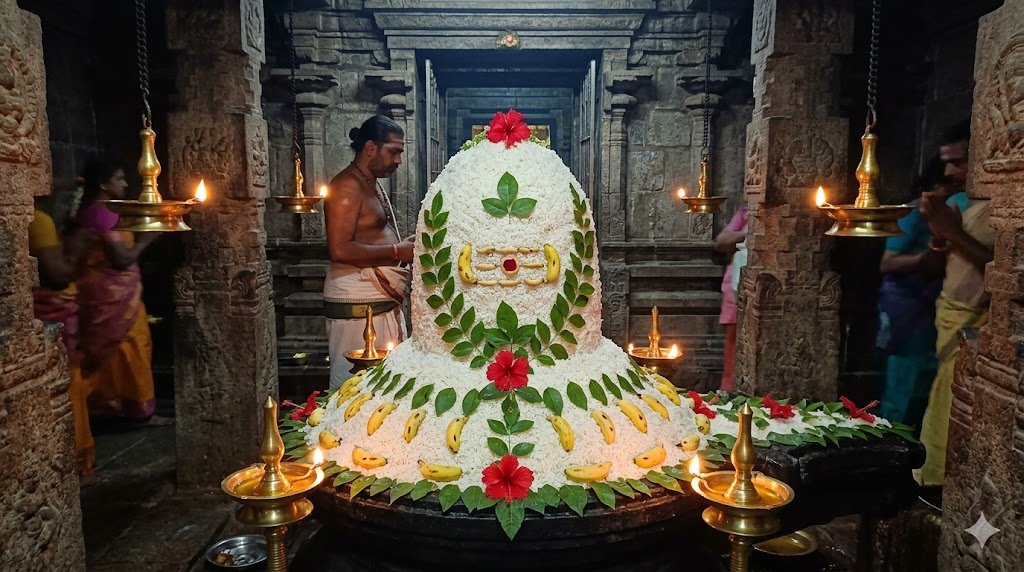
This is the dramatic centrepiece of the ritual. Priests carefully pack the cooked rice around and over the Shiva Lingam, building it into a smooth white mound that completely covers the deity. Specifically, the mound is shaped to mirror the form of the lingam itself, with the rice rising to a peak. As a result, the entire lingam vanishes under a fragrant white blanket.
Stage 4: The Mizhagai Pachadi Offering
Alongside the rice, a special vegetable preparation is offered — known as mizhagai pachadi or chilli pachadi. Specifically, it is made with ladies finger (vendakkai), cluster beans (kothavarangai), green chillies, and ginger. This pachadi is placed at the base of the rice mound, completing the meal-form of the offering. Moreover, the combination represents a complete south Indian thali offered to the Lord.
Stage 5: Decoration and Final Alankaram
Once the rice mound is shaped, priests decorate it with bilva leaves, hibiscus and lotus flowers, banana, tender coconut, and other fruits. Additionally, vibhuti and kumkum are applied at the peak. Lamps are lit around the sanctum, and a final aarti is performed. Then, the doors open for public darshan.
Pidari Amman Offering: The Companion Ritual
A separate but linked offering is made to Pidari Amman, worshipped in the third prakaram of the temple. Specifically, around 7:30 PM on the same evening, the Goddess receives her own naivedyam consisting of vadai, rice, pachadi, two vegetable curries, and sweet payasam. As a result, the ritual honours both the Shiva and Shakti principles on the same day, completing the cosmic offering.
Spiritual Benefits Devotees Believe Follow
Annabhishekam is regarded across Saiva tradition as one of the most karma-dissolving rituals in the Hindu calendar. Specifically, devotees attribute the following benefits to witnessing or sponsoring the ritual.
| Benefit Category | What Devotees Seek |
|---|---|
| Material Prosperity | Removal of food scarcity, financial stability, business growth |
| Karma Reduction | Dissolution of accumulated past-life karmic burden |
| Health | Relief from chronic ailments, particularly digestive issues |
| Family Welfare | Harmony, longevity for family members, child blessings |
| Spiritual Progress | Deepened sadhana, removal of obstacles to spiritual practice |
| Dosha Nivarana | Relief from planetary doshas affecting daily life |
Importantly, ancient texts hold that the very sight of the rice-covered lingam grants the devotee assurance of food, shelter, and dignity in this lifetime. Furthermore, the prasadam distributed afterward is considered uniquely potent.
How Devotees Participate: Sponsorship and Darshan
There are two ways to participate in the Annabhishekam Arunachaleswarar Temple ritual — as a sponsor or as a darshan devotee. Each carries its own value and approach.
Sponsoring the Ritual
The temple administration permits devotees to sponsor the Annabhishekam through official ticket counters at the Arunachaleswarar Temple. Specifically, sponsorship rates vary by category and are best confirmed by calling the temple office directly or visiting the official Tamil Nadu HR&CE temple management portal. Furthermore, sponsoring devotees may be given closer-distance darshan and additional prasadam.
Bookings open well before Aippasi Pournami each year, and slots fill quickly. Therefore, prospective sponsors should contact the temple at least 30 days in advance. Several pooja organisations also offer proxy sponsorship for devotees living overseas who cannot travel to Tiruvannamalai.
Attending the Public Darshan
For most devotees, the darshan window after 6:00 PM is the primary way to participate. Specifically, the rice-covered lingam remains visible to the public throughout the evening. The same rice and pachadi is later distributed as prasadam. Moreover, anyone consuming this prasadam is believed to be freed from food scarcity through the year ahead.
Step-by-Step Guide for First-Time Visitors
- Arrive in Tiruvannamalai by the morning of Aippasi Pournami day (October 25, 2026)
- Check into accommodation early — hotels fill up fast for this festival
- Take darshan of Lord Arunachaleswarar in the morning, before the special abhishekams begin
- Use the afternoon to perform Giri Pradakshina (the 14-km circumambulation of Annamalai hill)
- Reach the temple by 5:30 PM to secure a position for the evening darshan
- Enter through the main eastern gopuram, follow signage to the inner sanctum
- Witness the rice-covered lingam, offer your silent prayer, accept prasadam
- Visit Pidari Amman shrine in the third prakaram for the evening Goddess offering
What to Wear and Carry
The temple follows the traditional Tamil Nadu Shiva temple dress code. Specifically, men should wear a dhoti or veshti with an angavastram, and women should wear a saree or chudidar with dupatta. Furthermore, footwear, leather items, and cameras are not permitted inside the sanctum complex.
Mobile phones may be carried but should be switched off in silent mode and not used near the sanctum. Additionally, carry a small cotton bag for prasadam, drinking water, and some cash for offerings or donations.
Items to Avoid Bringing
- Plastic-wrapped commercial flower garlands — remove wrapping before entry
- Leather wallets, belts, or handbags
- Non-vegetarian food or alcohol in any form
- Loud electronic devices, speakers, or recording equipment
- Large luggage — temple does not provide secure cloak rooms during festival days
Temple Timings on Annabhishekam Day
| Time Slot | Activity |
|---|---|
| 5:30 AM – 12:00 PM | Regular morning darshan and standard abhishekams |
| 12:00 PM – 4:00 PM | Sanctum closed for Annabhishekam preparation |
| 4:00 PM – 6:00 PM | Rice mounding and final alankaram (priests only) |
| 6:00 PM onwards | Public darshan of the rice-covered lingam begins |
| 7:30 PM | Pidari Amman naivedyam offering in the third prakaram |
| 8:30 PM – 10:00 PM | Prasadam distribution and evening aarti |
Note that these timings can shift slightly each year based on tithi calculations and temple administration decisions. Therefore, devotees should confirm current schedules with the temple office before traveling.
The History and Legend Behind Annabhishekam
Saiva Siddhanta texts trace the practice back to the Tamil Pallava and Chola dynasties, when temple worship was being codified into the Agama tradition. Specifically, the Aippasi Pournami abhishekam evolved from the agricultural calendar — Aippasi marks the period when the rice harvest is brought home in Tamil Nadu. As a result, offering the first abundance of the new harvest to Shiva became the natural devotional practice.
Moreover, the great Tamil saint Manickavasagar references food offerings to Shiva in his hymns of the Tiruvasagam. Additionally, the four Saiva saints Appar, Sambandar, Sundarar, and Manickavasagar all sang of Arunachaleswarar — placing this temple at the heart of the Tamil Saiva canon known as Tirumurai.
Common Mistakes Devotees Make
- Arriving on the wrong day: The ritual happens only on Aippasi Pournami, not the entire month
- Trying to enter before 6:00 PM: The sanctum is closed for preparation in the afternoon
- Skipping the Pidari Amman shrine: The Goddess offering completes the ritual cycle
- Not staying for prasadam: The rice prasadam is the spiritual takeaway of the day
- Forgetting Giri Pradakshina: Pournami at Arunachala is incomplete without circumambulating the hill
- Booking last-minute stays: Hotels in Tiruvannamalai run full a month before Aippasi Pournami
What to Expect at the 2026 Annabhishekam
The 2026 Annabhishekam at Arunachaleswarar Temple falls on Sunday, October 25 — a weekend, which means significantly higher attendance than usual. Therefore, expect dense crowds, longer darshan queues, and stricter temple management protocols. Furthermore, the Tamil Nadu Hindu Religious & Charitable Endowments Department typically announces additional crowd-control measures closer to the date.
Looking forward, the temple administration has been expanding live-streaming arrangements for major festivals — which means devotees unable to travel can watch the ritual online through official channels. Additionally, prasadam shipping arrangements via authorised proxies have become more reliable for the diaspora.
How to Reach Arunachaleswarar Temple
Tiruvannamalai is well-connected to all major south Indian cities. Specifically, the most common route is from Chennai (about 185 km by road, 3.5 hours) via Tindivanam. Furthermore, from Bengaluru, the journey is roughly 210 km via Krishnagiri. From Tirupati, devotees can travel via Vellore.
| From | Distance | Mode |
|---|---|---|
| Chennai | 185 km | Road (3.5 hrs), Train |
| Bengaluru | 210 km | Road (4 hrs) |
| Vellore | 80 km | Road (1.5 hrs) |
| Tirupati | 160 km | Road (3 hrs) |
| Pondicherry | 110 km | Road (2.5 hrs) |
The nearest railway station is Tiruvannamalai Railway Station, well-connected to Villupuram, Katpadi, and Chennai Egmore. Additionally, the nearest major airports are Chennai International (185 km) and Bengaluru International (220 km). Local autos and taxis are readily available from the bus stand and railway station.
The Bottom Line
The Annabhishekam Arunachaleswarar Temple ritual is the spiritual high point of the Tamil pilgrimage year for Shaiva devotees. Specifically, witnessing the Agni Lingam buried under fragrant white rice on Aippasi Pournami is considered both a karmic cleansing and a guarantee of food security for the year ahead. Furthermore, the combination of the rice mound, the mizhagai pachadi, and the Pidari Amman offering creates a complete cosmic exchange between devotee and Lord.
For 2026, mark Sunday, October 25 on the calendar. Arrive in Tiruvannamalai by morning, complete Giri Pradakshina in the afternoon, secure your darshan spot by 5:30 PM, and witness the ritual that has nourished Tamil devotion for over a thousand years. Carry home the prasadam — it is meant to last you the entire year.
Frequently Asked Questions
When is Annabhishekam at Arunachaleswarar Temple in 2026?
Annabhishekam at Arunachaleswarar Temple in 2026 falls on Sunday, October 25 — the Aippasi Pournami day. The full moon tithi begins at 11:31 AM on October 25 and concludes at 10:14 AM on October 26. Public darshan of the rice-covered lingam begins after 6:00 PM.
Can I sponsor the Annabhishekam ritual personally?
Yes, devotees can sponsor the Annabhishekam through official counters at the Arunachaleswarar Temple. Furthermore, advance booking is recommended at least 30 days before Aippasi Pournami. The temple administration also accepts proxy sponsorships from devotees living overseas through authorised channels.
How much rice is used in the Annabhishekam?
More than 25 kilograms of cooked rice are used to cover the Shiva Lingam during the Annabhishekam at Arunachaleswarar Temple. Additionally, the rice is cooked without salt, oil, or ghee in the temple kitchen under traditional Saiva protocols, accompanied by mantra chanting throughout.
What is the significance of Annabhishekam?
Annabhishekam symbolises gratitude to Lord Shiva as the sustainer of all life through food. Specifically, rice represents prosperity, abundance, and the fundamental nourishment of creation. Devotees believe witnessing or sponsoring the ritual removes karma, ensures food security, and grants relief from doshas.
Is Annabhishekam performed in other Shiva temples?
Yes, Annabhishekam is performed on Aippasi Pournami across all major Shiva temples in Tamil Nadu — including Chidambaram Natarajar Temple, Thanjavur Brihadeeswarar Temple, and Madurai Meenakshi Temple. However, the Arunachaleswarar Temple celebration is regarded as the grandest because of its Agni Linga status.
Can devotees take the rice prasadam home?
Yes, the rice and pachadi used in the Annabhishekam is distributed as prasadam to devotees who attend the evening darshan. Furthermore, this prasadam is considered uniquely potent. Devotees traditionally consume it within a day or share it with family members who could not attend.
What should I wear for Annabhishekam darshan?
Men should wear a traditional dhoti or veshti with an angavastram. Women should wear a saree or chudidar with dupatta. Additionally, footwear and leather items are not permitted inside the sanctum complex. Plain cotton attire in white, cream, or saffron is most appropriate for the occasion.

The Tiruvannamalai Devasthanam editorial team is an independent group of writers and researchers documenting pilgrimage to the Arunachaleswarar Temple and Arunachala Hill, Tiruvannamalai. We are not affiliated with the temple or the Tamil Nadu HR\&CE Department. Every darshan timing, festival date and ritual detail we publish is cross-checked against the HR\&CE department, on-the-ground reports and at least two independent sources before it is published, and festival dates are re-verified each year. Spotted an error? Tell us and we will correct it.
