
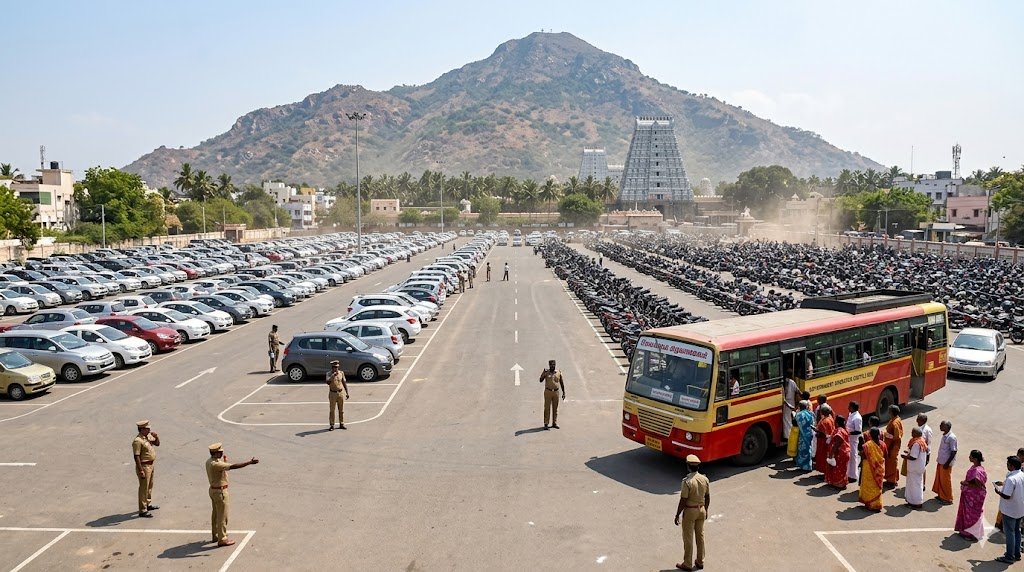
A practical Tiruvannamalai parking guide covering temple lots, Girivalam restrictions, Pournami rules, festival shuttles, and pilgrim-friendly walking routes.
The Tiruvannamalai parking guide most pilgrims wish they had read before driving in usually arrives too late — after circling Car Street for an hour, getting flagged by traffic police, or paying ₹200 to a random “agent” near East Gopuram. This sacred town hosts the 25-acre Arunachaleswarar Temple, lakhs of monthly Girivalam walkers, and a festival circuit that draws 30 lakh devotees on Karthigai Deepam alone. However, the parking system here is far more organised than first-time visitors realise. You just need to know which lot opens when, what gets blocked off on Pournami, and how the 90+ designated parking zones connect to shuttle buses. This guide breaks it all down.
Quick Summary at a Glance
- Normal-day parking: Temple-managed lots near East Gopuram, ₹20-50 for two-wheelers, ₹50-100 for cars
- Pournami restrictions: Vehicle entry banned within 1 km of temple from 4 PM onwards
- Festival parking: 90+ designated zones spread across 11 roads leading into the town
- Karthigai Deepam capacity: 120 parking spaces holding around 20,095 cars
- Shuttle service: Free government and private buses connect outer parking zones to temple
- Best alternative: Park at hotel, walk or take auto to the temple complex
- Avoid: Roadside parking — towing and fines are enforced strictly on festival days
Why Tiruvannamalai Parking Needs Its Own Guide
Most South Indian temple towns have one or two main parking lots. Tiruvannamalai is different. The Arunachaleswarar Temple sits in the heart of an old town surrounded by narrow streets — Car Street, Sannadhi Street, Thirumanjana Gopuram Street — that simply cannot absorb modern vehicle flow.
Furthermore, the 14-kilometre Girivalam path circles Arunachala Hill through the same road network. Therefore, every full moon night turns the town into a closed pedestrian zone. Add festivals like Karthigai Deepam, Chitra Pournami, and Maha Shivaratri, and the parking logic shifts completely from “where can I park near the temple” to “where can I park anywhere and which shuttle do I take.”
Three Different Parking Realities
Specifically, this Tiruvannamalai parking guide deals with three distinct scenarios. First, normal weekdays when the town functions like any other temple town. Second, Pournami nights when Girivalam restrictions kick in. Third, major festival days when the entire town becomes a managed parking grid.
Normal-Day Parking Near Arunachaleswarar Temple
On a regular weekday or weekend without a Pournami, parking is straightforward. The temple complex maintains its own parking facility on the periphery. Additionally, several private parking lots operate in the streets surrounding the East Gopuram, the main entrance for pilgrims.
Temple Premises Parking
The Arunachaleswarar Temple has dedicated parking areas managed by the Hindu Religious and Charitable Endowments (HR&CE) department. These lots accommodate both two-wheelers and four-wheelers. However, during festival seasons and special occasions, parking can fill up by mid-morning, so arriving early matters.
The parking rates remain modest. Two-wheelers typically cost ₹20-30, while cars run ₹50-100 depending on duration. Notably, the lots stay open from 5:00 AM to about 10:00 PM, aligned with temple darshan hours.
Streets Around the East Gopuram
The temple’s main entrance opens onto East Gopuram Street, which connects to Car Street and Sannadhi Street. Although these streets host over 50 small devotional-item shops, they offer almost no dedicated parking. Walking distance from the bus stand via Car Street takes about 20 minutes. As a result, most pilgrims park near the bus stand and walk or take a quick auto-rickshaw ride for ₹50-80.
Private Parking Lots Around the Bypass Road
For pilgrims arriving with their own vehicles, the Bypass Road area offers safer parking with attendants. Locations along Thamarai Kulam Kodi Thandarampet Road, Mathalangulam, and the Vediyappan Kovil street complex operate paid lots throughout the day. Generally, these charge ₹50-80 for cars and ₹20-30 for two-wheelers.
Pournami Parking Rules and Restrictions
Every full moon night, lakhs of devotees walk the 14-kilometre Girivalam path around Arunachala Hill. Consequently, vehicle movement near the temple is restricted to allow the safe flow of foot pilgrims.
The 4 PM Vehicle Cut-Off
Local authorities restrict vehicle entry within 1 kilometre of the temple from 4:00 PM onwards on Pournami days. After this cut-off, only emergency vehicles, police, and authorised media vehicles can enter the inner zone. Therefore, planning your arrival before 3:00 PM is critical if you want to drive close to the temple.
For those arriving after 4 PM, the only option is to park at designated outer lots and walk or use shuttle services. Furthermore, this restriction usually extends until early Sunday morning following Pournami night, depending on crowd density.
Designated Pournami Parking Lots
The Tiruvannamalai municipality and police designate temporary parking zones on Pournami nights. These are mostly along the Chengam Road, Vellore Road, Tindivanam Road, and Ring Road perimeters. Each lot charges ₹20-50 for the full night for cars and ₹10-20 for two-wheelers.
Pournami 2026 Calendar Dates
Plan your Tiruvannamalai parking guide consultations around these high-crowd dates. Pournami nights in 2026 fall on January 3, February 1, March 3, April 1, April 30 (Chitra Pournami), May 30, June 29, July 29, August 27, September 26, October 25, November 24, and December 23. Above all, Chitra Pournami draws the biggest non-Karthigai-Deepam crowd of the year.
Festival Parking: Karthigai Deepam, Chitra Pournami & Maha Shivaratri
Major festivals transform parking into a town-wide managed operation. The municipality, police, temple administration, and traffic department coordinate to handle massive vehicle inflow.
Karthigai Deepam Parking Setup
Karthigai Deepam is Tiruvannamalai’s biggest festival, drawing approximately 30 lakh devotees over 10 days. For Karthigai Deepam, around 120 designated parking spaces hold about 20,095 cars across 11 distinct zones spread across the town’s road network. The zones include Inside Tiruvannamalai Town, Vellore Road, Avalurpet Road, Tindivanam Road, Vettavalam Road, Thirukovilur Road, Manalurpet Road, Thandrampet Road, Chengam Road, Kanji Road, and the Ring Road.
Chitra Pournami 2026 Arrangements
For Chitra Pournami on April 30 and May 1, 2026, around 90 designated parking locations have been arranged across major entry routes, with strict bans on roadside parking and penalties enforced for violators. Specifically, six parking locations have been arranged on Vellore Road, ten on Tindivanam Road, ten on Chengam Road, thirty along the Ring Road, and another ten within town limits.
Additionally, 16 temporary bus stands have been set up across the town, with all buses required to stop only at designated temporary bus stations. Vellore Road buses arriving from Vellore, Tirupati, Chittoor, Arcot, and Arani stop at Anna Arch Bus Stand. Chennai and Puducherry buses arriving via Tindivanam Road stop at the New Central Bus Stand. Bengaluru, Salem, and Coimbatore buses from Chengam Road use multiple temporary parking lands near the Girivalam path.
Shuttle Bus Services
Free government and private shuttle buses operate from outer parking zones to the main temple area at regular intervals. These shuttles run throughout festival days and Pournami nights. As a result, pilgrims can park 5-10 kilometres away from the temple and still reach the entrance within 15-20 minutes by shuttle.
Parking Zones by Entry Route
The town has 11 main road approaches, each with its own designated parking arrangement during festivals and Pournami days. Here is a quick reference table.
| Entry Route | Bus Stand | Parking Zones | Best For Pilgrims From |
|---|---|---|---|
| Vellore Road | Anna Arch Bus Stand | 6 locations | Vellore, Tirupati, Chittoor, Arcot |
| Tindivanam Road | New Central Bus Stand | 10 locations | Chennai, Puducherry |
| Chengam Road | Near Girivalam Path | 10 locations | Bengaluru, Salem, Coimbatore |
| Avalurpet Road | Near Kiliyapattu Village | Multiple | Kanchipuram, Vandavasi |
| Tirukovilur Road | Aravindan Nagar, Municipal Grounds | Multiple | Southern Tamil Nadu districts |
| Ring Road | Distributed Stops | 30 locations | All routes (overflow) |
Importantly, the Ring Road parking zones absorb overflow from all other routes. If your primary entry road is full, Ring Road lots almost always have space.
How to Find the Right Parking Lot
Tiruvannamalai authorities have made parking discovery much easier in recent years. The municipality publishes parking maps for major festivals via WhatsApp. Devotees can access Google Maps links for bus stands and parking by sending “Hello” to WhatsApp number 9487851015.
Additionally, the “May I Help You” police booths set up across town during festivals direct pilgrims to the nearest available lots. These booths also handle lost vehicles, emergency support, and shuttle bus information.
Using Google Maps Smartly
Search “Car Parking Lot Tiruvannamalai” on Google Maps to find authorised lots. Notable pinned locations include the lot on Bypass Road in Tiruvennanallur, the Mathalangulam parking near Thamarai Kulam Kodi Thandarampet Road, and the Vediyappan Kovil 1st Street lot in Gandhi Nagar. Furthermore, these are open year-round, not just during festivals.
Smart Parking Strategy: The Hotel Approach
Many experienced pilgrims skip the parking-lot stress entirely by booking hotels with their own parking, then walking or taking autos to the temple. Specifically, this strategy works well because Tiruvannamalai has dozens of small hotels and homestays within 1 kilometre of East Gopuram.
Hotels with Free On-Site Parking
Several hotels near the temple include free self-parking. Arudra Residency on Thirumanjana Gopuram Street sits just 0.07 miles from the temple and offers free parking. Sri Adhilakshmi Templeview Residency near the North Gopuram also includes parking. Lingaa’s Residency in Pavazhakundur and Sara Happy Stay on Sivan Padai Street are popular budget options with parking.
The advantage is straightforward. You park once, secure your vehicle for the entire stay, and use auto-rickshaws (₹50-80) or walk to the temple as needed. As a result, festival-day parking chaos becomes someone else’s problem.
Hotels on the Chengam Road Corridor
For travellers driving in from Bengaluru or Salem, hotels along Chengam Road offer better parking conditions. Properties near Ramana Ashram and the Ganapathi Nagar area have spacious parking lots. Although the walking distance to the temple is 1-2 kilometres, the autos and share-autos in this corridor are well-priced and frequent.
What Not to Do — Common Parking Mistakes
Three mistakes ruin most first-time pilgrims’ parking experience. Avoiding these saves both money and time.
- Do not park on the roadside — even on normal days, traffic police occasionally tow vehicles blocking narrow streets. During festivals, towing and ₹500-1,000 fines are enforced strictly.
- Do not trust unauthorised “parking agents” — random individuals near East Gopuram offering “VIP parking” for ₹200-500 often direct you to private plots with no security. Vehicle theft and vandalism complaints are common.
- Do not ignore festival traffic plans — driving into Tiruvannamalai on Karthigai Deepam day without checking the parking map can mean 3-4 hours of crawling through one-way diversions. Check the official parking map first.
Additionally, never leave valuables visible inside parked vehicles. Festival-day crowds bring opportunistic theft along with the spiritual atmosphere.
Two-Wheeler vs Four-Wheeler Parking
The parking experience differs significantly by vehicle type. Two-wheelers enjoy major advantages in this town.
Two-Wheeler Parking
Bikes and scooters can use smaller temple-side lots that cars cannot access. Many private lots within 300-500 metres of the temple accept two-wheelers exclusively. Rates run ₹10-30 per session. Furthermore, on Pournami nights, two-wheelers are sometimes allowed slightly closer to the inner zones than cars.
Four-Wheeler Parking
Cars and SUVs need designated lots that can accommodate manoeuvring space. As a result, most car parking sits 800 metres to 1.5 kilometres from the temple. Festival-day car parking can be as far as 3-5 kilometres out, with shuttle dependency. Hence, if you’re driving a car and visiting during festivals, build extra time into your schedule.
Parking for Senior Citizens and Disabled Pilgrims
The temple provides limited disabled-access parking near the East Gopuram. However, these spots are not formally reserved on most days — you may need to politely request assistance from temple security to park closer.
For senior citizens, the practical approach is to drop them at the East Gopuram entrance, then park elsewhere. Auto-rickshaws can also drop pilgrims directly at the gate without parking concerns. Notably, wheelchairs are available inside the temple complex on request.
Future Outlook: What’s Changing
Tiruvannamalai authorities are progressively modernising the parking system. In 2026, expect more app-based parking lot discovery, real-time availability updates via WhatsApp, and expanded shuttle networks for major festivals. Looking ahead, the proposed Ring Road expansion will likely add several thousand additional parking slots, reducing festival-day pressure on inner-town lots.
Furthermore, paid digital parking through UPI is being tested at select lots. Although cash remains the dominant payment method, expect QR-based payments to roll out widely by 2027. Your Tiruvannamalai parking guide will likely include digital-first options in coming years.
Final Thoughts on Your Tiruvannamalai Parking Guide
A practical Tiruvannamalai parking guide ultimately comes down to one principle: match your parking strategy to the day you’re visiting. For normal weekdays, temple-side and bypass road lots work fine. For Pournami nights, arrive before 3:00 PM or use outer parking zones with shuttle support. For major festivals, study the official parking map, identify your entry route, and never gamble on roadside parking. Above all, treat parking as part of your pilgrimage planning — not an afterthought. The two hours you save by parking smart can be the two hours you spend in calm darshan, not stuck in traffic.
Frequently Asked Questions
Is parking available at Arunachaleswarar Temple in Tiruvannamalai?
Yes, the Arunachaleswarar Temple provides parking facilities for both two-wheelers and four-wheelers within the temple premises. Rates run ₹20-30 for two-wheelers and ₹50-100 for cars. However, during festival seasons and Pournami days, parking fills up quickly. Therefore, arriving by mid-morning or using outer lots is recommended.
Are vehicles allowed near the temple on Pournami nights?
No, vehicle entry is restricted within 1 kilometre of the Arunachaleswarar Temple from 4:00 PM onwards on Pournami days. This restriction supports safe Girivalam foot traffic. Pilgrims arriving after 4 PM must park at designated outer lots along Vellore Road, Chengam Road, Tindivanam Road, or Ring Road, then use shuttle buses or walk.
How many parking lots are arranged during Karthigai Deepam?
During Karthigai Deepam festival, around 120 designated parking spaces with a combined capacity of approximately 20,095 cars are arranged across 11 zones in Tiruvannamalai. These zones cover Vellore Road, Avalurpet Road, Tindivanam Road, Chengam Road, Ring Road, and other entry routes. Free shuttle buses connect these zones to the temple.
Where can pilgrims park during Chitra Pournami 2026?
For Chitra Pournami on April 30 and May 1, 2026, about 90 designated parking locations are arranged. These include 6 lots on Vellore Road, 10 on Tindivanam Road, 10 on Chengam Road, 30 along Ring Road, and 10 within town limits. Roadside parking is strictly banned with fines and towing enforced.
Is there free shuttle service from parking lots to the temple?
Yes, free government and private shuttle buses run from designated outer parking zones to the temple area during major festivals and Pournami nights. Services operate at regular intervals throughout festival days. Pilgrims can park 5-10 kilometres outside the town and reach the temple within 15-20 minutes by shuttle.
What is the parking cost in Tiruvannamalai?
Parking costs in Tiruvannamalai are modest. Two-wheelers cost ₹10-30 per session, while cars cost ₹50-100 at most lots. Festival-day parking at outer zones ranges ₹20-50 for cars. Importantly, all official lots use printed tickets — refuse to pay if you don’t receive a ticket, as that indicates an unauthorised “agent.”
Can I get a parking map for Tiruvannamalai festivals?
Yes, the municipality shares official parking maps via WhatsApp for major festivals. Send “Hello” to WhatsApp number 9487851015 to receive Google Maps links for designated bus stands and parking zones. Additionally, “May I Help You” police booths across town provide printed maps and direct pilgrims to available lots.

The Tiruvannamalai Devasthanam editorial team is an independent group of writers and researchers documenting pilgrimage to the Arunachaleswarar Temple and Arunachala Hill, Tiruvannamalai. We are not affiliated with the temple or the Tamil Nadu HR\&CE Department. Every darshan timing, festival date and ritual detail we publish is cross-checked against the HR\&CE department, on-the-ground reports and at least two independent sources before it is published, and festival dates are re-verified each year. Spotted an error? Tell us and we will correct it.
