
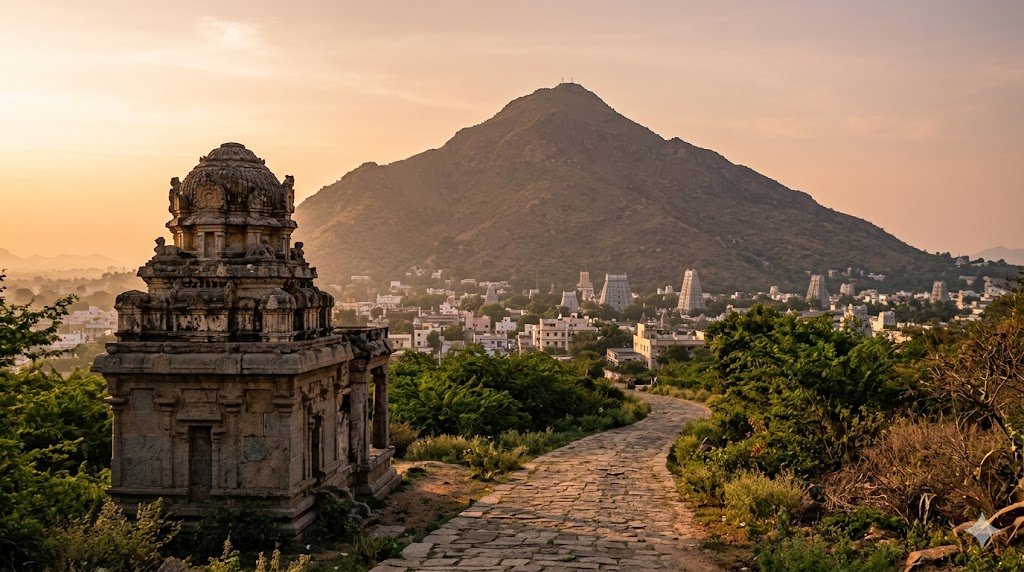
Your guide to the Ashta Lingam Tiruvannamalai: all eight Shiva lingams around Arunachala Hill, with directions, planets, and the blessings each grants.
The Ashta Lingam Tiruvannamalai circuit guards the eight directions around Arunachala Hill, and each shrine answers a different prayer. Pilgrims who walk the 14-km Girivalam path pass Indra Lingam, Agni Lingam, Yama Lingam, and five more along the way. You came here for the complete list with benefits, and that is exactly what follows. Moreover, you will find the ruling planet, the direction, and the practical darshan details for every single one.
Ashta Lingam Tiruvannamalai: Key Takeaways
- Eight lingams, eight directions: they sit in a near-perfect octagon around Arunachala Hill.
- Each has a ruling planet: together they cover all nine Navagrahas.
- Order on the path: Indra, Agni, Yama, Niruthi, Varuna, Vayu, Kubera, then Esanya.
- Best day: Pournami (full moon) draws the largest crowds, often three lakh devotees.
- Temple timings: roughly 5:30 AM to 12:30 PM and 3:30 PM to 9:30 PM.
What Is the Ashta Lingam Tiruvannamalai?
The Ashta Lingam Tiruvannamalai is a set of eight Shiva lingams placed around Arunachala Hill in eight directions. Each one marks a cardinal or corner point. A guardian deity installed each shrine, and a planet from the Navagraha rules it. Devotees worship them in sequence during Girivalam to seek specific blessings.
Notably, the word “ashta” means eight in Sanskrit. Devotees treat the hill at the centre as Lord Shiva himself, present in the form of fire. Therefore, walking around it counts as worship of Arunachaleswarar. Sri Ramana Maharshi, the sage of Arunachala, often urged followers to perform this circumambulation.
Complete List of the Ashta Lingam Tiruvannamalai
Below sits every shrine in walking order, starting from the east. For each one, you get the direction, the deity, the ruling planet, and the blessing devotees seek. Remember, these are traditional beliefs passed down for centuries, not medical or financial guarantees.
1. Indra Lingam (East)
First on the path, Indra Lingam opens the circuit on the eastern side, near the temple’s Rajagopuram. Legend says Lord Indra, king of the celestials, installed it. The Sun and Venus rule this shrine.
Specifically, worshippers come here for recognition and authority. Devotees also seek good health and a long life. The energy suits anyone starting a fresh venture.
2. Agni Lingam (South-East)
Next comes Agni Lingam in the south-east, near the lotus tank. Lord Agni, the fire god, presides here, and the Moon rules it. Fire stands for transformation and the burning away of past karma.
Therefore, devotees pray to Agni Lingam for relief from illness and fear. Many seek emotional calm and a clearer mind. Interestingly, it is the only one of the eight that sits on the right side of the path.
3. Yama Lingam (South)
Yama Lingam follows in the south, fittingly close to the cremation grounds on Chengam Road. Yama, the god of death, presides, and Mars governs the shrine. The lingam reminds visitors that the body is temporary while the spirit endures.
Consequently, people worship here to shed their fear of death. Devotees also pray for longevity and freedom from heavy debts. A carving above the shrine shows Yama himself bowing to Shiva and Parvati.
4. Niruthi Lingam (South-West)
Moving to the south-west, you reach Niruthi Lingam. Niruthi, lord of that direction, installed this one, and Rahu governs it. The shrine guards against negative forces and hidden enemies.
For example, childless couples come here to pray for children. Others seek health, wealth, and relief from fear. The shrine helps devotees loosen their grip on worldly chaos.
5. Varuna Lingam (West)
Varuna Lingam sits in the west, dedicated to the god of rain and oceans. Saturn rules this shrine. Water here represents cleansing, balance, and emotional flow.
As a result, devotees pray for relief from water-borne and skin ailments. Many believe worship here washes away accumulated sins. The shrine also brings clarity to a troubled mind.
6. Vayu Lingam (North-West)
In the north-west stands Vayu Lingam, linked to the wind god. Ketu governs this shrine. Wind symbolises breath, movement, and the life force called prana.
Hence, devotees with breathing or heart troubles pray here. Worship is said to calm anxiety and aid digestion. Furthermore, the shrine connects to speed, clarity, and communication.
7. Kubera Lingam (North)
Kubera Lingam guards the north, named after the divine treasurer of the gods. Jupiter rules it. Tradition holds that Kubera recovered his lost riches at this very spot.
Naturally, this shrine attracts those chasing wealth and stability. Business owners and entrepreneurs visit often. Devotees pray for stronger careers and rising social status.
8. Esanya Lingam (North-East)
Finally, Esanya Lingam completes the octagon in the north-east. Mercury rules this shrine, and it ties to peace and wisdom. The north-east is considered the most auspicious corner for spiritual growth.
In particular, students and seekers pray here for sharper minds. Worship is said to bring contentment and inner calm. The shrine suits anyone walking a meditative path.
Ashta Lingam Direction and Ruling Planet Table
Additionally, the table below maps each lingam to its direction, planet, and main blessing. Keep it handy while you walk.
| Lingam | Direction | Ruling Planet | Main Blessing |
|---|---|---|---|
| Indra | East | Sun, Venus | Fame, long life |
| Agni | South-East | Moon | Health, courage |
| Yama | South | Mars | Longevity, debt relief |
| Niruthi | South-West | Rahu | Progeny, protection |
| Varuna | West | Saturn | Purity, healing |
| Vayu | North-West | Ketu | Breath, vitality |
| Kubera | North | Jupiter | Wealth, status |
| Esanya | North-East | Mercury | Peace, wisdom |
Which Lingam Suits Your Birth Sign?
Because each Ashta Lingam Tiruvannamalai shrine carries a planet, many devotees match their visit to their birth sign, or raasi. This is an old astrological practice, not a temple rule. Still, it adds a personal layer to the walk.
For instance, Taurus and Libra natives feel drawn to Indra Lingam, ruled by Venus. Aries and Scorpio link to Yama Lingam under Mars. Meanwhile, Sagittarius and Pisces connect with Kubera Lingam under Jupiter. Gemini and Virgo align with Esanya Lingam under Mercury.
Of course, you need not believe in astrology to benefit. The walk itself settles the mind. Even so, knowing your planetary shrine can make the journey feel more personal.
How to Do the Ashta Lingam Tiruvannamalai Darshan
The walk follows a clear order, and the steps below keep it simple. First-timers should allow four to five hours at a relaxed pace. Carry water, since the full circuit runs about 14 km.
- Start at the temple: begin at the main Arunachaleswarar Temple gate. Light camphor and offer a coconut.
- Walk clockwise: keep the hill on your right throughout the journey.
- Visit Indra Lingam first: it sits on the east side near the Rajagopuram.
- Follow the sequence: Agni, Yama, Niruthi, Varuna, Vayu, Kubera, then Esanya.
- Chant as you go: repeat “Om Arunachaleswaraya Namaha” with a japamala.
- Finish with darshan: return for darshan of Arunachaleswarar and Unnamalai Amman.
Temple Timings and Best Time to Visit
Generally, the Arunachaleswarar Temple opens at 5:30 AM and closes by 9:30 PM. It stays shut in the afternoon for rituals, usually between 12:30 PM and 3:30 PM. However, timings shift on Pournami and festival days, so confirm before you travel.
For the calmest darshan, arrive between 5:30 AM and 7:30 AM. Plan the Ashta Lingam Tiruvannamalai darshan around these quiet hours. Meanwhile, full moon nights stay open far later, sometimes past midnight.
In terms of season, October to December brings cool weather and major festivals. Karthigai Deepam falls in this window, during November or December. Therefore, expect huge crowds if you visit then. The Tamil Nadu HR&CE Department manages the temple and posts updates.
How to Reach Tiruvannamalai
Tiruvannamalai sits in northern Tamil Nadu, well connected by road. Chennai lies about 185 km away, while Vellore is roughly 80 km from the town. Buses run frequently from Chennai, Bengaluru, and Vellore.
By train, the nearest major junctions are Katpadi (Vellore) and Villupuram. From there, taxis and buses reach the temple easily. Additionally, the closest airport is Chennai, about four hours by road. You can plan routes through Tamil Nadu Tourism.
Within the town, autos and cabs are everywhere. Simply tell the driver “Big Temple” or “Arunachaleswarar Temple.” Naturally, every local driver knows the route.
Insider Tips for Your Visit
First, wear modest traditional clothing out of respect. Men often choose a dhoti or simple shirt, while women prefer sarees or salwar. Remove footwear before each shrine.
Second, the Ashta Lingam Tiruvannamalai walk runs barefoot for most pilgrims, and crews clean and water the path on Pournami. Carry a small torch for night walks. Furthermore, keep cash handy, since card machines are rare along the route.
Guards do not permit photography inside the main shrines. Even so, the outer corridors and gopurams make superb photos. Finally, plan short rest stops, because the older lingam shrines can be hard to spot.
Girivalam Pournami Dates in 2026
The full moon draws the biggest gatherings, often three lakh devotees in a single night. For planning, here are the key Pournami dates still ahead in 2026.
- 29 June 2026
- 29 July 2026
- 27 August 2026
- 26 September 2026
- 25 October 2026
- 24 November 2026
- 23 December 2026
Note that these dates follow the Tamil lunar calendar and may shift by a day. Therefore, verify two to three weeks ahead through local notices. The path stays open every day, so any quiet weekday works too.
The Bottom Line
The Ashta Lingam Tiruvannamalai walk blends faith, astrology, and a real physical journey. Each of the eight shrines speaks to a different wish, from health at Agni to wealth at Kubera. Start early, walk clockwise, and hold the sequence in mind. Above all, treat the 14-km circuit as moving meditation rather than a checklist. Visit on a calm weekday for peace, or a Pournami night for raw energy.
Frequently Asked Questions
What is the Ashta Lingam Tiruvannamalai?
It refers to eight Shiva lingams placed around Arunachala Hill in eight directions. A guardian deity installed each one, and a planet rules it. Devotees worship them in order during Girivalam.
In what order should I visit the eight lingams?
Start with Indra in the east, then move clockwise. The sequence runs Indra, Agni, Yama, Niruthi, Varuna, Vayu, Kubera, and Esanya. Always keep the hill on your right.
Is it mandatory to visit all eight lingams?
No, it is not mandatory. However, devotees believe visiting all eight brings complete blessings. You can still gain merit by worshipping at the main temple alone.
How long does the Ashta Lingam walk take?
The full 14-km circuit takes about four to five hours at a calm pace. Faster walkers finish in roughly three hours. Allow extra time on Pournami because of the crowds.
Which lingam is worshipped for wealth?
Kubera Lingam in the north is linked to wealth and prosperity. Ruled by Jupiter, it carries the name of the treasurer of the gods. Business owners often pray there.
Can I do Girivalam on a normal day?
Yes, the path stays open every day of the year. Quiet weekdays offer a peaceful walk with thin crowds. Full moon nights, by contrast, feel crowded but charged with energy.

The Tiruvannamalai Devasthanam editorial team is an independent group of writers and researchers documenting pilgrimage to the Arunachaleswarar Temple and Arunachala Hill, Tiruvannamalai. We are not affiliated with the temple or the Tamil Nadu HR\&CE Department. Every darshan timing, festival date and ritual detail we publish is cross-checked against the HR\&CE department, on-the-ground reports and at least two independent sources before it is published, and festival dates are re-verified each year. Spotted an error? Tell us and we will correct it.
