
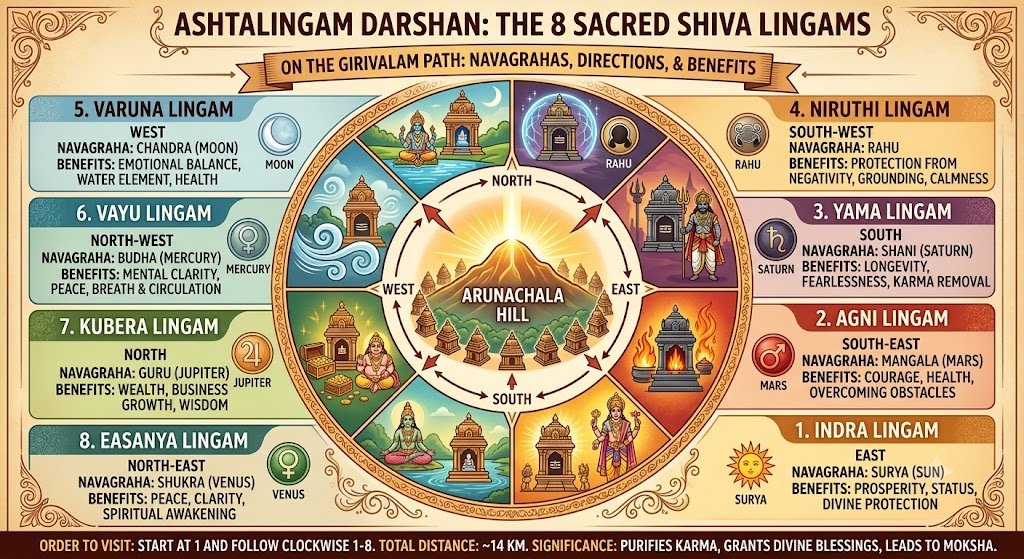
Ashtalingam Darshan guide: all 8 Shiva lingams on the Tiruvannamalai Girivalam path, their directions, ruling planets, benefits and correct walking order.
Ashtalingam Darshan is the worship of eight sacred Shiva lingams placed around Arunachala Hill in Tiruvannamalai. Each lingam guards one direction on the 14 km Girivalam path. Together, they connect all nine navagrahas in a single barefoot walk. Most pilgrims pass within metres of these shrines without knowing their names, their order, or which one answers their specific prayer. This guide fixes that completely.
Quick Summary: Ashtalingam Darshan at a Glance
- What it is: Darshan of 8 Shiva lingams in 8 directions around Arunachala Hill
- Order: Indra → Agni → Yama → Niruthi → Varuna → Vayu → Kubera → Esanya
- Path: 14 km Girivalam route, walked clockwise (hill on your right)
- Time needed: 4 to 5 hours including darshan stops
- Best day: Pournami (full moon); next one falls on 29 June 2026
- Cost: Free; archana at each shrine is ticketed at that shrine’s counter
What Is Ashtalingam Darshan?
Ashtalingam Darshan means worshipping the eight directional Shiva lingams installed around Arunachala Hill on the Girivalam path. Each lingam represents a guardian deity (Dikpalaka) and a ruling navagraha. Devotees visit all eight in sequence while circumambulating the hill, seeking blessings tied to each planet and direction.
The word “ashta” means eight in Sanskrit. Accordingly, the lingams sit in a near-perfect octagon around the hill. The guardians of the four cardinal points are called Lokapalas. Together with the four corner guardians, they form the Ashta Dikpalakas.
Arunachala itself is the Agni (fire) sthalam among the five Pancha Bhoota temples of Lord Shiva. Therefore, devotees treat the hill as Shiva himself. The eight lingams act as his sentinels, each receiving prayers for a different need.
The 8 Lingams: Directions, Planets and Benefits
Here is the complete reference table. Notably, the eight shrines cover all nine navagrahas, because Indra Lingam carries both Sun and Venus.
| Lingam | Direction | Navagraha | Believed Benefit |
|---|---|---|---|
| Indra Lingam | East | Suryan & Sukran | Prosperity, honour, leadership |
| Agni Lingam | South-East | Chandran | Health, long life, courage |
| Yama Lingam | South | Sevvai (Mars) | Relief from debts, longevity |
| Niruthi Lingam | South-West | Rahu | Progeny, removal of fear |
| Varuna Lingam | West | Sani (Saturn) | Cure from ailments, abundance |
| Vayu Lingam | North-West | Ketu | Relief from lung and heart issues |
| Kubera Lingam | North | Guru (Jupiter) | Wealth, business growth |
| Esanya Lingam | North-East | Budhan (Mercury) | Peace of mind, wisdom |
Why this page no longer quotes rupee figures
We could not find a published seva tariff for Arunachaleswarar Temple (HR&CE temple code TM020343) anywhere on the government portal, annamalaiyar.hrce.tn.gov.in. The figures we used to print here were not sourced from HR&CE, and they contradicted the figures on our own other pages — the same seva appeared at prices that differed several times over.
The seva counter inside the temple quotes the current rate, and HR&CE revises rates from time to time. That counter is the only authority we can point you to with confidence.
These planetary associations come from temple tradition and devotee belief. Astrologers often recommend a specific lingam based on one’s horoscope. However, worshipping all eight in order remains the classic practice.
Indra Lingam (East)
The circuit begins here, near the eastern Rajagopuram of Arunachaleswarar Temple on Car Street. Indra, king of the devas, is its guardian, and the shrine carries the combined grace of Suryan and Sukran. Consequently, devotees pray here for status, recognition and a prosperous household.
Agni Lingam (South-East)
Agni Lingam stands on Chengam Road, close to Seshadri Ashram. Interestingly, this is the only lingam on the right side of the Girivalam path; some websites wrongly place it on the left. Chandran rules this shrine, and prayers here are believed to grant health and fearlessness.
Yama Lingam (South)
Lord Yama, the god of death, is said to have installed this lingam. Sevvai (Mars) is its ruling planet. Devotees facing loan burdens or chronic financial stress offer prayers here. The Simha Theertham tank sits beside the shrine.
Niruthi Lingam (South-West)
Niruthi, guardian of the south-west, presides over this lingam with Rahu as its planet. Childless couples traditionally pray here for progeny. Moreover, devotees troubled by Rahu dosha in their charts consider this stop essential.
Varuna Lingam (West)
Varuna, lord of rain and water, guards the western point. Sani (Saturn) rules the shrine. As a result, devotees undergoing Sade Sati or Saturn transits stop here for relief. Prayers are also offered for recovery from long illnesses.
Vayu Lingam (North-West)
Vayu Lingam belongs to the wind god, with Ketu as its navagraha. Pilgrims often report a constant breeze at this shrine, whatever the season. Tradition holds that worship here eases breathing disorders, heart trouble and stomach ailments.
Kubera Lingam (North)
Kubera, treasurer of the devas, is believed to have regained his lost wealth at this very spot. Guru (Jupiter) rules the shrine. Naturally, business owners and job seekers make this the most-visited of the eight lingams.
Esanya Lingam (North-East)
The circuit ends at Esanya Lingam, ruled by Budhan (Mercury). The north-east is the most auspicious direction in Vastu tradition. Fittingly, devotees pray here for mental peace, clarity and spiritual progress before completing the round.
How to Complete Ashtalingam Darshan in the Right Order
Follow these steps for a smooth, traditional circuit. The full Ashtalingam Darshan takes 4 to 5 hours at an unhurried pace.
- Start at Arunachaleswarar Temple. Offer prayers to Lord Annamalaiyar first. The temple opens from 5:30 AM to 12:30 PM and again from 3:30 PM to 9:30 PM.
- Begin at Indra Lingam near the eastern gopuram and walk clockwise. Keep the hill on your right at all times.
- Stay on the left edge of the road. Tradition reserves the right side for siddhas; practically, it also keeps you safe from traffic.
- Stop at each lingam in sequence. Offer a simple archana, or just fold your hands and chant “Om Arunachala” if shrines are crowded.
- Carry water and walk barefoot if comfortable. Barefoot walking is customary, not compulsory; elderly pilgrims may use soft footwear.
- Finish at Esanya Lingam, then return to the main temple for a closing darshan.
For the exact shrine locations with a map, see our detailed Ashtalingam Girivalam route map.
Best Time for Ashtalingam Darshan
Pournami (full moon) night is the most powerful occasion by tradition. On these nights, lakhs of devotees walk the path, and crowd estimates regularly cross three lakh. The next Pournami Girivalam falls on 29 June 2026, followed by 29 July 2026.
Since Girivalam follows the purnima tithi rather than the calendar date, timings shift each month. Therefore, verify the exact tithi window on Drik Panchang’s Tiruvannamalai purnima page before travelling.
Prefer solitude? Walk on a regular weekday at dawn. The path stays open every single day of the year, contrary to the belief that Girivalam only “counts” on full moon. Karthigai Deepam in November–December and Maha Shivaratri are the other peak occasions.
Is Ashtalingam Darshan Compulsory During Girivalam?
No, and this needs saying clearly because a few websites claim otherwise. Girivalam itself is the core observance; the eight lingams add layered blessings for those who wish. Skipping a shrine due to crowds does not invalidate your pradakshina.
Insider Tips Most Guides Miss
- Start at 4 AM on non-Pournami days. You will finish all eight shrines before the sun turns the tar road hot, which matters if walking barefoot.
- Pournami queues differ wildly. Kubera Lingam draws the longest lines; Niruthi and Varuna stay relatively quick even at peak hours.
- Carry coins and small notes. Archana counters at the smaller shrines rarely have change for ₹500 notes.
- The shrines may close briefly at midday on ordinary days, even though the path itself never closes. Plan darshan for morning or evening.
- Phone GPS works on the whole route. Search each lingam by name on Google Maps; all eight are pinned accurately.
- On Deepam day, abandon the car entirely. Police divert all vehicles several kilometres out; walking is the only realistic option.
How to Reach Tiruvannamalai
Tiruvannamalai sits about 190 km from Chennai and 210 km from Bengaluru by road. TNSTC and SETC buses run round the clock from Chennai (CMBT), Vellore, Villupuram and Bengaluru.
By train, Tiruvannamalai station lies on the Villupuram–Katpadi line, barely 2 km from the temple. Additionally, Chennai International Airport is the most practical airport, with taxis covering the distance in about four hours.
For accommodation and temple services, check the official Arunachaleswarar Temple HR&CE website. Tamil Nadu Tourism also lists approved hotels on the official state tourism portal.
The Bottom Line
Ashtalingam Darshan turns a 14 km walk into a structured spiritual circuit covering all nine navagrahas. Begin at Indra Lingam, move clockwise, and end at Esanya for the complete traditional sequence. Pournami nights offer raw devotional energy, while quiet weekday mornings suit those seeking meditation over crowds. Above all, treat the walk as worship in motion, not a checklist. Verify the tithi on Drik Panchang, start early, and let Arunachala do the rest.
Frequently Asked Questions
What is Ashtalingam Darshan in Tiruvannamalai?
Ashtalingam Darshan is the worship of eight Shiva lingams installed in eight directions around Arunachala Hill. Devotees visit them in order while walking the 14 km Girivalam path. Each lingam has a guardian deity and a ruling navagraha.
What is the correct order of the 8 lingams?
The traditional order is Indra, Agni, Yama, Niruthi, Varuna, Vayu, Kubera and Esanya. Start at Indra Lingam in the east near the temple’s Rajagopuram. Then walk clockwise, keeping the hill on your right.
Which lingam should I worship for wealth?
Kubera Lingam on the northern side is associated with wealth and business success. Guru (Jupiter) is its ruling planet. Devotees believe Kubera himself regained his riches at this shrine.
How long does Ashtalingam Darshan take?
Plan for 4 to 5 hours covering all eight shrines at a steady pace. Fast walkers without long darshan stops finish in about 3 hours. On Pournami nights, crowds can stretch the circuit to 6 hours or more.
Can I do Girivalam on any day, or only on full moon?
The Girivalam path remains open every day of the year. Pournami is simply the most auspicious and crowded occasion. Weekday mornings offer the same spiritual merit with far greater peace.
Which lingam helps with Sani dosha?
Varuna Lingam in the west carries Sani (Saturn) as its navagraha. Devotees undergoing Sade Sati or Ashtama Sani traditionally offer prayers here. Lighting a gingelly oil lamp at this shrine is a popular remedy.
Is barefoot walking mandatory for Ashtalingam Darshan?
Barefoot walking is the honoured custom, not a strict rule. Elderly pilgrims and those with medical conditions may wear soft footwear. The devotion behind the walk matters more than the footwear.

The Tiruvannamalai Devasthanam editorial team is an independent group of writers and researchers documenting pilgrimage to the Arunachaleswarar Temple and Arunachala Hill, Tiruvannamalai. We are not affiliated with the temple or the Tamil Nadu HR\&CE Department. Every darshan timing, festival date and ritual detail we publish is cross-checked against the HR\&CE department, on-the-ground reports and at least two independent sources before it is published, and festival dates are re-verified each year. Spotted an error? Tell us and we will correct it.
