
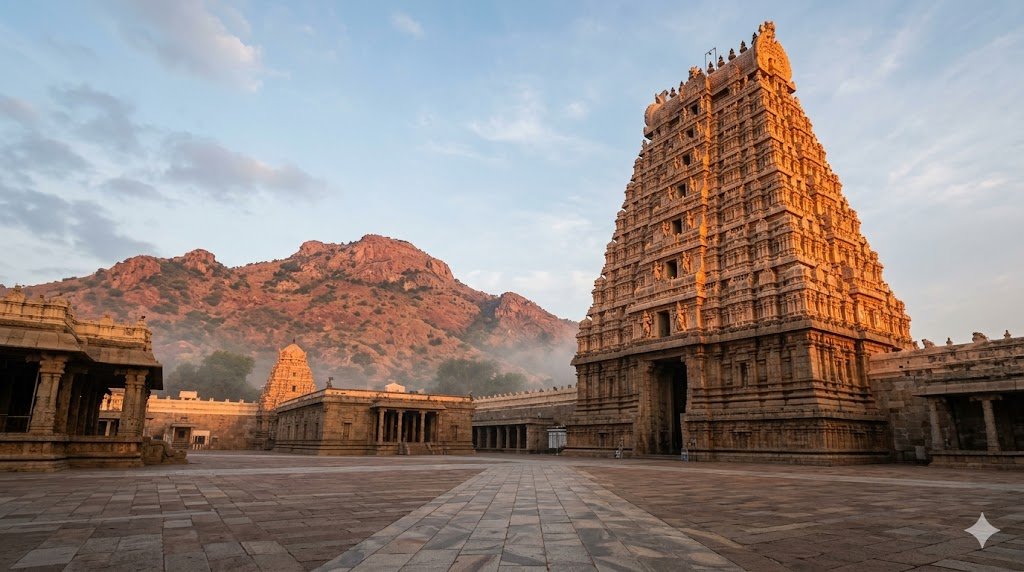
The best places to visit in Tiruvannamalai fit neatly into two circles — one around the sacred Arunachala Hill, and one within an hour’s drive of it. Most visitors only see the big temple and leave. That is a mistake, because this small Tamil Nadu town packs ancient shrines, hillside caves, world-famous ashrams, a crocodile farm, and one of India’s mightiest forts into a single weekend.
Tiruvannamalai at a Glance
- Top attraction: Arunachaleswarar Temple, a 25-acre Shiva temple representing the fire element
- Signature experience: Girivalam, the 14 km barefoot walk around Arunachala Hill
- Key ashrams: Sri Ramanasramam, Seshadri Swamigal Ashram, Yogi Ramsuratkumar Ashram
- Best day trips: Sathanur Dam (about 30 km) and Gingee Fort (about 40 km)
- Best season: October to March, when the weather stays pleasant
- Time needed: one full day for the town, two days if you add day trips
Top 10 Places to Visit in Tiruvannamalai
This ranked list covers all the major places to visit in Tiruvannamalai, starting at the temple and moving outward. Each entry includes timings, fees, and practical detail, so you can plan without checking ten other pages.
1. Arunachaleswarar Temple
Arunachaleswarar Temple, also called Annamalaiyar Temple, is the heart of the town and one of the largest Shiva temples in India. It spreads across roughly 25 acres, while its eastern gopuram rises 66 metres over 11 tiers — among the tallest temple towers in the country.
This shrine is one of the Pancha Bhoota Sthalams, the five temples linked to the elements of nature. Here, Lord Shiva is worshipped as the Agni Lingam, the form of fire. The Tamil Nadu Hindu Religious and Charitable Endowments Department (HR&CE) manages the temple.
Darshan runs from 5:30 AM to 12:30 PM and again from 3:30 PM to 9:00 PM. Entry is free, although paid special-darshan and seva tickets cut waiting time on busy days. Visit before 8 AM if you want a calm sanctum, because full moon days and weekends draw huge crowds. The Karthigai Deepam festival, held between November and December, ends with a giant flame lit on the hilltop.
2. Girivalam — The 14 km Walk Around Arunachala
Girivalam is a barefoot circumambulation of Arunachala Hill covering about 14 kilometres, walked clockwise so the hill stays on your right. Most people finish in 3 to 5 hours, and lakhs of devotees walk it on every full moon (Pournami) night.
The route passes the Ashta Lingams — eight shrines named Indra, Agni, Yama, Niruthi, Varuna, Vayu, Kubera, and Eesanya — each facing a different direction. Devotees regard the hill itself as a form of Shiva, so the walk is treated as worship, not exercise.
Start after sunset or before dawn, since the tar road heats up badly by mid-morning. Carry no valuables, drink water at the free stalls, and keep small change for offerings along the way.
3. Sri Ramanasramam
Sri Ramanasramam is the ashram built around the samadhi of Bhagavan Sri Ramana Maharshi, the sage who lived on Arunachala from 1896 until 1950. Seekers from across the world come here for silent meditation, daily Vedic chanting, and the old hall where Ramana sat for decades.
Entry is free and no booking is needed for a day visit, though many halls close for a midday break around 11 AM and reopen by 2 PM. Accommodation inside the ashram requires advance online registration through the official website, and stays are short by design.
Dress modestly with shoulders and knees covered. The peacocks, the library, and the small shrine of Cow Lakshmi reward unhurried visitors.
4. Skandashram
Skandashram is a tree-shaded hermitage on the slope of Arunachala where Ramana Maharshi lived from 1916 to 1922 with his mother Alagammal. It opens from about 8 AM to 4 PM, and entry is free.
The climb starts from a gate behind Sri Ramanasramam and takes 30 to 45 minutes on a rough stone path. Tradition asks visitors to walk barefoot on the hill, so go early before the rocks heat up. From the verandah, you get a sweeping view of the temple’s gopurams below — easily the best free viewpoint in town.
5. Virupaksha Cave
Virupaksha Cave sits a short walk below Skandashram and holds the samadhi of the sage Virupaksha Deva. Ramana Maharshi meditated here for 16 years, from 1899 to 1916, and the cave’s interior is shaped like the sacred syllable Om.
The space inside is tiny and dark, yet remarkably cool even at noon. Sit quietly for ten minutes rather than rushing through, because silence is the whole point of this spot. You can reach it either from the Ramanasramam trail or by climbing from the path near the big temple.
6. Arunachala Hill Viewpoints
Arunachala Hill rises about 800 metres above the plains, and the upper trail beyond Skandashram offers the finest sunrise views in the district. The full summit climb is strenuous, with loose rock and no shade for long stretches.
The forest department restricts access to the upper hill at times, especially in the weeks around Karthigai Deepam, so confirm locally before attempting it. For most visitors, the Skandashram ledge delivers ninety percent of the view with a fraction of the effort. Carry water, start before 6:30 AM, and bring nothing plastic onto the hill.
7. Sathanur Dam
Sathanur Dam, about 30 km from town, is the most popular family outing among all places to visit in Tiruvannamalai district. Built across the Thenpennai (Pennaiyar) river between 1953 and 1958, it was one of Tamil Nadu’s flagship irrigation projects under Chief Minister K. Kamaraj.
The dam complex opens from 10 AM to 5 PM, and entry costs ₹5 per person, with small extra fees for the crocodile farm and park. The crocodile farm houses over 300 crocodiles, while landscaped gardens, a fish grotto, and a children’s park fill the rest of the grounds.
Visit just after the monsoon, between October and December, when the reservoir brims and the spillway sometimes runs. Carry snacks and water, since food stalls on site are limited.
8. Gingee Fort
Gingee Fort, roughly 40 km away on the Tiruvannamalai–Puducherry road, is the single best day trip from town. The British called it the “Troy of the East” because its three fortified hills — Rajagiri, Krishnagiri, and Chandrayandurg — proved nearly impossible to capture.
The Archaeological Survey of India (ASI) maintains the fort. It opens from 9 AM to 5:30 PM, with entry around ₹30 for Indian visitors. Crucially, entry to the Rajagiri hill climb stops by 3 PM, because the round trip up its 1,000-odd steps takes close to three hours.
Reach by 9 AM, climb Rajagiri first, and save Krishnagiri for the cooler late afternoon. The granaries, the Kalyana Mahal tower, and the ASI museum at the base deserve an hour on their own.
9. Yogi Ramsuratkumar Ashram
Yogi Ramsuratkumar Ashram stands on Chengam Road, right on the Girivalam route, and honours the saint devotees called the “Beggar of Tiruvannamalai” (1918–2001). His samadhi shrine sits beneath a vast meditation hall, and daily chanting fills the mornings and evenings.
Entry is free, and the ashram serves as a natural rest stop during the Girivalam walk. Even non-devotees find the hall a quiet, cool refuge after the temple crowds.
10. Seshadri Swamigal Ashram
Seshadri Swamigal Ashram sits right next to Sri Ramanasramam and preserves the samadhi of Seshadri Swamigal (1870–1929). He was the saint who first drew attention to the young Ramana when the boy sat unnoticed in the temple’s underground vault.
The ashram is small, rarely crowded, and takes barely twenty minutes to see. Combine it with your Ramanasramam visit, since the two gates are a one-minute walk apart.
Places to Visit in Tiruvannamalai: Distance and Time Chart
Use this chart to group nearby spots into one outing instead of criss-crossing town.
| Place | Distance from temple | Time needed |
|---|---|---|
| Arunachaleswarar Temple | 0 km | 1.5–2 hrs |
| Girivalam path | Starts at temple | 3–5 hrs |
| Sri Ramanasramam | 2 km | 1–2 hrs |
| Skandashram + Virupaksha Cave | 2 km + trek | 2–3 hrs |
| Sathanur Dam | 30 km | Half day |
| Gingee Fort | 40 km | Full or half day |
In plain terms: everything sacred sits within 2 km of the temple, while the two day trips lie 30 km and 40 km out in opposite directions. Therefore, never plan Sathanur Dam and Gingee Fort on the same half day.
How to Plan Your Route: 1-Day vs 2-Day Itinerary
With one day, start at the temple by 6 AM, then climb to Virupaksha Cave and Skandashram before 10 AM while the rocks stay cool. After lunch, rest until 3 PM, visit Sri Ramanasramam and Seshadri Ashram, and end with an evening walk on a section of the Girivalam road.
With two days, keep day one for the hill circle above, and give day two to Gingee Fort in the morning plus Sathanur Dam in the late afternoon — though the two lie on different roads, so a car or taxi works far better than buses for this loop.
If your dates are flexible, anchor the trip to a full moon night for the Girivalam atmosphere. Just know the trade-off: rooms cost more, and the temple queue triples.
How to Reach Tiruvannamalai
Tiruvannamalai has its own railway station (code TNM), barely 2 km from the temple, with direct trains on the Villupuram–Katpadi line. Major junctions at Villupuram and Katpadi, each about 65–76 km away, connect to trains from across India.
By road, the town links directly to Chennai (around 185 km), Bengaluru (around 210 km), Vellore, and Puducherry. Frequent government buses run from Chennai’s Kilambakkam and Koyambedu terminals, and the Tamil Nadu Tourism Development Corporation lists routes on its portal.
The nearest airport is Chennai International Airport, about 185 km away. From there, a taxi takes four hours, while buses take a little longer but cost far less.
What First-Time Visitors Get Wrong
Several travel sites still print the temple hours as “6 AM to 6 PM” — that is outdated. The actual darshan windows are 5:30 AM to 12:30 PM and 3:30 PM to 9:00 PM, with short ritual closures in between.
Other common mistakes, learned the hard way by regular pilgrims:
- Attempting Girivalam at noon — the tar burns bare feet, so walk after sunset or before dawn
- Reaching Gingee Fort after lunch — hill entry closes at 3 PM, so you see only the base
- Expecting walk-in rooms at Ramanasramam — stays need advance online registration
- Wearing shorts to ashrams and the temple — modest dress is expected everywhere
- Skipping water on the hill treks — there are no shops above Virupaksha Cave
Book accommodation early for full moon weekends and the Deepam season, because the town’s limited rooms sell out days ahead.
Before You Go
Tiruvannamalai rewards slow travel: one unhurried day around the hill beats three rushed ones. Prioritise the temple at dawn, the cave trail before the heat, and the ashrams in the calm afternoon. Add Gingee Fort if you have a second day, since no other site within reach matches its scale. Above all, check the Tamil Nadu HR&CE Department, the official Sri Ramanasramam website, and the Tamil Nadu Tourism portal for the latest timings before you travel, because festival schedules shift these hours.
Frequently Asked Questions
What are the best places to visit in Tiruvannamalai in one day?
The best one-day circuit of places to visit in Tiruvannamalai covers Arunachaleswarar Temple at dawn, the trek to Virupaksha Cave and Skandashram by mid-morning, and Sri Ramanasramam in the afternoon. Add an evening stretch of the Girivalam road if your legs allow it.
How many days are enough for Tiruvannamalai?
Two days cover the town comfortably. Day one handles the temple, hill caves, and ashrams, while day two fits Gingee Fort and Sathanur Dam. Solo pilgrims focused only on the temple and Girivalam can manage in a single long day.
What is the best time to visit Tiruvannamalai?
October to March is the best season, since daytime temperatures stay manageable for treks and the barefoot walk. The Karthigai Deepam festival between November and December is the most spectacular period, though crowds and room rates peak then.
How long does Girivalam take?
Girivalam covers about 14 km and takes 3 to 5 hours at a normal pace. Time varies with crowd density, rest stops at the Ashta Lingams, and whether you walk barefoot, which most devotees do.
Is there an entry fee for Arunachaleswarar Temple?
No, general darshan is free for everyone. Paid special-entry and seva tickets exist for faster access, and they are worth taking on full moon days when free queues stretch past an hour.
Can we stay at Sri Ramanasramam?
Yes, but only with advance registration through the ashram’s official website, and stays are limited to a few days. Day visitors need no booking at all, since entry to the halls and samadhi shrine is free.
Is Gingee Fort worth visiting from Tiruvannamalai?
Yes — it is the strongest day trip in the region, about 40 km away. Reach before 9 AM though, because hill-climb entry closes at 3 PM and the Rajagiri ascent alone takes nearly three hours round trip.

The Tiruvannamalai Devasthanam editorial team is an independent group of writers and researchers documenting pilgrimage to the Arunachaleswarar Temple and Arunachala Hill, Tiruvannamalai. We are not affiliated with the temple or the Tamil Nadu HR\&CE Department. Every darshan timing, festival date and ritual detail we publish is cross-checked against the HR\&CE department, on-the-ground reports and at least two independent sources before it is published, and festival dates are re-verified each year. Spotted an error? Tell us and we will correct it.
