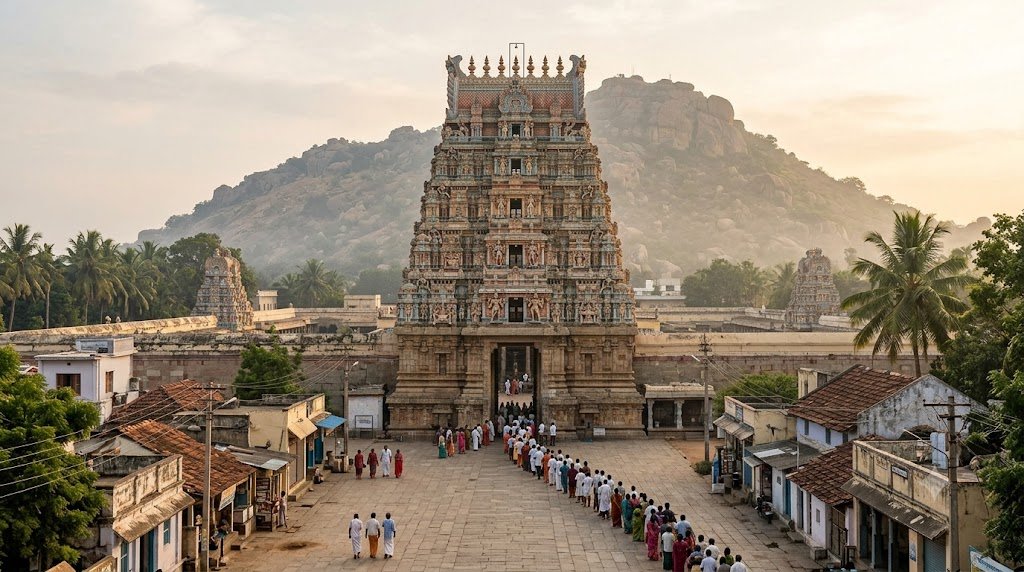
Arunachaleswarar Temple free darshan is open to every devotee, and it costs nothing at all. Many first-time pilgrims arrive expecting to buy a ticket, because dozens of websites push a “₹50 special” or “₹200 VIP” tier. That impression is misleading.
The general queue at this ancient Shiva temple in Tiruvannamalai stays free, and it always has been. So this guide gives you the real timings, the midday break, honest queue tips, and how the free route differs from paid darshan.
Quick note: this is an independent pilgrim guide. We are not affiliated with the temple, the Tamil Nadu HR&CE department, or any official body. We take no bookings, donations, or payments. For tickets and official updates, please use the official temple portal.
Arunachaleswarar Temple Free Darshan at a Glance
- Cost: completely free for the general darshan queue.
- Temple: Arulmigu Arunachaleswarar (Annamalaiyar) Temple, Tiruvannamalai.
- Open daily: roughly 5:30 AM to 12:30 PM, then again from about 3:30 PM to 9:00 PM.
- Best low-crowd slot: a weekday morning, soon after the temple opens.
- Official portal: annamalaiyar.hrce.tn.gov.in (HR&CE) for any e-ticket or seva.
- Dress code: traditional attire; no shorts or sleeveless tops.
What Is Arunachaleswarar Temple Free Darshan?
Arunachaleswarar Temple free darshan is the ordinary, no-cost entry that every visitor can take to see the Agni Lingam. You simply join the general queue, pass security, and walk through to the sanctum. No ticket is needed for this route. The temple is one of the Pancha Bhoota Sthalams, and it represents the fire element among the five.
Some pilgrims search for “Sarva Darshan” here, though that term belongs to Tirumala. At Arunachaleswarar Temple, the same idea is simply called free or general darshan. So if you carried the Tirumala habit of booking a slot, relax. Here, walking in through the general line is the normal way.
Is Arunachaleswarar Temple Free Darshan Really Free?
Yes. Entry to the temple is free, and the general darshan queue never charges a rupee. Many aggregator pages blur this by advertising “special entry” prices as if they were compulsory.
They are not. Because the temple is managed by the Tamil Nadu HR&CE department, its core worship stays open to all without a fee.
What you can pay for are optional sevas, such as an abhishekam or an archana in your name. Those tickets carry published prices, while a plain darshan does not. So do not let a website convince you that a free walk-in is unavailable. It is the default, and it is the route most devotees take every day.
Arunachaleswarar Temple Free Darshan Timings
The temple follows a traditional Saiva Agama schedule, so it opens early and closes late with a midday gap. On most regular days, the doors open around 5:30 AM. After the noon rituals, the sanctum usually closes for a short rest, then reopens in the afternoon. Timings can shift on festival days, so confirm before a long trip.
| Session | Approximate Window |
|---|---|
| Morning darshan | 5:30 AM – 12:30 PM |
| Midday break | around 12:30 PM – 3:30 PM |
| Evening darshan | 3:30 PM – 9:00 PM |
Treat these as indicative. Different official notices list the evening window as starting at 3:30 or 4:00 PM, and closing near 9:00 or 9:30 PM. Because minor changes happen during utsavams and Pournami days, always check the temple office or the official portal for the exact hours on your date.
The Six Daily Poojas
Six kaala poojas mark the deity’s day, and each one includes abhishekam, alankaram, and deeparadhana. You can watch most of them during a free darshan. The evening lamp ritual is the most atmospheric, so many devotees plan around it.
| Pooja | Approx. Time |
|---|---|
| Ushakala Pooja | 5:30 AM |
| Kalasandhi Pooja | 8:00 AM |
| Uchikala Pooja | 11:00 AM |
| Sayaratchai (evening lamp) | 6:00 PM |
| Irandam Kala Pooja | 7:30 PM |
| Ardha Jama Pooja | 9:00 PM |
Best Time for Arunachaleswarar Temple Free Darshan
A weekday morning is the calmest choice, especially between 5:30 AM and 8:00 AM. Crowds stay light from Tuesday to Thursday, so you may finish in well under an hour. Early risers also get a cooler queue, so the wait feels far lighter.
Fridays and Sundays draw more footfall, and weekends fill up fast. If you value quiet, avoid those days.
Full-moon days are a different story. On Pournami, lakhs of devotees arrive for Girivalam, and the whole town swells. During Karthigai Deepam in November or December, the crowd reaches its yearly peak. So plan a free darshan well outside these windows if you want a peaceful visit.
Free Darshan vs Special Darshan: What Changes?
The difference is time, not access. A free darshan gives you the same view of the deity as any paid route. On a busy day, though, the general line can take one to two hours, while a special or quick-entry option may shorten the wait. Neither buys you a “better” darshan, only a faster queue.
| Route | Cost | Typical Wait (busy day) |
|---|---|---|
| Free / general darshan | Free | 1–2 hours |
| Special / quick entry | Paid (varies) | Shorter, when offered |
Special-darshan prices vary and are revised by the temple, so we do not quote a fixed figure here. For the current rate and availability, check our special darshan tickets guide or the official portal. On quiet weekday mornings, most pilgrims find the free route perfectly comfortable anyway.
How to Use the Free E-Ticket Option
The HR&CE portal sometimes offers a free e-ticket slot alongside paid ones, mainly during heavy-crowd events. It helps manage entry on Pournami and festival days. On regular days, though, most darshan and seva tickets are still issued at on-site counters. So do not worry if online slots are not showing.
- Open the official portal (annamalaiyar.hrce.tn.gov.in).
- Find the booking or e-ticket section on the homepage.
- Choose the free option, if it is enabled for your date.
- Enter your details and generate the ticket.
- Carry the printout or mobile ticket plus a government ID.
For a fuller walkthrough, see our Tiruvannamalai temple online booking guide. When online slots are closed, simply reach a counter early and collect your token there.
Dress Code and What to Carry
Traditional attire is expected for darshan. Men usually wear a dhoti, or trousers with a shirt, while women wear a saree, salwar kameez, or a long skirt with a full-sleeve top. Shorts and sleeveless tops are discouraged, and they may restrict inner entry. Footwear comes off before the premises, and free shoe stands sit near the entrance.
Carry a valid photo ID, since it helps at any e-ticket checkpoint. Leave large bags and electronics behind, because photography inside the sanctum is restricted. For the full rules, read our Tiruvannamalai temple dress code guide before you travel.
Health and Safety Notes
Tiruvannamalai gets hot, and queues can be long. So carry water and stay hydrated, especially in summer. If you plan Girivalam, remember it is a 14 km walk, often done barefoot on Pournami. Elderly pilgrims, pregnant women, and anyone with a medical condition should pace the walk and pack any needed medication.
Faith practices here are matters of tradition, not medical treatment. So enjoy the rituals for their spiritual value, while you follow a doctor’s advice for any health concern. A calm, well-planned visit is far more rewarding than a rushed one.
Avoid Fake Booking Portals
Only one portal is official: annamalaiyar.hrce.tn.gov.in, run by the Tamil Nadu HR&CE. Because free darshan needs no payment, any site charging a “processing fee” for a free slot is a red flag. Genuine government portals use a gov.in address, and they never demand a fee for a free walk-in.
If a page asks for a large advance to “guarantee” darshan, close it. Book sevas only on the official site, or at the temple counter. This simple habit protects your money and your personal data from scams. When in doubt, walk up to the temple counter, since a free queue never needs an agent or a middleman.
Why Free Darshan Draws Millions to Arunachala
The hill itself is the deity here. Devotees believe Arunachala is a form of Lord Shiva, and the Agni Lingam inside the sanctum stands for fire, one of the five great elements. That belief pulls pilgrims from across India, and free access keeps the shrine open to rich and poor alike.
Saints such as Ramana Maharshi lived and taught in its shadow, which deepened the town’s spiritual pull. Karthigai Deepam, when a giant flame is lit on the summit, is the temple’s most famous festival. Yet on any ordinary morning, a quiet Arunachaleswarar Temple free darshan can feel just as powerful. So the shrine rewards devotion far more than spending.
Getting to Arunachaleswarar Temple
Tiruvannamalai sits in northern Tamil Nadu, and it connects well by road. Regular buses run from Chennai, Bengaluru, Vellore, and Puducherry. By train, the nearest major railheads are Villupuram, about 76 km away, and Katpadi, roughly 65 km away. From either station, a bus or taxi reaches the temple town easily.
The closest airport is Chennai, around 185 km away, so most flyers land there and drive down. In town, the temple sits on Sannathi Street, and autos reach the main entrance quickly. Because parking fills up on Pournami and festival days, arrive early. An early start also lines up neatly with a calm Arunachaleswarar Temple free darshan.
The Bottom Line
Arunachaleswarar Temple free darshan remains the heart of a Tiruvannamalai pilgrimage, and it asks nothing of your wallet. Arrive on a weekday morning, dress modestly, and let the general queue carry you to the Agni Lingam. Pay only for an optional seva if you truly want one. For timings and slots on your exact date, confirm on the official portal, and read our Tiruvannamalai temple darshan timings guide before you set out.
Frequently Asked Questions
Is Arunachaleswarar Temple free darshan really free?
Yes, completely. Entry and the general darshan queue cost nothing. You only pay if you choose an optional seva, such as an abhishekam or archana in your name.
Do I need to book online for free darshan?
No, not usually. On regular days you can walk in and join the general queue. A free e-ticket sometimes appears on the official portal only for Pournami or festival crowds.
What are the free darshan timings at the temple?
The temple opens around 5:30 AM and closes near 9:00 PM, with a midday break. Confirm the exact hours for your date, since festival days shift the schedule.
Is “Sarva Darshan” the same as free darshan here?
Effectively, yes. “Sarva Darshan” is Tirumala’s term for its free queue. At Arunachaleswarar Temple, the equivalent is simply called free or general darshan.
How long does free darshan take on a busy day?
Expect one to two hours during weekends, Pournami, or festivals. On a quiet weekday morning, the same free darshan can finish in well under an hour.
Is there a dress code for darshan?
Yes. Traditional attire is expected. Men wear dhoti or trousers with a shirt, and women wear a saree or salwar kameez. Shorts and sleeveless tops are best avoided.
Which is the official booking website?
The only official portal is annamalaiyar.hrce.tn.gov.in, run by the Tamil Nadu HR&CE department. Avoid any third-party site that charges a fee for free darshan.
Can I do Girivalam and free darshan on the same day?
Yes, many pilgrims do both. Because Girivalam is a 14 km walk, plan your darshan for a calmer hour, and carry water for the circumambulation.
Is photography allowed during darshan?
No. Photography is restricted inside the temple premises, especially near the sanctum. Leave cameras and large bags outside, and keep your phone away during the darshan.
Are there free shoe stands at the temple?
Yes. Footwear must come off before you enter, so free shoe stands sit near the entrance. Keep your token safe, and collect your footwear afterwards.
What is the best month to visit Tiruvannamalai?
The cooler months from October to January are the most comfortable. Karthigai Deepam falls in this window, though, so expect large crowds around the festival. For a calm visit, pick a non-festival weekday.

The Tiruvannamalai Devasthanam Editorial Team is an independent group of writers and pilgrimage researchers focused on the Arunachaleswarar (Annamalaiyar) Temple and the Girivalam. Our guides are compiled from published sources and the official Tamil Nadu HR&CE portal, then cross-checked before publishing. We are an independent information resource and are not affiliated with, or endorsed by, the temple administration or HR&CE. Because timings, fees and seva details change without notice, we recommend confirming anything that affects your travel at the temple counter or on the official government portal before you go.
