
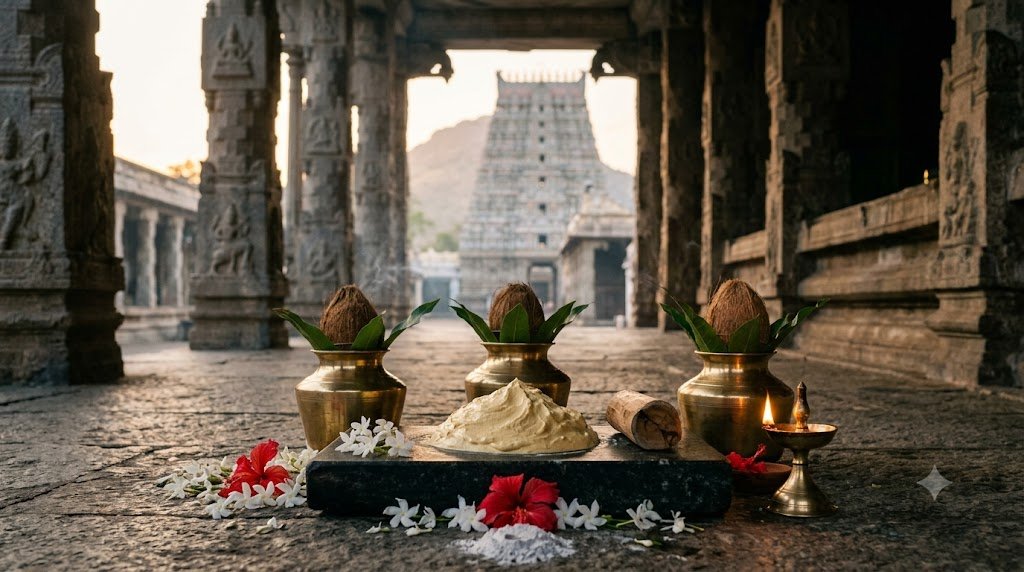
Sandal Abhishekam Tiruvannamalai is one of the most searched rituals at the Arunachaleswarar Temple, yet almost every page describing it gets one basic thing wrong. There is no separate sandal-only ticket sold at this temple. Sandal paste is a sacred substance poured during the abhishekam sequence, so you sponsor it by booking the right seva, not by asking for sandal at a counter. Once you understand that difference, planning becomes simple.
Independence note: tiruvannamalaidevasthanam.org.in is an independent pilgrim guide. We are not affiliated with, endorsed by, or the official website of Arulmigu Arunachaleswarar Temple or the Tamil Nadu Hindu Religious and Charitable Endowments (HR&CE) Department. We accept no bookings, donations, or payments. Use the official portal at annamalaiyar.hrce.tn.gov.in for every reservation.
Sandal Abhishekam Tiruvannamalai at a Glance
- What it is: chandanam, or sandalwood paste, poured over the deity during the ritual bath
- Who searches it: devotees looking for Sandal Abhishekam Tiruvannamalai slots and rates
- Separate ticket? No. Sandal is part of the wider abhishekam sequence
- Where to book: the official HR&CE portal, or the temple booking counter
- Seva cost: quoted at the booking counter — the figures circulating online for this temple conflict with each other
- Best viewing windows: the morning Ushakala and Kalasandhi poojas
- Take home: vibhuti, kumkumam, sandal paste and theertham as prasadam
What Sandal Abhishekam Means at Arunachaleswarar
Abhishekam is the ritual bathing of a deity with sacred substances. Sandal abhishekam refers to the stage where priests pour or smear chandanam, a cool sandalwood paste, over the lingam or idol. It arrives within a longer sequence that also uses milk, curd, honey, tender coconut, rose water, turmeric and vibhuti.
Tamil news reports of recent Pradosham worship at the temple list sandanam among the substances used on the Nandi shrines. Reports of the Astra Devar abhishekam mention the same. So sandal is not an occasional extra here. It is a standing part of Agamic practice at this temple.
Sandal Abhishekam Tiruvannamalai therefore describes a ritual stage, not a product. The word chandanam appears constantly in Shaiva ritual manuals. Because Shiva is described as abhisheka priya, or fond of the ritual bath, temples treat abhishekam as the central act of worship rather than a side offering.
The Booking Truth Behind Sandal Abhishekam Tiruvannamalai
Here is the correction that matters most. The published seva list for Arulmigu Arunachaleswarar Temple contains milk abhishekam, special abhishekam, Panchamoorthigal abhishekam, Mahanyasam, Thirukalyana Utsavam and the 1008 Sangu Pooja. It does not contain a line item called sandal abhishekam.
Several travel pages still advertise Sandal Abhishekam Tiruvannamalai as a fixed seva with a confident price. Others quote an abhishekam ticket at around ₹300. We could not find a published slab on the HR&CE portal to settle which, if any, is right. Treat both claims with caution, because a wrong figure sends devotees to the wrong counter.
What you actually do is straightforward. Book a special abhishekam or the Panchamoorthigal abhishekam, and sandal appears inside that ritual sequence. Confirm the exact seva name and current rate on the official portal before paying anything.
Why Sandal Suits This Particular Temple
Arunachaleswarar Temple is the Agni sthalam among the five Pancha Bhuta Sthalams. Shiva is worshipped here as fire, and the hill itself is treated as the Lord. Sandalwood, meanwhile, is the classic cooling substance of Indian ritual and medicine.
Devotees therefore read sandal at this shrine as a gesture of cooling the fire. Priests and traditional texts describe chandanam as calming the fierce aspect of Shiva. That reading belongs to faith and tradition, and we present it as such rather than as a proven outcome.
That contrast is why Sandal Abhishekam Tiruvannamalai carries such weight for devotees. Still, the symbolism explains why sandal features visibly in summer alangaram at Tamil Shiva temples. When the Tamil months of Chithirai and Vaikasi bring peak heat, the cooling imagery lands harder for pilgrims standing on hot stone.
Daily Pooja Timings When Sandal Is Used
Six kala poojas run each day, and every one includes abhishekam, alankaram and deeparadhanai. Sandal can feature in any of them, although morning services are easiest to watch. Plan Sandal Abhishekam Tiruvannamalai viewing around a morning slot. The table below gives the widely published schedule.
| Pooja | Indicative time | What happens |
|---|---|---|
| Ko Pooja | 5.00 AM | Worship of the cow, temple opens |
| Ushakalam | 5.30 AM | Abhishekam, alankaram, deeparadhanai |
| Kalasandhi | 8.00 AM | Abhishekam, alankaram, deeparadhanai |
| Uchikalam | 11.00 to 11.30 AM | Abhishekam, alankaram, deeparadhanai |
| Sayarakshai | 5.30 to 6.00 PM | Abhishekam, alankaram, deeparadhanai |
| Irandam Kalam | 7.30 PM | Abhishekam, alankaram, deeparadhanai |
| Ardhajamam | 9.00 PM | Final service before closing |
Why this page no longer quotes rupee figures
We could not find a published seva tariff for Arunachaleswarar Temple (HR&CE temple code TM020343) anywhere on the government portal, annamalaiyar.hrce.tn.gov.in. The figures we used to print here were not sourced from HR&CE, and they contradicted the figures on our own other pages — the same seva appeared at prices that differed several times over.
The seva counter inside the temple quotes the current rate, and HR&CE revises rates from time to time. That counter is the only authority we can point you to with confidence.
The official portal lists darshan from 5.30 AM to 8.00 PM, with an internal ritual break in the afternoon. On Saturdays, Sundays, Pournami days and public holidays, the temple permits entry until 7.30 PM. Devotees enter through the East Rajagopuram and the North Ammani Amman Gopuram.
Timings shift during festivals, so check the current schedule in our Tiruvannamalai temple darshan timings guide before you travel.
Seva Costs That Include Sandal
These are the abhishekam sevas the temple publishes. Any of them can carry Sandal Abhishekam Tiruvannamalai within its ritual sequence. Rates below are indicative only, because HR&CE revises them periodically. Always confirm on the official portal at booking time.
| Seva | Indicative cost | Indicative slot |
|---|---|---|
| Swamy and Amman Milk Abhishekam | Ask at the counter | 6.30 AM to 9.00 PM window |
| Swamy and Amman Special Abhishekam | Ask at the counter | 6.30 AM to 9.00 PM window |
| Vinayagar, Swamy and Amman Special Abhishekam | Ask at the counter | Morning slots |
| Panchamoorthigal Abhishekam, five deities | Ask at the counter | 8.30 AM and 10.30 AM |
| Mahanyasam with Special Pooja | Ask at the counter | Confirm at counter |
| 1008 Sangu Pooja Special Abhishekam | Ask at the counter | Confirm at counter |
One figure deserves a flag. Different listings quote the Vinayagar and Amman special abhishekam at ₹2,500 and at ₹3,000. We could not resolve that conflict against a live official page, so we are not going to endorse either figure. Ask at the booking counter before you pay.
For the wider list, see our Tiruvannamalai temple seva tickets guide.
How to Book Sandal Abhishekam Tiruvannamalai
There is no sandal-only button, so book the seva that contains it. You sponsor Sandal Abhishekam Tiruvannamalai through a standard abhishekam ticket. The process itself takes a few minutes online.
- Open the official temple portal at annamalaiyar.hrce.tn.gov.in
- Choose the temple booking service section
- Select an abhishekam seva rather than a plain darshan ticket
- Pick your date, since popular slots close early on Pournami and festival days
- Enter devotee details exactly as they appear on your identity document
- Pay online and save the confirmation on your phone
If online slots show as unavailable, the temple booking counter still issues tickets in person. Arrive early on Pradosham, Pournami and Krithigai days, because counters clear quickly. Our abhishekam timings and booking walkthrough covers the counter route in detail.
Festival Days When Sandal Features Heavily
Aani Thirumanjanam is the standout occasion. Observed in the Tamil month of Aani, which falls across June and July, it centres on a grand thirumanjanam for Lord Nataraja on the Uthiram star day.
After the holy bath, Nataraja and Sivakamasundari are decorated and carried in procession to the thousand-pillared hall. Tiruvannamalai also observes the Arakattu Utsavam at this time, when the shrines of revered Tamil saints face the Nataraja shrine during deeparadhanai.
Pradosham evenings are the other reliable window for Sandal Abhishekam Tiruvannamalai. During Sani Maha Pradosham, the Nandi shrines receive abhishekam with milk, rose water, tender coconut, honey, panchamirtham and sandanam. Karthigai Deepam in November or December remains the largest festival, although crowds then make quiet ritual viewing difficult.
What You Receive After the Ritual
Prasadam is where most first-time devotees are pleasantly surprised. After the abhishekam concludes, priests distribute vibhuti, kumkumam, sandal paste and theertham according to the ticket booked.
So sandal reaches you twice in one visit. It is poured during the ritual, and a portion returns to you as prasadam. Carry a small clean container, because the paste stains cloth and bags easily.
Bring a change of clothes if the priest invites you closer during the pouring. Sandal and panchamirtham both mark fabric, and the stains rarely wash out fully.
Fake Portals and Agents: How to Spot Them
Search results for temple sevas attract copycat booking sites. Some charge inflated service fees, while others simply harvest personal details. A few advertise premium sandal packages that the temple does not sell.
Use these checks before paying anyone. The genuine portal sits on a government domain ending in gov.in. No agent can guarantee a sanctum slot, and no legitimate booking asks for your full identity document upload to a private site.
If a page promises guaranteed VIP access to a named priest, walk away. Route every payment through the official portal or the temple counter instead.
What Beginners Get Wrong
- Assuming Sandal Abhishekam Tiruvannamalai is a standalone product with its own rate card
- Arriving during the afternoon ritual break, when the sanctum stays closed
- Booking only darshan and expecting to stand inside the abhishekam
- Trusting a price quoted by a blog instead of the government portal
- Skipping the Unnamulai Amman shrine after seeing the main sanctum
One more practical point. Photography rules inside the shrines are strict, so watch what other devotees do and follow temple staff instructions.
Safety and Comfort Notes
The complex spreads across roughly 25 acres, and you walk it barefoot. Granite heats up sharply between 11 AM and 4 PM, so morning visits protect your feet.
Carry drinking water, especially if you plan Girivalam, the 14 kilometre circuit around Arunachala hill. Elderly pilgrims, pregnant women and anyone with a heart or joint condition should pace the walk and rest often.
Ritual participation involves long periods of sitting or standing. If you are fasting or have a medical condition, speak to your doctor before the trip. Temple rituals are acts of faith, and they are not a substitute for medical treatment.
Before You Go
Sandal is genuinely central to worship at the Agni sthalam, yet it is not a ticket you buy by name. Book a special abhishekam or the Panchamoorthigal abhishekam, then arrive for a morning kala pooja. Treat Sandal Abhishekam Tiruvannamalai as a ritual stage inside a seva you book.
Verify the current rate on the official portal, because published figures change. For wider planning, start with our complete Arunachaleswarar Temple guide.
Frequently Asked Questions
Is there a separate sandal abhishekam ticket at Tiruvannamalai?
No. The temple’s published seva list has no standalone sandal ticket. Sandal paste is poured within the special abhishekam and Panchamoorthigal abhishekam sequences, so booking one of those sevas is how devotees sponsor it.
What does Sandal Abhishekam Tiruvannamalai cost?
Because sandal sits inside a larger seva, the cost is the seva cost. We could not find published rates for this temple’s abhishekams anywhere on annamalaiyar.hrce.tn.gov.in, so the counter’s quote is the figure that counts.
What time is abhishekam performed at Arunachaleswarar Temple?
Six kala poojas run daily, each with abhishekam. The commonly published times are Ushakalam at 5.30 AM, Kalasandhi at 8.00 AM, Uchikalam near 11.00 AM, Sayarakshai near 5.30 PM, Irandam Kalam at 7.30 PM and Ardhajamam at 9.00 PM.
Can I book abhishekam online?
Yes. The Tamil Nadu HR&CE portal for this temple handles online seva booking. When online slots are exhausted, the temple booking counter still issues tickets in person on the day.
Which substances are used besides sandal?
Milk, curd, honey, tender coconut water, rose water, turmeric, panchamirtham and vibhuti all appear in temple abhishekam sequences here. Reported Pradosham services list sandanam alongside these substances.
Which festival features the biggest thirumanjanam?
Aani Thirumanjanam, in the Tamil month of Aani during June and July, is the major ritual bathing festival for Lord Nataraja. Karthigai Deepam draws far larger crowds, though its focus is the hilltop lamp.
Do I get sandal paste as prasadam?
Yes. Devotees who book an abhishekam typically receive vibhuti, kumkumam, sandal paste and theertham afterwards. The exact prasadam depends on the ticket category booked.
Is there a dress code for attending abhishekam?
Traditional attire is expected. Men usually wear a dhoti with an angavastram, while women wear a saree or salwar kameez. Shorts and sleeveless tops are best avoided inside the shrines.
Where is the official information published?
The temple sits under the Tamil Nadu HR&CE Department. Its official pages carry timings, services and booking links, and the Tamil Nadu Tourism site lists the annual festival calendar.

The Tiruvannamalai Devasthanam editorial team is an independent group of writers and researchers documenting pilgrimage to the Arunachaleswarar Temple and Arunachala Hill, Tiruvannamalai. We are not affiliated with the temple or the Tamil Nadu HR\&CE Department. Every darshan timing, festival date and ritual detail we publish is cross-checked against the HR\&CE department, on-the-ground reports and at least two independent sources before it is published, and festival dates are re-verified each year. Spotted an error? Tell us and we will correct it.
