The Tiruvanandal Pooja is the first ritual of the day at the Arunachaleswarar Temple in Tiruvannamalai. Priests perform it at dawn to gently wake Lord Shiva from His night’s rest. Many pilgrims arrive expecting a bookable “Suprabhatam seva” like the one at Tirupati. Yet the reality here differs, because this dawn ritual follows the ancient Saiva Agama routine instead.
So knowing what happens, when it starts, and how to witness it saves you a wasted early trip. This guide clears the common confusion with the verified schedule, meaning, and practical steps.
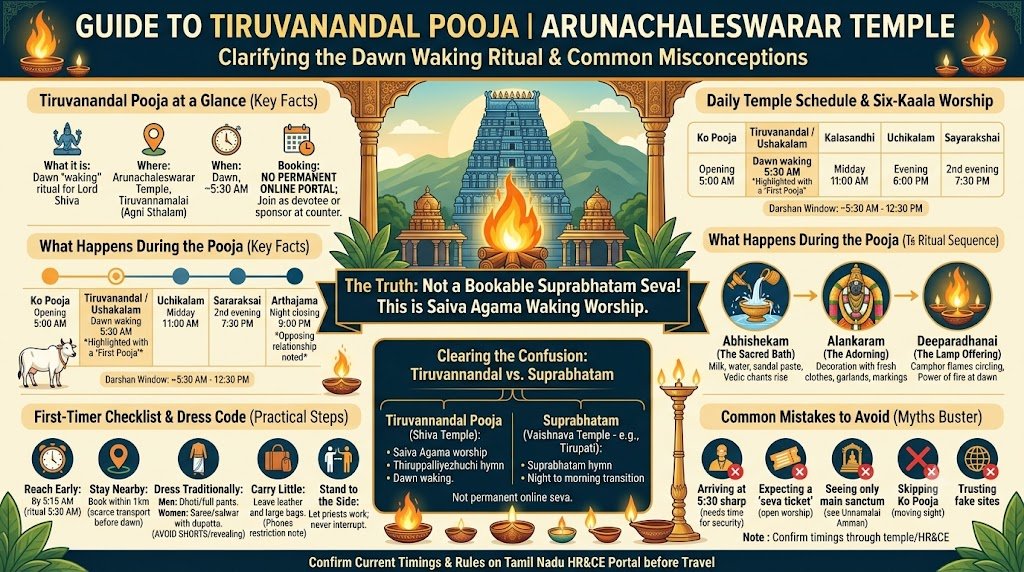
Tiruvanandal Pooja at a Glance
The Tiruvanandal Pooja opens the temple’s six-time daily worship cycle at the foot of Arunachala Hill. Here are the essentials before you plan an early visit.
- What it is: the dawn “waking” ritual for Lord Arunachaleswarar, the first pooja of the day.
- Usual time: around 5:30 AM, right after the temple opens with the Ko Pooja (cow worship) near 5:00 AM.
- Rituals inside it: Abhishekam (sacred bath), Alankaram (adorning), and Deeparadhanai (lamp offering).
- Tradition: Saiva Agama worship, not the Vaishnava Suprabhatam sung at Tirupati.
- Booking: no permanent online portal exists; you join as a devotee or arrange offerings at the temple counter.
What Is the Tiruvanandal Pooja?
The Tiruvanandal Pooja is the sacred dawn ceremony that “wakes” the deity and starts the temple’s ritual day. The Tamil word blends “Thiru” (sacred) with “ananthal” (rousing from sleep). Priests treat the Lord as a living presence, so each morning begins by rousing Him with light, sound, and offerings.
Because Arunachaleswarar Temple honours Shiva as the Agni (fire) element, this first pooja carries deep meaning. It marks the moment the divine flame is tended anew for the day. Devotees who attend often describe a calm, charged silence that later crowds never quite match.
The ritual is also spelt “Thiruvananthal” on many boards and older records. Both spellings point to the same dawn worship. While the name repeats across Tamil Shaiva temples like Madurai and Kutralam, the Tiruvannamalai version keeps its own rhythm and timing.
Tiruvanandal Pooja Timing and Daily Schedule
The Tiruvanandal Pooja usually takes place around 5:30 AM, soon after the temple gates open. First comes the Ko Pooja near 5:00 AM, a short cow-worship rite that marks the opening. Then the dawn pooja proper begins inside the sanctum. Timings can shift on festival days, so confirm at the counter before a long journey.
Arunachaleswarar Temple follows the traditional six-kaala (six-time) worship pattern each day. The table below shows the full sequence, which helps you place the dawn ritual within the day.
| Pooja | Usual Time | Main Rituals |
|---|---|---|
| Ko Pooja (opening) | 5:00 AM | Cow worship, temple opens |
| Tiruvanandal / Ushakalam | 5:30 AM | Abhishekam, Alankaram, Deeparadhanai |
| Kalasandhi | 8:00 AM | Abhishekam, Alankaram, Deeparadhanai |
| Uchikalam | 11:00 AM | Midday worship |
| Sayarakshai | 6:00 PM | Evening worship |
| Irandam Kalam | 7:30 PM | Second evening pooja |
| Arthajama | 9:00 PM | Night worship, temple closes |
The morning darshan window runs from about 5:30 AM to 12:30 PM. So the dawn pooja sits right at the start, when the sanctum is freshest and least crowded. For the complete day-long schedule, see our Tiruvannamalai temple darshan timings guide.
What Happens During the Tiruvanandal Pooja
During the Tiruvanandal Pooja, priests perform three linked rituals in a fixed order. Each one carries a distinct purpose, and together they form the complete dawn worship. Watching them in sequence reveals why this pooja feels so different from a quick darshan.
Abhishekam — the sacred bath
First, priests bathe the Lingam with sacred substances, a rite called Abhishekam. Milk, water, sandal paste, and holy ash flow over the stone while Vedic chants rise. Because this cleansing renews the deity’s energy, devotees consider it the heart of the morning.
Alankaram — the adorning
Next comes Alankaram, the decoration of the deity with fresh clothes, garlands, and sacred markings. After the bath, the Lord is dressed for the new day. So this stage transforms the freshly bathed form into a radiant, blessed vision.
Deeparadhanai — the lamp offering
Finally, priests wave oil lamps before the deity, a rite called Deeparadhanai. As camphor flames circle the sanctum, the gathered devotees fold their hands in prayer. Since fire is Arunachala’s own element, this lamp offering feels especially powerful at dawn.
Why the Dawn Ritual Matters at an Agni Sthalam
The dawn worship carries extra weight here because Arunachaleswarar is the Agni Sthalam among the five Pancha Bhoota temples. Each of these five shrines honours one element of nature, and Tiruvannamalai holds the element of fire. So lighting the first lamps of the day at a fire temple feels deeply symbolic.
Ancient Tamil hymns describe Arunachala Hill itself as an endless column of fire that neither Brahma nor Vishnu could measure. The morning pooja tends that eternal flame in ritual form. According to Tamil Nadu Tourism, the temple ranks among the largest Shiva shrines in India, spread across roughly 25 acres. Because of this scale, the quiet dawn hour offers a rare chance to feel the sanctum’s power without festival crowds.
Tiruvanandal Pooja vs Suprabhatam: Clearing the Confusion
The single biggest myth online treats the Tiruvanandal Pooja as a “Suprabhatam seva.” That is wrong, because the two belong to different temple traditions. Suprabhatam is a Vaishnava waking hymn, sung to wake Vishnu at temples like Tirupati and Srirangam.
Arunachaleswarar is a Shiva temple, so it follows Saiva Agama worship. The Tamil Shaiva waking hymn is the Thiruppalliyezhuchi, composed by the saint Manikkavacakar. While both traditions “wake” the deity at dawn, the hymns, rites, and rules are not the same. So do not expect a ticketed Suprabhatam counter here; that model belongs to Vaishnava shrines.
This distinction matters for planning. If you arrive asking for a “Suprabhatam booking,” staff may look puzzled. Instead, ask about the morning Ushakalam or Tiruvanandal worship, and you will be understood at once.
Is the Tiruvanandal Pooja the Same as the Night Pooja?
No, the Tiruvanandal Pooja is the morning waking ritual, while the night ritual is the opposite. At dawn, priests rouse the deity; at night, they put Him to rest. Many first-time visitors mix these up, so the difference is worth stating plainly.
The final worship of the day is the Arthajama Pooja, held around 9:00 PM before the temple closes. In some temples, a Palliyarai (bed-chamber) rite symbolically retires the deity for the night. So the dawn Tiruvanandal and the night Arthajama sit at exactly opposite ends of the daily cycle. Confusing them means arriving fifteen hours early or late.
Can You Book the Tiruvanandal Pooja Online?
You cannot book the Tiruvanandal Pooja through any permanent online portal, because no such seva-booking website exists for this temple. This is another point where competing pages mislead readers. Unlike Tirupati’s structured seva system, Arunachaleswarar keeps most daily worship open to all devotees present.
The Tamil Nadu Hindu Religious and Charitable Endowments (HR&CE) Department manages the temple. During major festivals, the department sometimes opens seasonal darshan or abhishekam slots online. Yet these links appear only for crowd control and vanish afterward, so treat any “book Tiruvanandal pooja” site with caution.
If you wish to sponsor offerings, the reliable route is the temple counter or the Assistant Commissioner’s office. You can also simply attend the dawn worship as a devotee. For festival-season slots, our Tiruvannamalai temple online booking guide explains when links go live.
How to Attend the Dawn Pooja: A Simple Checklist
Attending the dawn worship needs little planning, though a few steps make it smoother. Follow this checklist for a calm, unhurried morning at the sanctum.
- Reach early: arrive by 5:15 AM so security checks do not make you miss the 5:30 AM ritual.
- Stay nearby: book a room within one kilometre, since autos are scarce before dawn.
- Dress traditionally: men in dhoti or full pants; women in saree or salwar. Avoid shorts.
- Carry little: leave leather items and large bags behind, because they slow the queue.
- Stand to the side: let priests work; never interrupt an ongoing pooja.
Personal abhishekam participation stays limited inside the sanctum. If witnessing the bath matters to you, read our Tiruvannamalai abhishekam timings and booking guide before you travel.
Why the Dawn Pooja Is the Best Time to Visit
The dawn worship is, in my experience, the finest hour to see Arunachaleswarar Temple. Crowds thin out to a handful of serious devotees, so the sanctum feels intimate. The morning air stays cool, and the chants carry clearly through the empty stone corridors. Because the light is still soft at that hour, the whole complex glows gently against the dark hill behind it.
There is a practical reason too. Because the free darshan line can stretch for hours by mid-morning, an early arrival means near-instant access. So you gain both a deeper experience and a shorter wait. Weekday mornings from Monday to Wednesday are usually the quietest of all.
What Most Pilgrims Get Wrong About the Dawn Ritual
Even regular visitors trip over a few avoidable mistakes. These insider notes come from watching the morning routine unfold many times.
- Arriving at 5:30 sharp: security screening takes time, so 5:15 AM is safer.
- Expecting a “seva ticket”: the dawn pooja is open worship, not a paid counter slot.
- Seeing only the main sanctum: the Unnamalai Amman shrine deserves a visit too.
- Skipping the Ko Pooja: the 5:00 AM cow-worship opening is a quiet, moving sight.
- Trusting fake booking sites: always verify timings through the HR&CE department or temple office.
Before You Go
The Tiruvanandal Pooja rewards the effort of an early start with a rare, peaceful darshan of Lord Arunachaleswarar. Remember that it is the dawn waking ritual at roughly 5:30 AM, rooted in Saiva Agama rather than the Vaishnava Suprabhatam. Skip any site promising an online “Tiruvanandal pooja booking,” and plan instead to attend as a devotee or sponsor offerings at the counter.
Reach by 5:15 AM, dress simply, and let the morning chants do the rest. For deeper planning, explore the full Arunachalam temple guide. Always confirm current timings through the temple or the Tamil Nadu HR&CE department before you travel.
Frequently Asked Questions
What time is the Tiruvanandal Pooja at Arunachaleswarar Temple?
The Tiruvanandal Pooja usually takes place around 5:30 AM, just after the temple opens with the Ko Pooja near 5:00 AM. Timings can change on festival days, so confirm with the temple office before you travel.
What does Tiruvanandal mean?
Tiruvanandal means the sacred waking of the deity, from “Thiru” (sacred) and “ananthal” (rousing from sleep). It is the first pooja of the day, when priests wake Lord Shiva for morning worship.
Is the Tiruvanandal Pooja the same as Suprabhatam?
No. Suprabhatam is a Vaishnava waking hymn used at Vishnu temples like Tirupati. Arunachaleswarar is a Shiva temple and follows the Saiva waking tradition, whose Tamil hymn is the Thiruppalliyezhuchi.
Can I book the Tiruvanandal Pooja online?
No permanent online booking exists for this ritual. The HR&CE department may open seasonal festival slots, but daily dawn worship stays open to devotees. Sponsor offerings at the temple counter if you wish.
What rituals happen during the dawn pooja?
Three rituals unfold in order: Abhishekam (the sacred bath), Alankaram (adorning the deity), and Deeparadhanai (the lamp offering). Together they form the complete dawn worship at the sanctum.
How early should I arrive for the morning worship?
Arrive by 5:15 AM so security screening does not make you miss the 5:30 AM ritual. Staying within one kilometre of the temple helps, since transport is limited before dawn.
Which is the last pooja of the day?
The Arthajama Pooja, held around 9:00 PM, is the final worship before the temple closes. It is the night counterpart to the dawn Tiruvanandal ritual, so the two frame the daily cycle.
Is there a dress code for the dawn darshan?
Yes, traditional attire is expected. Men should wear a dhoti or full pants, and women a saree or salwar. Avoid shorts, sleeveless tops, and revealing clothing inside the temple.

The Tiruvannamalai Devasthanam editorial team is an independent group of writers and researchers documenting pilgrimage to the Arunachaleswarar Temple and Arunachala Hill, Tiruvannamalai. We are not affiliated with the temple or the Tamil Nadu HR\&CE Department. Every darshan timing, festival date and ritual detail we publish is cross-checked against the HR\&CE department, on-the-ground reports and at least two independent sources before it is published, and festival dates are re-verified each year. Spotted an error? Tell us and we will correct it.
