Most pilgrims first hear about Navagraha Homam benefits during a rough patch. A delayed marriage, a stalled career, or a run of poor health sends them to an astrologer. The advice that follows is often the same: appease the nine planets through a sacred fire ritual. Because the topic mixes faith, money, and hope, it also attracts half-truths and overpriced booking traps.
This guide explains what the ritual really involves. It also shows what devotees traditionally seek, and how to arrange one without falling for a scam.
tiruvannamalaidevasthanam.org.in is an independent pilgrim guide. We are not the official website of the Arunachaleswarar Temple, the Tamil Nadu HR&CE Department, or any priest service, and we hold no affiliation with them. We do not conduct homams, accept bookings, or take payments. Please use the official portals linked below to arrange any ritual.
Navagraha Homam at a Glance
- What it is: a Vedic fire ritual (homam) dedicated to the nine planetary deities, or Navagrahas.
- Why people do it: to seek relief from planetary doshas, and to invite peace, health, and prosperity as a matter of faith.
- The nine grahas: Surya, Chandra, Mangala, Budha, Guru, Shukra, Shani, Rahu, and Ketu.
- Best days: Saturdays and Amavasya (new moon) are popular, though your birth star decides the ideal date.
- Typical duration: a full homam runs roughly 2 to 4 hours; elaborate versions take longer.
- Cost: it varies widely by priest and scale, so confirm and pay only through an official source.
What Is Navagraha Homam?
Navagraha Homam is a Vedic fire ritual that honours the nine planetary deities. Devotees perform it to reduce the malefic effects that difficult planetary positions can cause in a horoscope. The priest invokes each Graha into the sacred fire (Agni) with mantras and offerings, then seeks balance and blessings.
The word breaks down simply. “Nava” means nine, and “Graha” means planet or celestial force. In Vedic astrology, these nine grahas shape a person’s karma across health, career, relationships, and mind.
When one or more sit in a hard position in the birth chart, tradition prescribes worship. The homam is one of the most complete forms of that worship, because it addresses all nine planets at once.
Navagraha Homam Benefits: What the Ritual Is Believed to Offer
The Navagraha Homam benefits described in tradition centre on balance, not magic. Devotees perform it to soften the effects of poorly placed planets and strengthen favourable ones. They also seek ayush (long life), arogya (health), and saukhyam (well-being). These are matters of faith and Vedic custom rather than guaranteed outcomes.
In short, the Navagraha Homam benefits work on mindset, devotion, and hope, and never on any promise written into a contract. Because each planet governs a different area of life, the hoped-for benefits also differ from person to person. Someone facing repeated obstacles may seek relief from Shani (Saturn). A couple facing marriage delays may instead focus on Guru and Shukra.
Still, the ritual honours all nine together, so the intent stays holistic. That is why the Navagraha Homam benefits are framed as all-round harmony rather than a single fix.
Navagraha Homam Benefits by Planet
The table below sums up how tradition understands each graha. It links every planet to a weekday and a life area, which shows why the Navagraha Homam benefits are seen as broad. Read it as belief and custom, not as a promise.
| Graha | Weekday | Life area (traditional belief) |
|---|---|---|
| Surya (Sun) | Sunday | Health, vitality, confidence |
| Chandra (Moon) | Monday | Mind, emotions, peace |
| Mangala (Mars) | Tuesday | Courage, property, energy |
| Budha (Mercury) | Wednesday | Learning, speech, business |
| Guru (Jupiter) | Thursday | Wisdom, marriage, prosperity |
| Shukra (Venus) | Friday | Relationships, arts, comfort |
| Shani (Saturn) | Saturday | Discipline, karma, patience |
| Rahu | — | Ambition, sudden change |
| Ketu | — | Detachment, spirituality |
The Honest Truth: Navagraha Homam Benefits vs Exaggerated Claims
Here is where many websites cross a line. Booking pages routinely promise that a homam will “cure” illness, guarantee a job, or clear debts within weeks. That framing is not tradition, and it is not honest.
The genuine Navagraha Homam benefits are spiritual and psychological. So treat any “100% results” or “guaranteed cure” claim as a clear red flag.
This matters most for serious problems. A homam is not a substitute for a doctor, a lawyer, or a financial adviser. Moreover, if you face illness, a legal dispute, or heavy debt, please consult a qualified professional as well.
Faith practice and expert help work best side by side. Framing a ritual as a medical cure can delay the care someone actually needs.
There is a physical safety note too. A homam involves an open fire and smoke over a long sitting. So anyone with asthma or breathing trouble, pregnant women, and elderly participants should sit further back and stay hydrated. A well-ventilated space matters more than sitting closest to the flames.
How the Navagraha Homam Is Performed
A qualified priest, or vadhyar, leads the ritual through a fixed sequence. The exact steps vary by tradition and region. Yet the core structure stays remarkably consistent, because it follows Agama and Vedic texts.
- Sankalpa: the devotee states their name, birth star, and intention, which dedicates the ritual to them.
- Kalasha Sthapana: the priest consecrates a sacred water pot to invite divine presence.
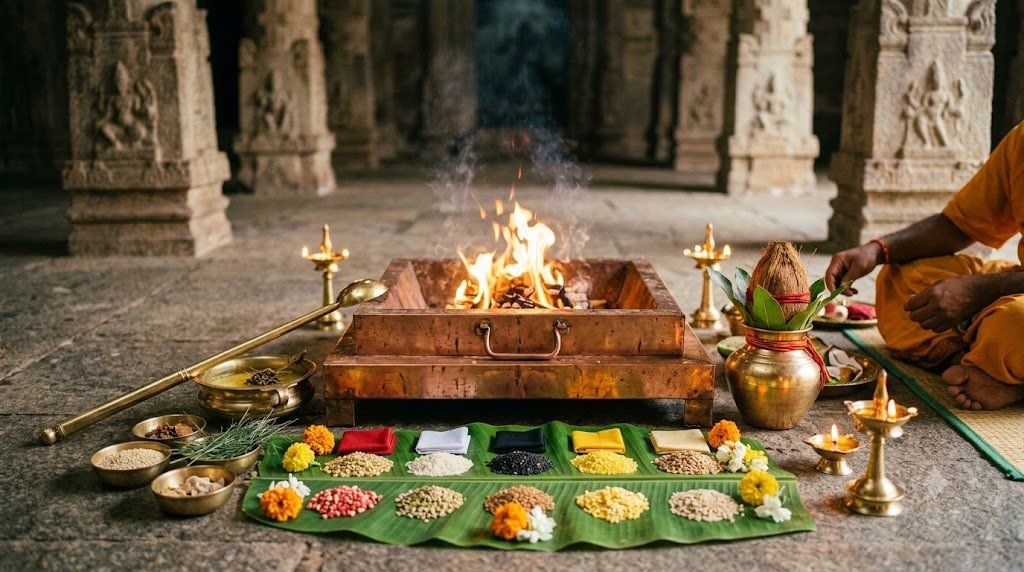
- Navagraha Puja: the priest worships each planet with its own grain (Nava Dhanyam), flower, cloth colour, and mantra.
- Agni Pratishtha: the priest kindles the sacred fire in the homa kunda.
- Homam: offerings of ghee, sesame, and herbs go into the fire while priests chant the Navagraha mantras.
- Purnahuti and Aarti: a final offering closes the ritual, after which the priest shares prasad and sacred ash.
Nine sacred twigs (samidha), one for each graha, often join the fire so every planet receives its due. Afterwards devotees usually receive vibhuti (grey ash) and kumkum. Many families keep these on the home altar, and they apply a little ash on the forehead to carry the blessing home.
When Should You Perform Navagraha Homam?
Vedic practice treats timing as important. Many devotees choose Saturdays or Amavasya (new moon day) for a general homam. A planet-specific concern may instead point to that planet’s own weekday. For a personal ritual, though, the strongest date follows your Janma Nakshatra (birth star) and the day’s tithi.
People often schedule the homam before a new chapter. For example, a housewarming, a wedding, a new job, or a business launch are common triggers. Others turn to it after a long rough phase, when they want a spiritual reset.
Because the right muhurta depends on your chart, ask a temple priest or family astrologer to confirm the date. A generic online slot cannot judge that for you.
Navagraha Worship at Arunachaleswarar Temple, Tiruvannamalai
Tiruvannamalai carries a special resonance for a fire ritual. The Arunachaleswarar Temple is the Agni (Fire) Sthalam among the five Pancha Bhoota Sthalams. So devotees worship Lord Shiva here as the Agni Lingam.
A homam is itself an offering through fire. That is why many pilgrims plan planetary worship around a Tiruvannamalai visit.
Like most large South Indian Shiva temples, the Arunachaleswarar complex includes a Navagraha sannidhi. Pilgrims offer prayers to the nine planets there. Everyday Navagraha worship usually means archana and lamp offerings at that shrine, rather than a full homam at a counter.
Do you want a formal Navagraha Homam arranged at the temple? If so, confirm the current options directly with the temple office or the Tamil Nadu HR&CE Department, since the administration sets any such arrangement and its fees.
One lovely local custom is worth knowing. Devotees who complete Girivalam on a Saturday traditionally seek the grace of the Navagraha. Girivalam is the 14 km barefoot circumambulation of Arunachala Hill.
Relief from planetary troubles is the blessing devotees link with that Saturday walk. So a Saturday Girivalam can pair naturally with your planetary worship. Our full Arunachalam Temple pilgrim guide and the Tiruvannamalai seva tickets list help you plan the wider visit.
Cost of Navagraha Homam and How to Avoid Booking Scams
Honest answer first: no single official price exists for a Navagraha Homam. The cost depends on the priest, the scale, the materials, and the venue. A modest priest-led homam may cost a few thousand rupees, while an elaborate one runs higher. So treat any suspiciously precise “special rate” for guaranteed results with caution.
Fraud is common in this space, so protect yourself. Fake portals and freelance agents often copy official temple branding. They harvest personal and payment details, and they inflate fees for rituals that cost far less at the temple.
Therefore, pay only through the temple’s own counter or its official portal. Never share card details on an unverified “book now” page.
For anything connected to the Arunachaleswarar Temple, use the Tamil Nadu HR&CE Department portal at hrce.tn.gov.in. You can also reach the temple’s official page through hrce.tn.gov.in. Planning other rituals during the same trip? Our abhishekam timings and booking guide explains how the temple’s seva counters work.
What Devotees Often Get Wrong About Navagraha Homam
A few honest corrections can save you money and disappointment. First, more expensive does not mean more powerful. Sincerity and a qualified priest matter far more than a premium package. Second, one homam is not a lifetime guarantee, because tradition treats planetary worship as ongoing.
Third, an online “e-homam” can feel meaningful, yet it is not automatically the same as being present. So choose the format that suits your faith and budget. Finally, do not skip the birth-star step. A ritual dedicated with your correct nakshatra and sankalpa feels far more complete than a generic booking where nobody records your details.
Before You Book a Navagraha Homam
The real value of this ritual lies in intention, tradition, and peace of mind. It does not lie in promises of instant results. Verify your date against your birth star, and choose a qualified priest or a temple you trust. Keep your expectations grounded in faith rather than guarantees.
Above all, pay only through official channels. Treat any serious problem, medical or financial, with proper expert help alongside your prayers. Approached this way, the homam becomes a calm, meaningful step rather than a costly gamble.
Frequently Asked Questions
What are the main Navagraha Homam benefits?
The traditional Navagraha Homam benefits include relief from planetary doshas, greater peace of mind, and blessings for health and harmony. These are matters of faith and Vedic custom, not guaranteed results. So treat any “guaranteed cure” claim with caution.
Who should perform Navagraha Homam?
Anyone can perform it, though tradition suggests it for people going through a hard phase or starting something new. If an astrologer has flagged a specific dosha in your chart, priests often recommend the homam as a remedy.
How long does a Navagraha Homam take?
A standard Navagraha Homam usually takes around 2 to 4 hours. The exact length depends on the priest and the scale of the ritual. Elaborate versions with extended chanting run considerably longer.
Which day is best for Navagraha Homam?
Many devotees choose Saturdays or Amavasya (new moon) for a general homam. For a personal ritual, though, your birth star and the day’s tithi decide the best day. So ask a priest to confirm it.
Can I do Navagraha Homam at Arunachaleswarar Temple in Tiruvannamalai?
The temple has a Navagraha sannidhi where devotees offer worship, and Saturday Girivalam is traditionally linked to Navagraha relief. For a formal homam and any fees, confirm current arrangements directly with the temple office or the Tamil Nadu HR&CE Department.
How much does a Navagraha Homam cost?
No fixed official price exists, since cost depends on the priest, materials, and scale. Confirm the amount in advance. Pay only through the temple counter or an official portal to avoid inflated agent fees.
Is Navagraha Homam a cure for illness or money problems?
No. The homam is a faith practice, not a medical, legal, or financial cure. Never use it as a substitute for professional help. Consult a qualified doctor or adviser for serious problems, and treat the ritual as spiritual support alongside that care.

The Tiruvannamalai Devasthanam editorial team is an independent group of writers and researchers documenting pilgrimage to the Arunachaleswarar Temple and Arunachala Hill, Tiruvannamalai. We are not affiliated with the temple or the Tamil Nadu HR\&CE Department. Every darshan timing, festival date and ritual detail we publish is cross-checked against the HR\&CE department, on-the-ground reports and at least two independent sources before it is published, and festival dates are re-verified each year. Spotted an error? Tell us and we will correct it.
