
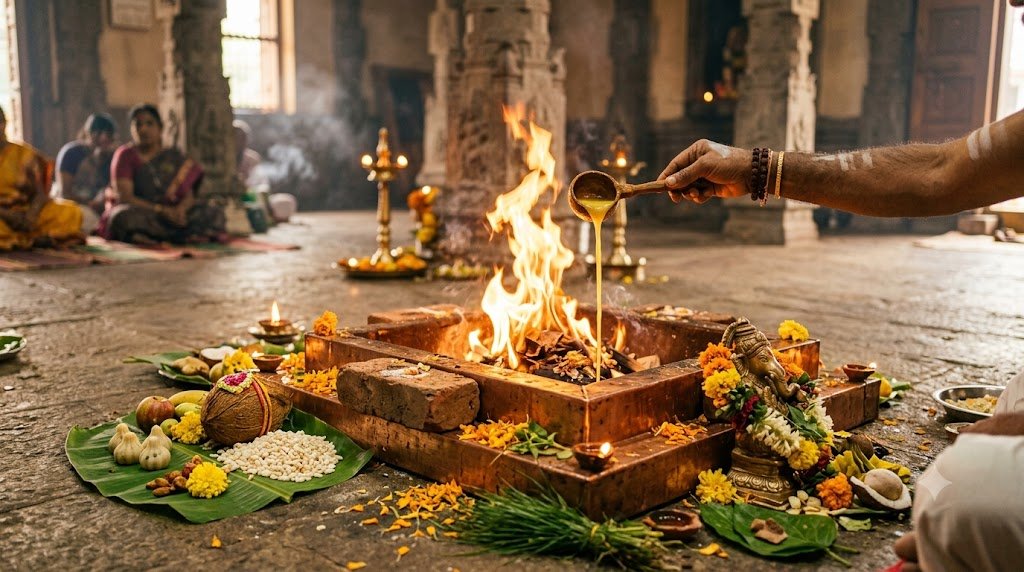
Ganapathi Homam is the Vedic fire ritual devotees turn to before starting anything important — a new business, a wedding, a housewarming, or any fresh chapter that needs a clean, obstacle-free beginning. Because devotees worship Lord Ganesha first among all deities, this homam usually opens any auspicious event. This guide explains what the ritual involves, why it matters, what it costs, when to perform it, and how devotees visiting Tiruvannamalai can weave Ganesha worship into their pilgrimage. You will get the practical detail most pages skip, without a single invented figure.
Tiruvannamalai Temple Guide is an independent pilgrim resource. It is not affiliated with the Arunachaleswarar Temple or the Tamil Nadu HR&CE Department, and it does not accept bookings, payments, or homam requests. Arrange any seva through the temple office or the official portal linked below.
Ganapathi Homam at a Glance
- What it is: a sacred fire offering (homa) to Lord Ganesha, the remover of obstacles.
- Main purpose: clearing hurdles before a new venture, and inviting wisdom and prosperity.
- Best days: Sankashti Chaturthi, Vinayaka Chaturthi, Ganesh Chaturthi, and Fridays.
- Timing: early morning, so the final offering falls around sunrise.
- Duration: roughly two to three hours for a standard version.
- Typical cost: about ₹1,000–₹3,000 privately; larger versions cost more.
What Is Ganapathi Homam?
Ganapathi Homam is a Vedic fire ceremony in which a priest offers ghee, grains, and other sacred materials into a consecrated fire while chanting Ganesha mantras. The fire, or Agni, carries the prayers to Lord Ganesha, whom the priest invokes to remove obstacles and bless the beginning. It is one of the oldest and most widely performed homams in Hindu tradition.
The ritual centres on Lord Ganesha, also called Ganapathi or Vigneshwara, the son of Lord Shiva and Goddess Parvati. His elephant head stands for wisdom, and his role as Vighnaharta means “remover of obstacles.” So before any wedding, business launch, or house-entering ceremony, families invoke him first to smooth the road ahead.
Why Ganesha Is Worshipped First
In Hindu practice, Ganesha is the Pratham Pujya — the deity honoured before all others. Any pooja or larger homam usually opens with a Ganapathi ritual, because clearing obstacles must come before every other prayer. This is why priests often begin a big ceremony with a short Ganapathi Homam, then move on to the main deity.
Benefits of Ganapathi Homam
Devotees perform Ganapathi Homam seeking specific blessings, though these benefits belong to faith and Vedic tradition rather than guaranteed outcomes. Still, the reasons people choose this ritual are consistent across regions and communities.
- Removal of obstacles: the core purpose, whether the hurdle is in work, study, or family life.
- Auspicious beginnings: a clean start for a business, marriage, or new home.
- Wisdom and focus: Ganesha is the patron of learning, so students and scholars often perform it.
- Peace of mind: the chanting and fire create a calm, centred atmosphere.
- Ketu remedy: in tradition, Ganesha governs the planet Ketu, so devotees offer the ritual to ease Ketu-related dosha.
Because these are matters of belief, treat any “remedy” claim as tradition, not as medical or financial advice. A Ganapathi Homam is a spiritual practice, never a substitute for a doctor, lawyer, or qualified professional.
Who Should Consider It
Anyone facing a big transition can perform this homam. It suits people starting a company, buying a home, planning a wedding, or sitting important exams. Families also arrange it once a year for general well-being, since Ganesha worship is open to devotees of every background.
Ganapathi Homam Procedure, Step by Step
The exact steps vary by tradition and region, yet the core sequence stays the same. A qualified priest leads the ritual, while the sponsor (yajaman) sits alongside and participates. Here is how a standard homam usually unfolds.
- Purification and Sankalpa: the priest cleans the space, and the devotee states the purpose aloud.
- Ganapathi Puja: the family offers flowers, fruit, and modak to a Ganesha idol or image.
- Kalasha Sthapana: a sacred pot of water, topped with mango leaves and a coconut, represents the divine presence.
- Agni Pratishthapana: the priest kindles and consecrates the sacred fire in the homa kunda.
- Mantra chanting: the priest recites Ganesha mantras, including the well-known “Om Gam Ganapataye Namaha.”
- Offerings into the fire: the priest offers ghee, grains, durva grass, and coconut while each mantra ends in “swaha.”
- Poornahuti: the final, fullest offering closes the ritual, ideally near sunrise.
- Aarti and prasadam: the priest performs a closing aarti, and everyone shares the blessed prasadam.
Materials You Will Need
The samagri, or ritual materials, are simple and easy to gather. Your priest will usually give you a list, but the common items rarely change.
| Item | Purpose in the Ritual |
|---|---|
| Pure cow ghee | Fuels the fire and symbolises nourishment |
| Modak / kozhukattai | Ganesha’s favourite offering |
| Durva (arugampul) grass | Sacred grass dear to Ganesha |
| Coconut and banana | Devotees offer these whole and in slices |
| Puffed rice, sesame, jaggery | Traditional grain offerings for prosperity |
Because the fire burns for a couple of hours, keep the room well ventilated and keep children at a safe distance. This is a simple safety point that many guides forget to mention.
Best Days for Ganapathi Homam
You can perform Ganapathi Homam on any day with sincere devotion, yet certain days carry special power. The most auspicious are the two monthly Chaturthi days — Vinayaka Chaturthi in the bright fortnight and Sankashti Chaturthi in the dark fortnight — both dedicated to Ganesha. Fridays and Tuesdays are also favoured for this ritual.
The grandest day of the year is Ganesh Chaturthi, which falls on 15 September 2026. Priests advise starting the homam early, before sunrise, so the Poornahuti lands as the sun rises. It is also wise to avoid the Rahu Kalam window on the chosen day. For accurate tithi and muhurtham timings, cross-check a reliable panchang such as Drik Panchang before you fix the date.
Ganapathi Homam Cost: What to Expect
A standard Ganapathi Homam usually costs between ₹1,000 and ₹3,000 when arranged privately at home. That figure covers the samagri and the priest’s dakshina, though it shifts with region, materials, and the number of chanting rounds. A larger Maha Ganapathi Homam, with more mantras and extra offerings, can run from ₹5,000 to ₹15,000 or higher.
These are indicative ranges, not fixed rates, so confirm the exact amount with your priest or venue before you commit. Never assume a number quoted on a random website is current. If a site demands a heavy “processing fee” upfront to “book” a temple homam, treat it as a warning sign.
A Common Misinformation Trap
Many aggregator pages claim you can instantly “book Ganapathi Homam online” at any famous temple for a fixed price. In reality, most South Indian temples issue sevas at their own counters, and availability changes with the festival calendar. Because fake portals and private agents do circulate, always verify through the temple office or the official HR&CE portal rather than an unknown middleman.
Home, Temple, or Online: How to Decide
| Option | Best For | Keep in Mind |
|---|---|---|
| At home | Personal events, full family participation | You arrange the priest and materials yourself |
| At a temple | Extra sanctity and a sacred setting | Enquire in advance; slots fill on festival days |
| Online / streamed | Devotees living far away or abroad | Use only trusted, verifiable priests and services |
Can You Do Ganapathi Homam at Tiruvannamalai?
Yes, Ganesha worship has a natural home at Tiruvannamalai, though with an important clarification. The Arunachaleswarar Temple is primarily a Shiva shrine — one of the five Pancha Bhoota Sthalams, representing the element of fire. Fittingly, the deity here is the Agni Lingam, so a fire ritual carries deep resonance in this town of sacred flame.
The temple complex also houses a shrine for Lord Ganesha, alongside Goddess Unnamulai Amman and Lord Subramanya. Devotees regularly worship Vinayaka first, especially before beginning Girivalam, the 14 km circumambulation of Arunachala Hill. So starting your Tiruvannamalai visit at the Ganesha shrine follows the same logic as a Ganapathi Homam — clear the obstacles, then proceed.
The temple’s published seva list centres on Shiva abhishekams and archanai rather than a fixed-rate Ganapathi Homam. If you want a homam tied to your visit, ask at the temple office or check the official portal, and browse our seva tickets list and pooja booking guide for what is currently offered. The HR&CE portal handles official seva bookings for Tamil Nadu temples.
A Note on Fasting and Fire Safety
Many devotees fast on Chaturthi before a Ganapathi Homam. If you are elderly, pregnant, diabetic, or on regular medication, consult your doctor before fasting or attending a long early-morning ritual. Keep the homa fire ventilated, and never leave it unattended. These small precautions keep a sacred day joyful rather than draining.
What First-Timers Often Get Wrong
The biggest mistake is treating the ritual as a transaction rather than a practice of devotion. Book your priest a few days ahead, especially near Chaturthi and Ganesh Chaturthi when demand spikes. Gather the materials the evening before, since morning starts are early.
Also confirm the muhurtham with your priest instead of guessing, because the right tithi matters more than a fancy setup. One more practical point on dates: a Chaturthi tithi can begin on one calendar day and end on the next. So match your start time to the tithi window, not the date on a wall calendar.
Final Thoughts Before You Begin
A Ganapathi Homam is one of the simplest yet most meaningful ways to mark a new beginning. Keep your intention sincere, verify the date and cost through trusted sources, and lean on a qualified priest rather than an unknown online agent. If your homam is part of a Tiruvannamalai pilgrimage, begin at the Ganesha shrine, then let the fire of Arunachala carry your prayers forward. For Tiruvannamalai timings and sevas, see our darshan timings guide.
Frequently Asked Questions
What is the main benefit of Ganapathi Homam?
The main benefit devotees seek is the removal of obstacles before a new venture. Devotees worship Ganesha as Vighnaharta, so they offer the homam for a smooth, auspicious start. These blessings are matters of faith and tradition, not guaranteed results.
How long does a Ganapathi Homam take?
A standard homam takes about two to three hours from start to finish. Elaborate versions with more chanting rounds can extend to half a day. Most families choose the standard form, which fits comfortably into a single morning.
What is the cost of Ganapathi Homam?
A private homam at home usually costs ₹1,000 to ₹3,000, covering materials and the priest’s dakshina. A larger Maha Ganapathi Homam can cost ₹5,000 to ₹15,000 or more. Always confirm the current amount directly with your priest, since rates vary widely.
Which day is best for Ganapathi Homam?
Sankashti Chaturthi and Vinayaka Chaturthi are the most auspicious monthly days, and Ganesh Chaturthi is the grandest of the year. Fridays and Tuesdays are also favoured. The ritual is best started early morning so the final offering falls near sunrise.
Can I perform Ganapathi Homam at home?
Yes, you can perform this homam at home with a qualified priest and basic materials. The ritual does not need elaborate arrangements, which makes it well suited to family ceremonies. Keep the room ventilated and the fire attended throughout.
Is Ganapathi Homam available at Arunachaleswarar Temple, Tiruvannamalai?
The Arunachaleswarar Temple is mainly a Shiva shrine, and its published sevas centre on abhishekams and archanai. The complex does have a Ganesha shrine where you can offer worship. For any homam tied to your visit, enquire at the temple office or the official HR&CE portal.
What mantra is chanted during Ganapathi Homam?
The most common mantra is “Om Gam Ganapataye Namaha,” used to invoke Lord Ganesha. Priests also chant the longer Ganapathi moola mantra and other Vedic verses. Each fire offering typically ends with the word “swaha.”
Do I need to fast for Ganapathi Homam?
Fasting is common on Chaturthi days but not strictly required for every homam. If you do fast, and you are elderly, pregnant, or unwell, consult your doctor first. Sincere devotion matters more than the strictness of the fast.

The Tiruvannamalai Devasthanam editorial team is an independent group of writers and researchers documenting pilgrimage to the Arunachaleswarar Temple and Arunachala Hill, Tiruvannamalai. We are not affiliated with the temple or the Tamil Nadu HR\&CE Department. Every darshan timing, festival date and ritual detail we publish is cross-checked against the HR\&CE department, on-the-ground reports and at least two independent sources before it is published, and festival dates are re-verified each year. Spotted an error? Tell us and we will correct it.
