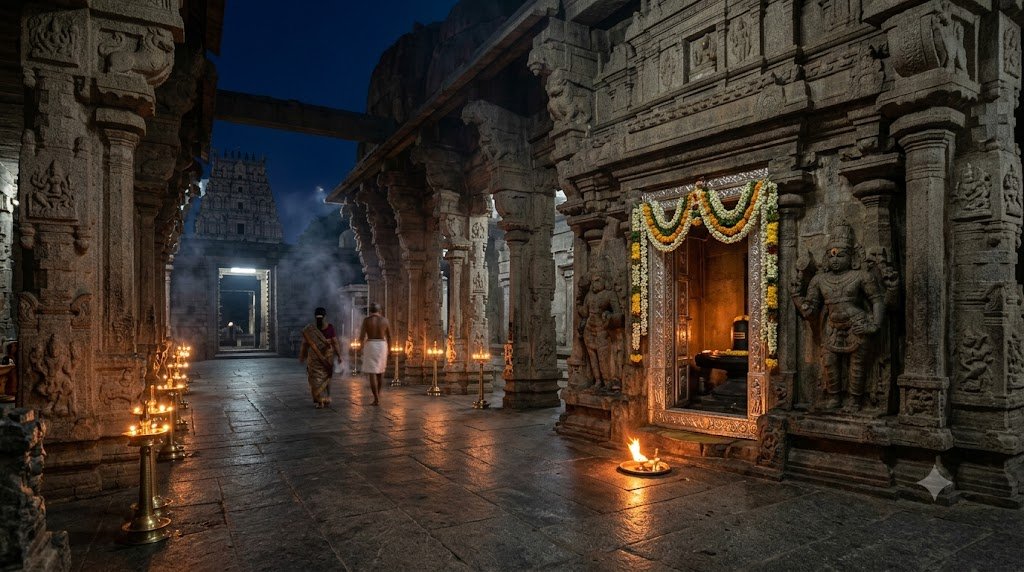
Most pilgrims leave the Arunachaleswarar Temple long before the Tiruvannamalai Palliyarai Pooja, the tender bedchamber ritual that closes the temple day. This is the moment when priests symbolically put the deity to rest for the night, like a king retiring to his private chamber. It happens quietly after the last major pooja, once the crowds thin and the sanctum falls silent.
If you have ever wondered what the priests do just before the great gopuram doors shut, this guide explains the ritual, its timing, its meaning, and exactly how to witness it.
Tiruvannamalai Palliyarai Pooja at a Glance
- What it is: the nightly bedchamber ritual that puts the deity to rest, the final act of the temple day.
- When: immediately after the Arthajama Pooja, roughly between 9:00 PM and 9:30 PM on normal days.
- Where: the palliyarai, a small resting chamber in the first precinct around the main sanctum.
- Cost: free to witness, because it is a temple ritual and not a bookable paid seva.
- Companion ritual: the morning Palliyarai Deepa Aradhanai wakes the deity again before sunrise.
What Is the Tiruvannamalai Palliyarai Pooja?
The Tiruvannamalai Palliyarai Pooja is the closing ritual of the day, when priests carry the processional deity to the palliyarai, the sacred bedchamber, and lay it to rest. The word palli arai simply means “resting room” in Tamil. Priests sing devotional hymns as a lullaby, wave a lamp, and then close the temple for the night.
This ritual flows from a beautiful idea at the heart of Agama worship. The temple treats the Lord not as a distant abstraction but as a living presence with a daily routine. So priests wake, bathe, dress, feed, honour, and finally put the deity to sleep, just as a royal household would care for its king.
At the Arunachaleswarar Temple, the main deity stays as the fixed Agni Lingam in the sanctum. Meanwhile, the festival bronze image, the Somaskandar form showing Shiva with Uma and the child Skanda, represents the Lord during processions and rest. Because this bronze is the “living” mobile form, it is the image that retires to the bedchamber each night.
Tiruvannamalai Palliyarai Pooja vs Arthajama Pooja
The Tiruvannamalai Palliyarai Pooja is not the same as the Arthajama Pooja, although countless guides mix the two up. The Arthajama is the final formal pooja offered to the Lord around 9:00 PM. The Palliyarai is the bedchamber ritual that follows it, when the deity is actually put to bed. One is worship; the other is the tucking-in.
This confusion is common even among local guides. A well-known traveller account from Madurai describes a guide insisting the late-night bedchamber ceremony was “the same” as the short 6 PM procession. It is not. The bedchamber ritual is a distinct, gentler event with its own hymns and mood.
Because the two rituals happen minutes apart, many pilgrims witness both without realising they are separate. If you stay for the Arthajama, simply wait a little longer. The bedchamber sequence follows almost immediately, and it is the truer finale of the night.
The daily pooja sequence at Arunachaleswarar Temple
The temple follows six daily poojas set by the Saiva Agama tradition. Each marks a phase of the day, from waking to rest. Below is the typical sequence on regular days, though timings shift slightly during festivals and Pournami. For the full schedule, see our Tiruvannamalai darshan timings guide.
| Ritual | Approx. time | What it marks |
|---|---|---|
| Palliyarai Deepa Aradhanai | Before sunrise | Waking the deity |
| Kalasanthi Pooja | Around 7:00 AM | Early morning worship |
| Uchikala Pooja | Around 12:00 PM | Midday worship |
| Sayaratchai Pooja | Around 6:00 PM | Evening worship |
| Arthajama Pooja | Around 9:00 PM | Final formal pooja |
| Palliyarai (bedchamber) | After Arthajama, by ~9:30 PM | Putting the deity to rest |
So the Arthajama Pooja happens around 9:00 PM, and the bedchamber ritual closes the night by about 9:30 PM. After that, the temple shuts until the pre-dawn waking. Always confirm the closing time on the day you visit, since festival schedules can push everything later.
What Actually Happens Inside the Bedchamber
Once the Arthajama Pooja ends, the priests prepare the deity for rest. Attendants ready the silver or golden vessels, flowers, and the swing or cot inside the palliyarai. Then they carry the mobile deity to the chamber with lamps and soft music, and gently close the doors after the final offering.
The lullaby and the lamp
Priests chant devotional verses as a kind of lullaby while the deity settles. The chief priest then waves a camphor lamp in the final deepa aradhanai, the lamp-offering that seals the day. Because the mood is quiet and intimate, many devotees find this the most moving darshan of all, far calmer than the daytime rush.
The consort and the resting image
In the palliyarai tradition, the Lord and the Goddess are honoured together at rest, reflecting the domestic, familial vision of the divine. At Tiruvannamalai the Goddess is Unnamalai Amman, whose own shrine sits in the second precinct. The bedchamber ritual expresses the union and repose of the divine couple after the day’s worship.
Waking the Deity: The Morning Side of the Ritual
The bedchamber cycle has two halves, and most guides mention only one. Before sunrise, priests perform the Palliyarai Deepa Aradhanai to wake the deity, opening the day with lamp and song. This morning waking is the mirror image of the night’s rest.
Traditional Shaivite temples sing the Thiruppalliyezhuchi, the “sacred waking hymn,” to rouse the Lord at dawn. So the deity that was laid to rest the previous night is gently woken again. This unbroken daily rhythm, sleep and waking, is what keeps the temple spiritually “alive” in the Agamic view.
If you cannot stay for the late-night bedchamber ritual, the pre-dawn waking offers a similar intimacy. Reaching the temple by 5:30 AM lets you catch the first lamp of the day. Both moments bracket the temple’s daily life like bookends.
Why the Tiruvannamalai Palliyarai Pooja Matters
The Tiruvannamalai Palliyarai Pooja matters because it completes the temple’s sacred day and treats the divine with human tenderness. Devotees believe that witnessing the Lord’s rest brings peace, gratitude, and a settled mind before their own night’s sleep. It is worship stripped of spectacle, down to pure devotion.
For the Saiva tradition, this ritual is also a lesson. It teaches that even the infinite chooses to dwell among people in a form they can love and serve. Because the Arunachaleswarar Temple is one of the Pancha Bhoota Sthalams, the fire shrine among Shiva’s five element temples, its rituals carry special weight for pilgrims. The Tamil Nadu Hindu Religious and Charitable Endowments (HR&CE) department administers the temple and its daily worship.
Many regular devotees deliberately plan a night darshan for this reason. The daytime queues are gone, the sanctum is hushed, and the closing lamp feels personal. It is a quiet reward for those willing to stay late.
Can You Watch the Tiruvannamalai Palliyarai Pooja?
Yes, you can watch the Tiruvannamalai Palliyarai Pooja as an ordinary devotee, and it needs no ticket or advance booking. It is part of the temple’s free daily worship, not a paid seva sold online. Any pilgrim present before closing can witness the ritual from the permitted darshan area.
This is worth stressing, because some websites wrongly list the bedchamber ritual as a bookable seva or claim online slots exist for it. They do not. Beware of any portal charging a fee to “book” this ritual, and rely only on the official Arunachaleswarar Temple portal for genuine announcements.
What you cannot do is enter the bedchamber itself or photograph the inner sanctum. Temple rules restrict the innermost chamber to priests only. So you watch from the outer darshan line, in silence, as the ritual unfolds.
How to Witness the Tiruvannamalai Palliyarai Pooja
Seeing this ritual takes a little planning, because it happens late and the window is short. Follow these steps for a smooth night darshan.
- Reach by 8:15 PM. Aim to be inside well before the 9:00 PM Arthajama, so you are settled when the sequence begins.
- Attend the Arthajama first. Watch the final formal pooja, then stay put rather than leaving with the crowd.
- Wait for the bedchamber sequence. Within minutes, priests carry the deity to rest, so do not walk out early.
- Keep silence. The mood is intimate; switch off your phone and avoid conversation near the sanctum.
- Confirm the closing time. Check the same-day schedule at the counter, since festival days run later.
Dress modestly for a night visit, as the temple follows traditional attire norms even after dark. Men usually wear a dhoti or full pants, while women wear a saree or salwar. Reviewing the temple’s dress code before you go saves any last-minute trouble at the entrance.
Insider Tips Most Pilgrims Miss
A few practical details make the night ritual far more rewarding. These come from the rhythm of the temple rather than any official notice.
- Avoid Pournami for a quiet experience. Full-moon nights draw huge Girivalam crowds, so a plain weekday is calmer.
- Stand near the flagstaff line. The view toward the sanctum is clearer there once the final lamp is shown.
- Carry a light shawl. Nights near Arunachala can turn cool, and you may wait on cold stone floors.
- Plan your exit. Autos thin out after 9:30 PM, so arrange return transport in advance.
- Pair it with an early Girivalam. Some pilgrims finish the bedchamber darshan and then begin the hill circumambulation.
Common Myths About the Bedchamber Ritual
Several errors circulate online about this ritual, and clearing them up helps you plan honestly. Here are the most frequent ones.
Myth: it is the same as the Arthajama Pooja. It is not. The Arthajama is the formal night worship, while the bedchamber ritual is the separate act of laying the deity to rest afterwards.
Myth: you must book it online. False. No booking exists, because it is free daily worship. Any site charging for it is untrustworthy.
Myth: only the morning ritual exists. Wrong. There is a night resting ritual and a pre-dawn waking, and both belong to the same bedchamber cycle.
Before You Go
The Tiruvannamalai bedchamber ritual is one of the most peaceful darshans the temple offers, yet very few pilgrims stay to see it. Reach the temple before the 9:00 PM Arthajama, wait for the deity to be carried to rest, and keep silence throughout. Remember that it is free, needs no booking, and closes the temple by about 9:30 PM.
For a fuller picture of the night, pair this ritual with an understanding of the Arthajama Pooja that precedes it. For travel logistics and town information, Tamil Nadu Tourism is a reliable reference. If you plan around the temple’s rhythm, you will experience Arunachala at its most intimate.
Frequently Asked Questions
What time is the Palliyarai Pooja at Tiruvannamalai?
The bedchamber ritual takes place right after the Arthajama Pooja, roughly between 9:00 PM and 9:30 PM on normal days. The temple then closes for the night. Festival and Pournami days can push the timing later, so confirm at the counter.
Is the Palliyarai Pooja different from the Arthajama Pooja?
Yes, they are two different rituals performed minutes apart. The Arthajama is the final formal pooja around 9:00 PM. The Palliyarai is the bedchamber ritual that follows, when the deity is put to rest for the night.
Do I need to book a ticket for the bedchamber ritual?
No, the ritual is free and needs no booking. It is part of the temple’s daily worship, not a paid seva. Any website charging a fee to “book” it should be treated as fraudulent.
Can I take photos during the Palliyarai Pooja?
No, photography is not permitted inside the main sanctum or inner precincts. You may witness the ritual from the outer darshan area but not photograph it. Keep your phone silent and away during the ritual.
What is the palliyarai in a temple?
The palliyarai is the sacred bedchamber where the deity is symbolically laid to rest each night. At Arunachaleswarar Temple it sits in the first precinct around the main sanctum. Priests use it for both the night rest and the pre-dawn waking.
Which deity is put to rest during the ritual?
The mobile festival bronze, the Somaskandar form of Shiva with Uma and Skanda, is the image that retires to the bedchamber. The fixed Agni Lingam remains in the sanctum. The Goddess Unnamalai Amman is honoured in the resting tradition too.
Is the night darshan safe and worth it?
Yes, night darshan is generally safe and far quieter than daytime hours. The bedchamber ritual offers a calm, intimate experience most pilgrims miss. Just plan your return transport, since autos thin out after the temple closes.
What is the difference between the morning and night bedchamber rituals?
The night ritual puts the deity to rest, while the pre-dawn Palliyarai Deepa Aradhanai wakes the deity again. Together they open and close the temple’s sacred day. Both use lamp offerings and devotional hymns.

The Tiruvannamalai Devasthanam editorial team is an independent group of writers and researchers documenting pilgrimage to the Arunachaleswarar Temple and Arunachala Hill, Tiruvannamalai. We are not affiliated with the temple or the Tamil Nadu HR\&CE Department. Every darshan timing, festival date and ritual detail we publish is cross-checked against the HR\&CE department, on-the-ground reports and at least two independent sources before it is published, and festival dates are re-verified each year. Spotted an error? Tell us and we will correct it.
